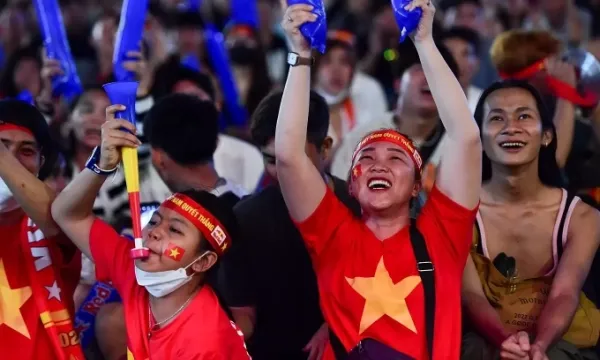
He quickly realized, however, that Vietnamese fans were celebrating a football victory.
Holland, a businessman who has worked in Vietnam since 2009, experienced his first taste of football-day traffic about a month after arriving. At around 9 p.m., as he left his office, he became stuck in a dense crowd. Vehicle horns, drums and cheers echoed everywhere. Confused and anxious, he was forced to get off his bike and push it through the crowd. Only later did he learn that Vietnam had just won a SEA Games semi-final match.
“That was when I realized how much they love football here,” recalls Holland, now 50. “Such passion doesn’t even happen in England.”
|
Paul Holland (C) in Nottingham, the U.K., July 2025. Photo courtesy of Holland |
What surprised Holland, who comes from the birthplace of football, even more was the reaction to defeat. He had braced himself for the tension, even violence, often seen in Europe when a home team loses a final. Instead, he saw Vietnamese fans accept the result calmly, with no vandalism or confrontations.
Since then, Holland has become “addicted” to watching football on the streets with Vietnamese fans. He enjoys the way strangers put their arms around each other, share plastic stools or offer one another a beer.
“The whole atmosphere was great,” he says.
Holland’s impressions are supported by data. Market research firm Nielsen previously reported that Vietnam leads Asia in the proportion of people who identify themselves as football fans, at 75%, far ahead of countries with more developed sports cultures such as Thailand (58%), South Korea (50%) and Japan (28%).
For Dutchman Thijs van Loon, eight years living in Ho Chi Minh City have been filled with memorable football- experiences. One that still stands out is seeing the normally bustling coastal tourist city of Vung Tau fall eerily quiet. The cinema he and his friends went to was completely empty.
“Because everybody was at home or meeting up with family and friends to watch football,” Thijs recalls.
But just two hours later, the silence was shattered. When he stepped outside, the scene had reversed entirely: streets packed with motorbikes, national flags everywhere, constant honking and cheering, with some people banging pots and pans. Thijs and his friends were caught in a massive traffic jam. Amid the standstill crowd, an elderly man squeezed through, grabbed Thijs’s hand firmly, shook it, and walked away without saying a word.
“Football really connects people,” Thijs says. “It makes everyone feel like a family, and that’s really nice.”
Another memory came from a match Vietnam lost. On television, scenes of Vietnamese fans mingling amicably with supporters of the opposing team after the game left a strong impression on him.
On the streets, people still poured out holding national flags. The atmosphere was not explosive, but it remained lively and positive. People talked, shared their emotions and celebrated in their own way because the team had given its all. For Thijs, the mood was light and pleasant.
|
HCMC fans cheer on Vietnam in a match against Thailand at the 32nd SEA Games, May 11, 2023. Photo by Read/Thanh Tung |
Englishman James Miller, 31, says football is the “lifeblood” of his country, a fixed weekly ritual and a conversation that stretches from the dinner table to the office.
“The passion in Vietnam is really strong too,” he says.
After moving to Ho Chi Minh City six years ago, Miller noticed the passion immediately. Every major match turns the streets into an open-air stadium. People watch everywhere: plastic chairs set up in front of houses, on pavements, cafés adding extra screens. Strangers sit side by side, eyes fixed on the screen, without even knowing each other’s names.
Miller also observed that Vietnamese fans do not watch football only for their national team. The World Cup, the Euros or major clashes between European teams are enough to fill cafés. People discuss and debate, cheer enthusiastically, but rarely become aggressive. There are none of the rigid divisions between fan groups seen in England’s club culture.
“The atmosphere is really cool here, and I like it,” Miller says.