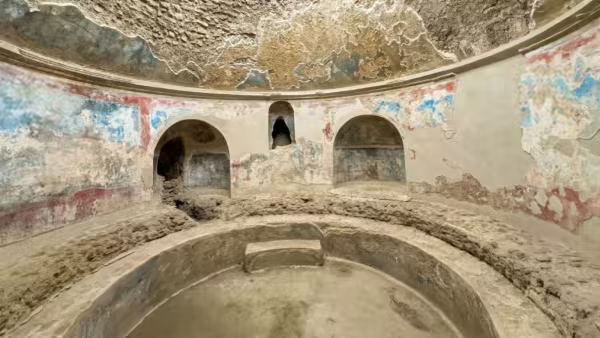
New findings suggest that bathing in ancient Pompeii may have been far less clean than the Romans are often credited for. When researchers looked into the city’s first bath complexes, they discovered that the water was only changed once a day and frequently included a combination of human waste and heavy metals.
By closely analysing mineral build-up inside old wells, pipes, and bathing pools, scientists were able to reconstruct how these facilities once operated. Their research revealed that once an aqueduct was built in the first century AD, the baths’ quality significantly increased. The baths relied solely on groundwater from deep wells before that, according to recent research published in Proceedings of the National Academy of Sciences on Monday.
This was not the best water supply in the past. There is evidence that it was frequently polluted by bathers’ perspiration, urine, and other organic waste. Additionally, traces of metals, including lead, copper, and zinc, were present in the water, most likely as a result of volcanic deposits gradually seeping into the groundwater. The little volume meant that contaminants were never completely removed, even though it seemed like the water was changed every day.
Everything changed with the arrival of the aqueduct. Instead of relying on polluted wells, the baths began receiving water from natural springs, which had lower metal content and could be replenished far more frequently. This significantly improved circulation and dilution, even if it did not eliminate the problem entirely.
Researchers were able to confirm through isotope testing that the city’s oldest bathing facilities, known as the Republican Baths, which were built long before Roman rule, were supplied by wells and rarely renewed. As a result, these baths fell well short of the hygienic reputation often associated with Roman public life.
Pompeii itself has a longer history than many realise. Located in southern Italy, it was originally inhabited by the Samnites before becoming a Roman town in 80 BC. Nearly 160 years later, the eruption of Mount Vesuvius buried the city under ash and rock, preserving it for centuries.
The study also revealed how the Samnite bath system functioned. Slaves ran a massive, treadwheel-style device that extracted water from deep down. Due to its restricted production and the already contaminated groundwater it tapped, this system found it difficult to satisfy the demands of crowded public baths.
The aqueduct, on the other hand, could supply nearly 50 times as much water as the previous lifting system, significantly boosting the flow via fountains, spas, and other public areas. This improved the removal of perspiration and grime, but it was still dependent on how frequently the water was changed.
Bathing in Pompeii was probably far different from present norms, even with greater facilities. According to accounts, it would have been noisy, congested, and unpleasantly stinky. People exercised, sweated heavily, relieved themselves in the pools, and scraped off dead skin, all in shared water that wasn’t always changed quickly enough.
Floating grime, murky water, and an overall sense of filth may have been a common sight. In fact, some Roman writers openly questioned the logic of seeking good health in spaces where people effectively soaked in each other’s waste.
To build a clearer picture of daily life in these ancient baths, researchers are now carrying out additional DNA tests on the mineral deposits left behind. These next steps could reveal even more about what bathers brought with them into the water, wheth