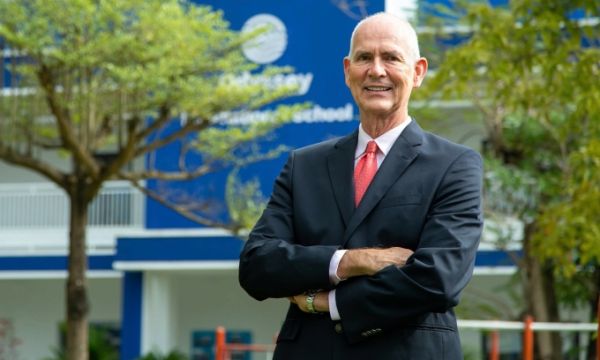
Osswald, who has lived in Vietnam for nearly 30 years, has more than 15 years of experience founding and operating schools, including the European International School (EIS) and the Wisdomland International Preschool System.
He is now leading a new education initiative in central Vietnam and recently shared his perspective on contributing to Da Nang’s development by establishing an international school aligned with global education standards.
|
Michael Osswald, CEO of Odyssey International School (OIS), Da Nang. Photo courtesy of Michael |
Why did you choose Da Nang for this project, and what is your vision for the school’s role in the city?
I chose Da Nang because it is developing rapidly and gaining recognition not only within Vietnam but also across Southeast Asia and beyond. I believe a city of this scale and ambition needs more high-quality international education options, and we want to contribute to that development.
Odyssey International School was founded on a simple idea: creating a positive learning environment where every student is valued. My aim is to build a close-knit school community where families feel welcome and connected.
We have selected the International Baccalaureate framework and are currently an IB candidate school going through the authorization process. I expect us to be authorized for the IB Primary Years Programme (PYP) and Middle Years Programme (MYP) by the end of 2026, with the Diploma Programme (DP) to follow.
When I founded the European International School in Ho Chi Minh City in 2009, we started with just 15 students. With a strong team, the school grew quickly and became an IB World School in a relatively short time. While Odyssey has its own identity, I am drawing on those experiences as we move forward.
How does the educational approach at Odyssey differ from traditional methods, and how does the IB program support this?
For me, learning should be an engaging and meaningful process, not a burden. In today’s world, students need to be proactive and take responsibility for their learning, with teachers guiding and supporting them. Learning should also be relevant to real life.
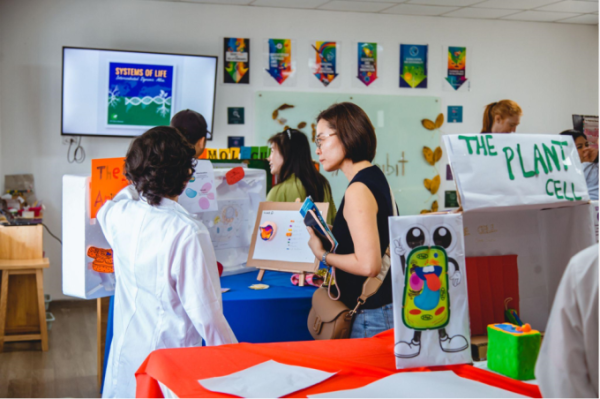
Recently, our secondary students organized a science exhibition focused on the systems of life. This allowed them to consolidate what they had learned over several weeks and present their findings to teachers, parents, and younger students.
 |
|
Students experiencing Odyssey Secondary Science Exhibition about Systems of Life. Photo courtesy of Odyssey International School |
What stood out to me was seeing students communicate their ideas confidently. That kind of experience helps develop skills beyond academic knowledge.
We also emphasize experiential learning. For example, when studying local identity, our students did not rely solely on textbooks; they visited the Da Nang Museum to explore the city’s history directly.
One parent told me that after learning about the Bach Dang Victory, their child independently asked to visit the Bach Dang River and searched for additional books on the topic. This curiosity came from interest, not homework pressure, and that is the type of motivation we aim to foster.
How did you build your team and the school culture?
I focus on creating a professional working environment where staff feel respected and valued. I believe this is essential for delivering consistent, high-quality education to students.
Our curriculum and programme development is led by experienced IB coordinators who provide ongoing guidance to teachers. This helps ensure the IB philosophy is applied rigorously and consistently across classrooms.
Is your school open to all nationalities?
Yes. Odyssey International School is open to students of all nationalities. Currently, about 70% of our students are international and 30% are local. I see this diversity as an important part of preparing students to live and work in a globally connected world.
How about the campus facilities and your long-term commitment to the location?
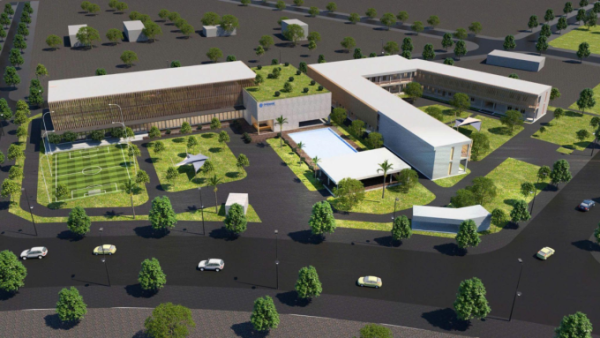
We have developed a purpose-built campus designed to support hands-on learning and student well-being. In this January 2026, we will open a 25-metre swimming pool suitable for both instructional and competitive use. We will also begin construction of a secondary and high school building, along with a multi-purpose hall and auditorium, which we expect to complete in 2027.
 |
|
3D visualization of the Odyssey International School campus with the completed secondary building. Photo courtesy of Odyssey International School |
Importantly, the land is owned by our company. We are fully licensed and operate in compliance with regulations. For me, this demonstrates a long-term commitment to Da Nang and provides families with confidence in the school’s stability.
How does Odyssey prepare students for university admissions in Vietnam and abroad?
Preparing students for university is a long-term goal. I see the IB Diploma Programme as one of the strongest pathways to higher education because of its emphasis on critical thinking and independent learning.
Whether students plan to study abroad or at leading universities in Vietnam, the IB provides a strong academic foundation.
We currently offer classes up to Grade 7 and plan to expand to higher grades during the 2026-2027 academic year, while continuing preparations for the IB Diploma Programme.
At my previous school, the European International School, we completed the IB continuum – from PYP to DP – within four years, and I am applying that experience here.
Tuition fees are a major concern for many families. How does Odyssey position itself?
I understand that tuition fees are an important consideration for families. Our fees are set to maintain IB standards and attract and retain qualified teachers. At the same time, I believe they are competitive when compared with IB schools in Hanoi and Ho Chi Minh City, given the educational services we provide.