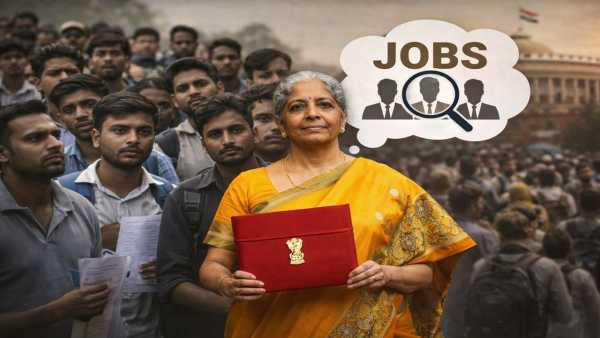
Finance Minister Nirmala Sitharaman will present the Union Budget on 1 February. He has a lot of experience in presenting the budget. India is keeping an eye on what the budget proposes for employment. The stakes are huge. The future and ambitions of a developed India rest on the shoulders of millions of youth who will soon become part of the country's workforce. Currently, the number of people of working age exceeds the number of people over the age of 65 or under the age of 16, which is a favorable situation for a nation that is aiming to become the next growth engine.
India's ambition to become a major global power will depend less on better growth data and more on whether it can provide stable, productive employment to millions of its youth. In the Union Budget 2026, employment is not just a social issue but a strategic issue. Countries that shape global supply chains and attract long-term investment are able to do so because they have vast reserves of skilled, employable labour. If India can convert its demographic edge into real livelihoods through manufacturing, skill development and practical labor reforms, it will strengthen the domestic economy and increase its influence in an increasingly fragmented global order.
However, converting the availability of more working-age people into sustainable benefits will not be easy. Economists at Morgan Stanley recently warned that India's economy needs to expand at an extraordinary rate of 12.2 percent per year to overcome its unemployment crisis. This points to the risk that many people may be deprived of productive work, which may increase social tension at the household level. If India fails to utilize its young workforce, it may miss achieving its goal of becoming a developed nation by 2047.
The NDA government is aware of this problem and is making every possible effort to overcome it. This urgency is clearly visible in the four new labor laws recently enacted, which 16th Finance Commission Chairman Arvind Panagariya has described as the “mother of all reforms”. These reforms make it easier for employers to hire and fire employees, and also enforce minimum wages and social security benefits for workers. The Union Budget to be presented in February will be the next test where policy makers can take more steps to tackle the unemployment crisis.
Karthik Narayan, CEO of Apna's jobs marketplace, said in an ET report that the upcoming budget is an opportunity to reset the agenda for labor market implementation. The government should notify necessary rules to implement the recently announced labor laws.
The new labor rules are likely to be fully implemented from April 1, 2026, as the ministry has started the process of implementing the rules under the notified law. Since labor falls in the concurrent list of the Constitution of India, states can make their own rules and enforce them within their borders, using the federal law as a guide. According to a report by SBI Research, the new laws are expected to create 77 lakh additional jobs and reduce the unemployment rate by 13 percent in the medium term.
Parliament had approved these laws in 2020, but they were put on hold due to political opposition and concerns from labor unions. Since then, global uncertainties, including tariffs imposed by US President Donald Trump, have increased pressure to move faster on reforms, while the recent state-level election victory in Bihar has provided Prime Minister Modi with more opportunities to act.
Amrita Tonk, partner, CMS IndusLaw, one of India's top law firms, said in an emailed response to ET Online that there are significant uncertainties in an increasingly uncertain global market driven by AI, and the China +1 opportunity may not have materialized as expected due to bureaucratic and regulatory challenges, including persistent delays, non-uniformity and corruption, which may have resulted in a slowdown in employment growth.
India's economy grew 8.2 percent in the September quarter, beating expectations, but far short of the pace needed to accommodate the 84 million people expected to join the workforce over the next decade. Morgan Stanley has warned that unless the country increases investment in advanced manufacturing, technology and skills development, the labor market could fall further behind the needs of its young workforce.
Tonk said that to revive manufacturing and exports as engines of employment, it is necessary to directly link fiscal incentives in Budget 2026 to compliance with codes. He assured that by rewarding companies that create employment, provide social security and maintain safe workplaces, it can be ensured that industrial growth translates into inclusive and sustainable employment.
The potential of the manufacturing sector is clearly visible. The electronics industry, considered the biggest success of Make-in-India, has created more than 13 lakh jobs in the last five years. The Production-Linked Incentive (PLI) scheme revolutionized smartphone manufacturing and increased exports almost tenfold during this period.
Moreover, in FY 2025 alone, the mobile phone manufacturing sector paid an estimated Rs 25,000 crore as wages to the working class, with the average salary of direct employees being Rs 18,000 per month and indirect employees being Rs 14,000 per month. Thus, this industry is contributing significantly to employment generation and economic growth.
Large manufacturing campuses set up by companies like Foxconn and Tata Electronics now employ thousands of workers at a single location, while food processing has emerged as a steady job creator, contributing about 13 per cent to organized manufacturing employment and expected to create over 3.39 lakh jobs by the end of 2025, Balasubramanian A, senior vice president, TeamLease Services, reported ET Online. Will do.
Additionally, India's manufacturing sector is expanding into high-tech and intensive manufacturing sectors, increasing its impact on employment in all sectors of the economy. He said that with semiconductor units expected to start commercial production from 2026, the demand for highly specialized positions in chip manufacturing, assembly, testing and supply chain management is increasing, and according to estimates, 10 lakh skilled professionals may be required by the end of 2026. He further said that this growth is being fueled by initiatives like the Chips to Startup program, which aims to create a strong talent chain in advanced electronics.
Despite all this progress, one gap is still not being bridged and that is skills. India's network of vocational and technical schools is clearly not meeting the needs of the world's 5th largest economy. The skills they teach do not match the needs of the private sector. According to a Bloomberg report, most schools do not even have active placement cells to connect their graduates with potential employers.
According to the official think tank of the government, out of lakhs of people trained in Industrial Training Institutes i.e. ITI, less than 0.1 percent got jobs in any company. Tonk said government spending on skills development and education has improved employability, but it is still not enough to tackle youth unemployment. He further said that development has not generated widespread employment, the level of informal labor is high and there is not enough coordination between skills and industry needs, hence the government is struggling to create employment.
According to recruitment agency Manpower, four out of five employers have reported a shortage in finding the skilled talent needed in 2025, which is higher than the global average, while the demand for laborers with IT and data skills in India is higher than in China and Singapore.
However, this remarkable difference did not happen overnight. Balasubramaniam said in the ET report that in 1990, Indians and Chinese were in almost equal position economically. Then came a big change. China became the world's factory, increasing income almost five times that of India, while India remained dependent on consumption and services and remained largely out of the global industrial wave. He said that as India moves towards the goal of a developed India by 2047, it is neither practical nor necessary to exactly replicate China's old, low-cost model.