Barcelona: The deadly train wreck in southern Spain has cast a pall over one of the nation’s symbols of success.
The collision Sunday killed at least 40 people and injured dozens more, according to officials as of Monday, January 19 night. Here’s a look at the history of a rail network that became a crown jewel of contemporary Spain, by the numbers.
It has been 34 years since Spain inaugurated its first high-speed AVE, which means “bird” in Spanish.

Both before and after that milestone, successive Spanish governments devoted tax revenues and European Union development aid to its high-speed rail network that quickly caught up and surpassed high-speed pioneers Japan and France.
The first high-speed train to speed across Spain preceded the opening of the 1992 Summer Olympic Games in Barcelona by two months.
Both marked high points in Spain’s recent history after it emerged from the economic doldrums and cultural and political isolation of the 20th-century dictatorship of Gen. Francisco Franco.
The trains has travelled 3,900 kilometres, equal to 2,400 miles, of high-speed rail that Spain has laid over the last three-plus decades for its 49 million residents.
Only China, with 45,000 kilometres (28,000 miles) for its 1.4 billion people, has more high-speed track, according to the International Union of Railways.
Spain’s commitment to high-speed rail, which the railway union defines as rails for trains going 250 kph (155 mph), has helped Spain shed its reputation of often being behind the industrial curve compared to other leading economies.
Spain’s train builders have been able to capitalise on its domestic expansion. A Spanish consortium built Saudi Arabia’s high-speed line connecting the holy cities of Mecca and Medina that opened service in 2018.
The approximate number of hours a train trip took between Madrid and Barcelona before and after the 2008 adoption of high-speed rail.
On an old, slow train, the 600-kilometer (385-mile) journey between Spain’s biggest cities used to take around seven hours, meaning many business travelers opted to take a plane.
Now that trip can be done in 2.5 hours, and Spain announced plans in November to modernize the Madrid-Barcelona line to allow trains to reach 350 kph (218 mph), matching the fastest Chinese trains. That would bring the transit time down to less than 2 hours.
The AVE has helped unite a country whose main population centers other than Madrid are located on its coasts, separated by some of the most sparsely populated areas in Europe.
Every region and provincial capital has pushed hard for its own high-speed line. Some critics say the administrations may have spent too much on questionable lines to the detriment of investing in local commuter lines, which suffer many more delays than the high-speed rail does.
Missing out on an AVE line and stop has become synonymous with economic decline for a provincial city.
The move away from air travel to rail also remains a key plank of Spain’s green energy and electrification plan to fight climate change.
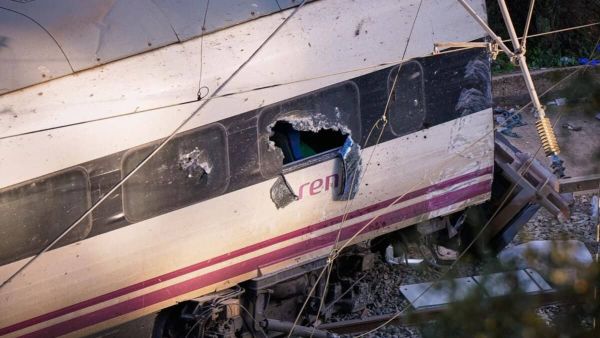
The number of deadly accidents involving a high-speed train in Spain’s history. One official described Sunday’s collision as transforming a train into a “mass of twisted metal.”
Spanish officials say they are still at a loss to understand what went wrong Sunday night when one high-speed train jumped the track and collided with another fast train going the other direction.
Álvaro Fernández, the president of public train company Renfe, told Spanish public radio station RNE that both trains were travelling well under the speed limit and “human error could be ruled out.”
One of the two trains was operated by Renfe and another by a private company.
Spain’s worst train accident this century occurred in 2013, when 80 people died after a train derailed in the country’s northwest. An investigation concluded the train was travelling 179 kph (111 mph) on a stretch with an 80 kph (50 mph) speed limit when it left the tracks. That stretch of track was not high speed.
The number of operators with high-speed trains in Spain.
Only in 2022 did Spain open its rail network to private companies to compete against Renfe.
The first company to get into the private high-speed market was Iryo, which is Italian-owned. It was followed by the French company Ouigo.
It was an Iryo train that first derailed on Sunday, knocking the Renfe train off its track. Iryo has said it is working with officials to determine the causes of the accident.