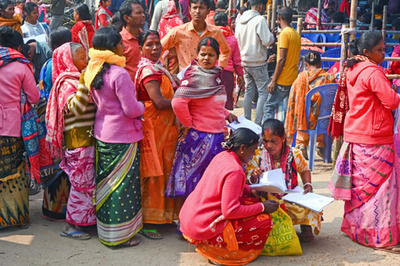
Kolkata, Jan 20 (IANS) The deadlines for concluding the hearing sessions on claims and objections on the draft voters’ list in West Bengal and publication of the final voters’ list might be extended in the wake of the Supreme Court’s recent order.
The apex court on Monday issued a slew of directions to the Election Commission of India (ECI) to ensure that the ongoing Special Intensive Revision (SIR) of electoral rolls in West Bengal, especially the verification of voters under the “logical discrepancies” category, is conducted transparently and without causing undue hardship to citizens.
A final decision in the matter is likely on Wednesday, said insiders from the office of the Chief Electoral Officer (CEO), West Bengal.
As of now, the deadline for completion of the hearing process is February 7, and the same for publication of the final voters’ list is February 14.
“The final decision regarding the extension of deadlines for completing the hearing process and the publication of the final voters’ list might be taken by the Commission on Wednesday. In case the deadline for completing the hearing sessions is extended, logically there will be a proportionate extension of the deadline for the publication of the draft voters’ list,” explained an insider from the CEO’s office.
However, the insider added, it is not yet clear whether the deadline extensions would be only in case of West Bengal or also for the other states and Union Territories where the parallel Special Intensive Revision (SIR) exercises have been going on.
Since the process of hearing on claims and objections on the draft voters’ list had begun, West Bengal had been exclusively in the national headlines for the very high number of “logical discrepancy” cases, which relate to voters in whose cases weird family-tree data was detected during the course of “progeny mapping”.
ECI had already explained why the number of cases flagged as “logical discrepancies” in the state is unusually high.
The ECI has identified around 94 lakh “logical discrepancy” cases in West Bengal. Such cases refer to anomalies detected during progeny mapping, where implausible or inconsistent family relationships appear in voter records.
Officials in the CEO’s office have cited several examples to illustrate how fake voters attempted to retain their names on the electoral roll by falsely linking themselves to unrelated genuine voters.
There have been cases where eight to ten voters were shown as sons or daughters of a single senior citizen voter during progeny mapping. However, during hearings, it was found that the senior citizen had only two children and had no blood relationship with most of those listed as his sons or daughters.
According to officials, such manipulation was aimed at ensuring that fake voters remained on the rolls by presenting themselves as siblings within a fabricated family structure linked to a genuine voter.
In another instance, the Commission came across a case involving a 64-year-old senior citizen voter who was shown as having two sons aged 60 and 59.
This would mean the voter became a father of two sons at the age of five. Subsequent verification revealed that both individuals listed as his sons were fake voters who had falsely linked themselves to the genuine voter to avoid deletion from the electoral roll.
--IANS
src/uk