As shark-hunting fishermen turn to become tour guides, new hopes for sustainable economic growth are opening up in NTB.
By Idham Khalid
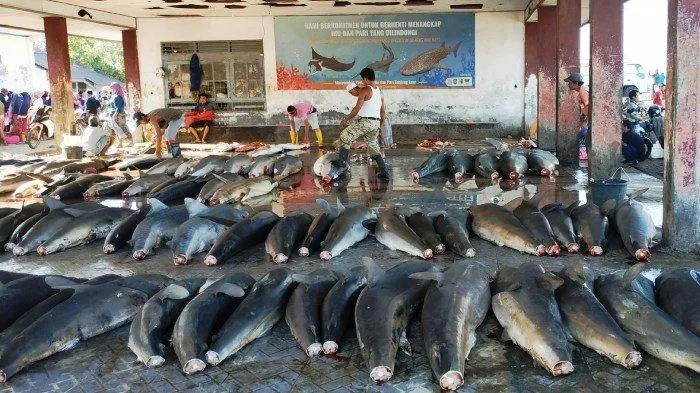
TRIBUNLOMBOK.COM, TANJUNG LUAR — The scent of the sea, thick and metallic, hits first. At the fish market in Tanjung Luar, on the eastern edge of Lombok, the air is a cacophony of progress and antiquity: the roar of motorbikes competing with the rhythmic clatter of cidomo horse carts, all underscored by the sharp, desperate bartering of the morning trade.
Laid out on the wet concrete are the spoils of the Indian Ocean—rows of snapper, ink-stained squid, and spiny lobsters. But it is the apex predators that command the eye. Great sharks, once the undisputed sovereigns of the deep, now lie motionless. Nearby, at the landing quay, men with rhythmic precision swing heavy blades, cleaving through cartilage and skin. Sweat slicking their brows, they reduce creatures of myth to mere kilograms of meat, their rows of serrated teeth no longer a threat to the hands that harvest them.
Yet, barely thirty yards from the blood-stained auction floor, a different economy is germinating. A modest, one-meter-wide wooden booth stands under a sign that reads: “The Charm of Teluk Jukung.” Beneath a nearby gazebo, men who once spent weeks chasing fins on the high seas now sit in the shade, waiting not for a catch, but for tourists.
For Ahnan, 51, the transition from predator to guide was born of exhaustion. He began his apprenticeship on the waves at age ten, following his father into a life defined by the horizon.
“We used to go for the big ones,” Ahnan recalled on a recent Sunday, his eyes tracing the silhouette of the boats in the harbor. “Sharks over a hundred kilos. It took seven of us, a desperate struggle of man against beast.”
The hunt often required a two-day voyage toward the waters of Sumba, a journey dictated by the whims of the weather and the endurance of the crew. “Storms, being stranded, even the mystical things you see when you’re alone in the dark water—we’ve lived through it all,” he said.
But the rewards rarely matched the risks. A successful trip might net a crew member 500,000 rupiah (about $32 USD), barely enough to keep a kitchen running. In Tanjung Luar, poverty has long been an inheritance; children often drop out of school by the eighth grade, trading their books for a place on their father’s boat because there is simply no money for anything else.
Baca juga: NTB Rich in Critical Mineral Potential for Renewable Energy Development
The economics of the hunt are as brutal as the act itself. Junaidi, 47, a fisherman from the nearby coast of Labuan Haji, explains that while sharks are becoming scarcer, a single lucky catch remains a lottery ticket. The value is almost entirely in the fins. If a shark is as large as a dugout canoe, its fins can fetch 25 million rupiah ($1,600 USD). The meat, by contrast, is a commodity of the poor, selling for pennies a pound.
As local waters are fished thin, the hunters must venture further—toward Australia and Papua—spending months at sea. “The fish are disappearing,” said Muhammad Ali, secretary of the local tourism group, Pokdarwis. “And the number of fishermen only grows. If we want something sustainable, it has to be tourism.”
Gaping, 48, is the face of this new direction. A former shark hunter, he now spends his days navigating the turquoise waters of Pink Beach, a destination famed for its strawberry-hued sands.
“I’ve tried it all—squid, sharks, everything,” Gaping said. He pivoted to tourism in 2016, lured by a lighter workload and a more stable ledger. A good month as a guide can bring in 10 million rupiah ($640 USD), a fortune compared to the uncertainty of the net.
Today, instead of harpoons, he carries snorkeling gear. His "One Day Trip" packages take visitors to Gili Pasir, a sandbar that vanishes at high tide, and Gili Petelu, where the coral reefs are a psychedelic tapestry of life. For the men of Tanjung Luar, the realization is sinking in: a shark seen through a snorkel mask is worth infinitely more over time than one lying on a cutting board.
However, this "green" pivot is precarious. The infrastructure remains skeletal—a few small buildings and a handful of boats. “It’s still very personal,” said Siham, another former fisherman. “If a guest calls, we go. If not, we wait.”
The local government, led by Governor Lalu Muhamad Iqbal, has signaled a grand vision to turn West Nusa Tenggara (NTB) into a "world-class destination." There are plans for shrimp processing plants to create "downstream" value and roadmaps to increase fishery production through better management.
Muslim, the Head of the Provincial Fisheries Department, acknowledges the decline. The number of active fishermen has plummeted from hundreds of thousands to just 65,000, driven by climate change, pollution, and a degrading marine ecosystem. “We can’t just tell them to protect the environment,” Muslim said. “We have to show them that a healthy nature is actually more expensive, more valuable.”
As the sun sets over the Teluk Jukung, the transition remains a work in progress. For men like Ahnan and Gaping, the goal is no longer to conquer the sea, but to coexist with it—trading the blood of the old world for the blue horizons of the new.
Editor Ismail Zakaria
This article has been translated using AI. See original.