Cabinet approval needed for new funding proposal as existing mechanism is insufficient to make flight operations viable for airlines
A plan to revamp the regional connectivity scheme is awaiting Cabinet approval. The plan proposes to provide financial support from the government to offset losses airlines may suffer due to flying to remote destinations.
Under the scheme launched in 2016, fare is capped for half of the seats to make air travel affordable. Since operations on hinterland routes are commercially not viable because of the fare cap and low traffic, government provides incentives to carriers such as waiver of landing and navigation charges and subsidies.
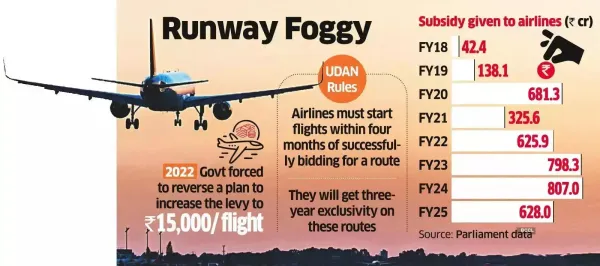
Currently, 80% of the subsidy is provided by levying a fee of ₹6,500 per commercial flight. The rest is borne by governments in states where the airports are located.
"According to our calculations, the existing mechanism of funding will not be enough to make those viable. We have proposed this alternative mechanism. Inter-ministerial consultations have been completed, and it is now awaiting cabinet's approval," a government official said.
Since 2016, government has disbursed more than ₹4,352 crore as subsidy under the scheme and invested another ₹4,638 crore for developing and upgrading airports. The scheme has shown a mixed response, with only about 60% of the original 649 routes operational currently.
The civil aviation ministry has spent nearly ₹900 crore on 15 regional airports that are currently non-operational.
The official quoted above said scrutiny of the scheme showed that there may be a requirement to increase the period of subsidy from the current three years. This may require the government to increase the fund size.
Under UDAN, airlines must start flights within four months of successfully bidding for a route. They will get three-year exclusivity on these routes, insulating them from any competitive pressure during this period. These remote airports levy a lower tax on aviation turbine fuel and do not charge airport fees.
"For smaller airlines, who are substantial players in remote connectivity, they can't start flights despite getting permission due to non-availability of aircraft or readiness of the airport. It becomes a big financial burden for them. So, there may be a requirement to increase the period of subsidy," a second government official said.
Finding a different way to fund the scheme is important for the government as India's mainline carriers like IndiGo and Air India may not be willing to cross-subsidise the scheme.
In 2022, the government was forced to reverse a plan to increase the levy to ₹15,000 per flight, as it faced a pushback from airlines which argued that it would lead to increase in ticket prices, hurting their passengers.
According to executives at regional carriers, government backing is important for the scheme as it has proved to be critical to improve regional connectivity. "Regional air connectivity is a powerful engine for progress," said Simran Singh Tiwana, CEO of regional airline Star Air. When a new flight route opens to a regional city, it offers multiple positive effects, like economic boost as local businesses gain access to more markets, he said. Faster travel options also improve healthcare access, educational opportunities and the overall quality of life, he said.
Under the scheme launched in 2016, fare is capped for half of the seats to make air travel affordable. Since operations on hinterland routes are commercially not viable because of the fare cap and low traffic, government provides incentives to carriers such as waiver of landing and navigation charges and subsidies.
Currently, 80% of the subsidy is provided by levying a fee of ₹6,500 per commercial flight. The rest is borne by governments in states where the airports are located.
"According to our calculations, the existing mechanism of funding will not be enough to make those viable. We have proposed this alternative mechanism. Inter-ministerial consultations have been completed, and it is now awaiting cabinet's approval," a government official said.
Since 2016, government has disbursed more than ₹4,352 crore as subsidy under the scheme and invested another ₹4,638 crore for developing and upgrading airports. The scheme has shown a mixed response, with only about 60% of the original 649 routes operational currently.
The civil aviation ministry has spent nearly ₹900 crore on 15 regional airports that are currently non-operational.
The official quoted above said scrutiny of the scheme showed that there may be a requirement to increase the period of subsidy from the current three years. This may require the government to increase the fund size.
Under UDAN, airlines must start flights within four months of successfully bidding for a route. They will get three-year exclusivity on these routes, insulating them from any competitive pressure during this period. These remote airports levy a lower tax on aviation turbine fuel and do not charge airport fees.
"For smaller airlines, who are substantial players in remote connectivity, they can't start flights despite getting permission due to non-availability of aircraft or readiness of the airport. It becomes a big financial burden for them. So, there may be a requirement to increase the period of subsidy," a second government official said.
Finding a different way to fund the scheme is important for the government as India's mainline carriers like IndiGo and Air India may not be willing to cross-subsidise the scheme.
In 2022, the government was forced to reverse a plan to increase the levy to ₹15,000 per flight, as it faced a pushback from airlines which argued that it would lead to increase in ticket prices, hurting their passengers.
According to executives at regional carriers, government backing is important for the scheme as it has proved to be critical to improve regional connectivity. "Regional air connectivity is a powerful engine for progress," said Simran Singh Tiwana, CEO of regional airline Star Air. When a new flight route opens to a regional city, it offers multiple positive effects, like economic boost as local businesses gain access to more markets, he said. Faster travel options also improve healthcare access, educational opportunities and the overall quality of life, he said.