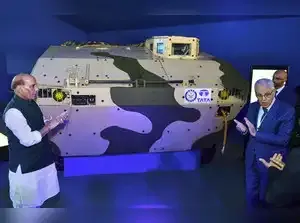
Tata Sons’ defence division is in talks to supply military hardware to African and European nations, as India pushes to strengthen its arms industry and expand exports, reported Financial Times.
India’s largest conglomerate is making its overseas push as Prime Minister Narendra Modi has vowed to build a “self-reliant India” by reducing the country’s dependence on imports and increasing its exports.
In September, Tata opened a factory near Casablanca to produce about 150 wheeled armoured platform vehicles for the Moroccan government. The factory is India’s first defence plant operated overseas by a private company, according to Tata.
ALSO READ: Budget 2026: The guns that can fuel India’s growth
“All platforms are already being proposed to countries abroad,” said Sukaran Singh, chief executive and managing director of Tata Advanced Systems, which manufactures equipment ranging from artillery to combat and logistics vehicles.
“We are in deep discussions,” Singh told the FT, describing the Morocco factory as an “entry point into Africa”.
ALSO READ: Tata Group arm sets up India's first overseas defence manufacturing unit in Africa
This status quo was disrupted over the past decade. Successive reforms in procurement, licensing, export controls and FDI policy have opened the sector. Indigenous procurement has been prioritised through negative import lists and domestic preference frameworks. Focus is increasingly on local manufacturing and not merely assembly.
The result is visible in rising domestic production, skyrocketing exports, a growing pipeline of indigenous platforms and a defence industrial ecosystem that now includes large private companies, specialised MSMEs and a growing number of defence-focused start-ups. Importantly, this growth has been policy-led but market-tested. Companies are being pushed to compete, deliver and innovate rather than rely on captive demand.
Defence exports create high-value revenue streams with strong multiplier effects across metallurgy, electronics, software and advanced manufacturing. The sector is labour-intensive in its supply chains while being capital- and technology-intensive at the top, making it uniquely suited to broad-based industrial development. Moreover, defence manufacturing embeds India into global strategic networks.
The country’s defence exports hit an all-time high of Rs 21,083 crore in 2023-24, a remarkable leap from just Rs 686 crore in 2013-14, representing a 30-fold increase over a decade.
India’s largest conglomerate is making its overseas push as Prime Minister Narendra Modi has vowed to build a “self-reliant India” by reducing the country’s dependence on imports and increasing its exports.
In September, Tata opened a factory near Casablanca to produce about 150 wheeled armoured platform vehicles for the Moroccan government. The factory is India’s first defence plant operated overseas by a private company, according to Tata.
ALSO READ: Budget 2026: The guns that can fuel India’s growth
“All platforms are already being proposed to countries abroad,” said Sukaran Singh, chief executive and managing director of Tata Advanced Systems, which manufactures equipment ranging from artillery to combat and logistics vehicles.
“We are in deep discussions,” Singh told the FT, describing the Morocco factory as an “entry point into Africa”.
ALSO READ: Tata Group arm sets up India's first overseas defence manufacturing unit in Africa
India's defence paradox
India’s defence industry historically suffered from a paradox. Despite being one of the world’s largest arms importers and possessing a vast domestic market, it failed for decades to develop a competitive indigenous industrial base. Production was concentrated in defence public sector undertakings and ordnance factories, innovation cycles were slow, and the private sector was largely excluded.This status quo was disrupted over the past decade. Successive reforms in procurement, licensing, export controls and FDI policy have opened the sector. Indigenous procurement has been prioritised through negative import lists and domestic preference frameworks. Focus is increasingly on local manufacturing and not merely assembly.
The result is visible in rising domestic production, skyrocketing exports, a growing pipeline of indigenous platforms and a defence industrial ecosystem that now includes large private companies, specialised MSMEs and a growing number of defence-focused start-ups. Importantly, this growth has been policy-led but market-tested. Companies are being pushed to compete, deliver and innovate rather than rely on captive demand.
Defence exports create high-value revenue streams with strong multiplier effects across metallurgy, electronics, software and advanced manufacturing. The sector is labour-intensive in its supply chains while being capital- and technology-intensive at the top, making it uniquely suited to broad-based industrial development. Moreover, defence manufacturing embeds India into global strategic networks.
The country’s defence exports hit an all-time high of Rs 21,083 crore in 2023-24, a remarkable leap from just Rs 686 crore in 2013-14, representing a 30-fold increase over a decade.