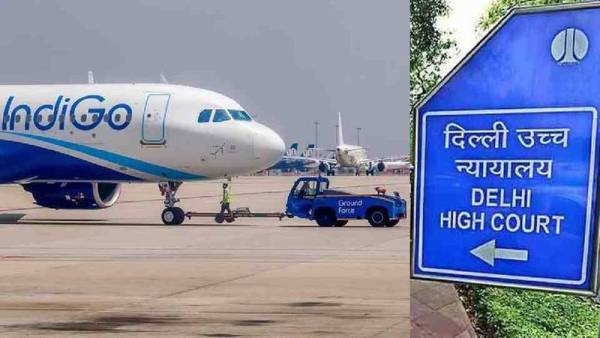
Delhi High Court: The Union of India has informed the Delhi High Court that firm and decisive action has been initiated following the inquiry commission’s report into the recent IndiGo flight disruption crisis. The incident involved large-scale flight cancellations that caused widespread inconvenience to passengers across multiple routes, prompting judicial scrutiny and regulatory intervention.
The submission was made before a Division Bench of the Delhi High Court, headed by Chief Justice DK Upadhyaya, during the hearing of a petition seeking an independent judicial investigation into the events that led to the operational breakdown at the airline.
Placing the steps taken on record, the Union government stated that strong disciplinary and financial measures have been enforced against the airline. According to the submission, a Senior Vice President of IndiGo has been directed to be dismissed from service, reflecting accountability at the highest managerial level. In addition, a monetary penalty of ₹22 crore has been imposed on the airline as a regulatory sanction for the lapses identified during the inquiry.
To ensure that corrective actions are implemented without delay, authorities have also secured a bank guarantee of ₹50 crore from the airline. This guarantee is intended to act as a safeguard, ensuring compliance with all remedial measures recommended in the inquiry report.
The Court was further informed that warnings have been issued to several senior officials of the airline. These include the Chief Operating Officer, a Director, the Deputy Head of Flight Operations, and a Resource Analyst. The inquiry reportedly found operational and managerial lapses that contributed to the scale of disruption, warranting formal warnings to prevent recurrence.
The Bench took note of these actions while assessing whether further judicial intervention was required, particularly in light of the petitioner’s demand for an independent probe.
On the issue of passenger relief, counsel appearing for the airline submitted that refunds for all cancelled tickets have already been processed. The Court was also informed that a structured compensation mechanism for stranded passengers is currently being finalised, aimed at addressing both financial losses and inconvenience suffered during the crisis.
However, concerns were raised by the petitioner’s counsel regarding vouchers issued to affected passengers. These vouchers reportedly carried a validity period, which was argued to potentially limit their effective use.
Seeking clarity, the Bench questioned the airline on the time limit prescribed for utilisation of the vouchers. In response, counsel for the airline stated that the vouchers were valid for a period of 12 months. The Court observed that a one-year validity appeared reasonable on the face of it, but sought clarification on the airline’s stance if a passenger is unable to use the voucher within that period.
The airline’s counsel informed the Court that further instructions would be sought on this issue, indicating that the matter remains under consideration.
Taking note of the submissions from both sides, the Court directed the airline to place on record complete details of refunds, compensation payments, and passenger assistance measures. These details are to be submitted by way of an affidavit within two weeks. The matter has been listed for further hearing on February 25.
Earlier, the Court had already directed both the airline and the Union government to ensure that compensation to stranded passengers is initiated without delay and that all regulatory norms are strictly followed. The Bench reiterated that passenger welfare remains its primary concern.
The Court also expressed concern over the sudden surge in airfares during the crisis period and sought explanations regarding regulatory oversight. It was informed that fare caps were introduced as a corrective regulatory measure once the situation escalated.
Additionally, the Bench flagged safety-related issues, including reports of pilots exceeding prescribed night-landing limits due to staffing shortages. The Court questioned what preventive steps regulators could take in such situations and noted that a show-cause notice had already been issued to the airline for regulatory non-compliance.
Senior counsel appearing for the airline submitted that such a situation had arisen for the first time in its 19-year operational history and urged the Court not to record adverse findings at this stage. While noting this submission, the Bench emphasised that the immediate priority remains the timely redressal of passenger grievances.
The airline has maintained that multiple unforeseen factors contributed to the crisis, and the Court observed that these claims would be examined as part of the ongoing inquiry process.