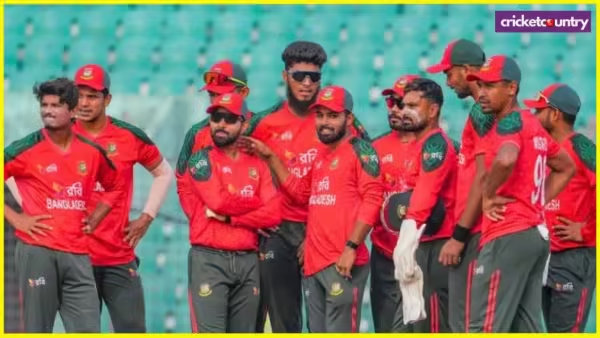
The Bangladesh Cricket Board (BCB), along with government authorities, has announced that the national team will not travel to India for the ICC Menâs T20 World Cup 2026 under the current schedule.
The decision has been widely described as a boycott. Bangladesh has made it clear that it is unwilling to take part unless changes are made.
Earlier, Bangladesh asked the International Cricket Council (ICC) to shift its World Cup matches out of India. However, the ICC rejected the request.
According to the ICC, there is no credible security threat that would justify moving the matches. The governing body also said that changing venues so close to the tournament would set a bad precedent.
Moreover, the ICC believes that altering the schedule now would disrupt planning, logistics, and fairness for all teams.
If Bangladesh officially withdraws, the players will suffer major financial losses. They would miss out on match fees, performance bonuses, and prize money.
In addition, the BCB would lose its ICC participation fee of USD 500,000. This amount equals around Rs 5 crore INR or 6.67 crore Bangladeshi Taka.
The T20 World Cup is one of the most lucrative tournaments in world cricket. As a result, the financial impact could be significant.
Bangladeshâs absence could also hurt broadcast and sponsorship revenue. In the Indian subcontinent, Bangladesh matches attract strong television viewership.
If those matches do not take place, TV ratings may fall. This would directly affect advertisers and sponsors who rely on high audience engagement.
Former cricketers and commentators have already warned that fewer Bangladesh games would reduce commercial value.
Despite the concerns, BCB officials claim the board itself will not face direct financial damage. According to the BCBâs finance committee chairman, most revenue is protected under fixed ICC agreements until 2027.
However, experts believe indirect losses cannot be ignored. These include weaker sponsorship appeal, strained relationships, and possible issues with future bilateral series.
Beyond finances, the decision could seriously affect Bangladeshâs cricketing future. Missing a World Cup would deny players valuable experience on the global stage.
It would also limit exposure for young talents who rely on major tournaments to build their careers.
For now, both sides remain firm in their positions. Discussions are expected to continue behind the scenes in the coming weeks.
Whether Bangladesh changes its stance or the ICC takes further action remains unclear. Until then, uncertainty surrounds Bangladeshâs participation in the ICC Menâs T20 World Cup 2026.