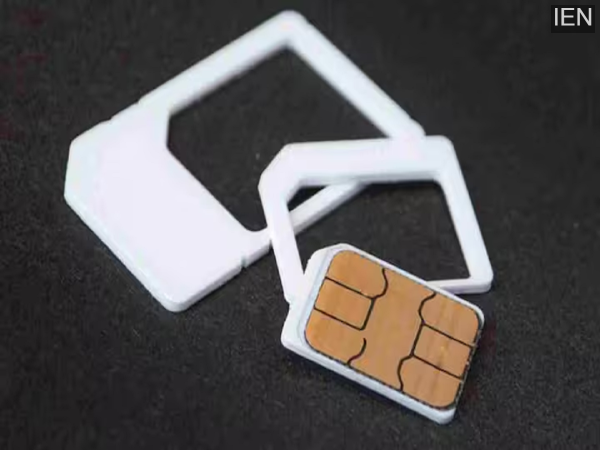
SIM Card: Have you ever looked closely at a SIM card? Almost every SIM card has a cut corner.
Have you ever looked closely at a SIM card? Almost every SIM card has a cut corner. Surprisingly, whether the SIM card is from India or another country, its shape and this corner remain almost identical. At first glance, it seems like just a design element, but in reality, there's an important technical reason behind it that protects your phone from damage. Interestingly, there was a time when SIM cards were completely square, but later, this corner was standardized worldwide.
The story of SIM cards begins in the early 1990s. Initially, SIM cards were as large as today's credit cards. As mobile phones became smaller, SIM cards also became smaller.
First came the mini-SIM, then the micro-SIM, and finally, the nano-SIM. Although the size changed, the cut corner of the SIM card never did. The European Telecommunications Standards Institute (ETSI) adopted it as a global standard so that SIM cards could be used in the same way all over the world.
The biggest advantage of this cut corner is that it prevents users from inserting the SIM card into the phone incorrectly. The golden chip in the middle of the SIM card needs to be in the exact correct position in the phone's SIM slot. If the SIM is inserted in the wrong direction, not only can the SIM card be damaged, but the delicate SIM reader inside the phone can also be harmed. The cut corner acts as a guide, making it easy to insert the SIM card into the SIM tray in the correct direction.
This design is beneficial not only for users but also for mobile phone manufacturers. The phone's SIM tray and the internal slot are designed according to this corner. This virtually eliminates the possibility of errors during phone assembly. This is why a person living anywhere in the world cannot insert a SIM card incorrectly into their phone.
Now, the use of e-SIMs is gradually increasing in smartphones. Some companies have even launched phones that don't offer the option of inserting a physical SIM card. In these phones, the telecom operator activates a digital SIM. In the future, as the use of e-SIMs becomes more widespread, it's possible that physical SIM cards will become a thing of the past.