


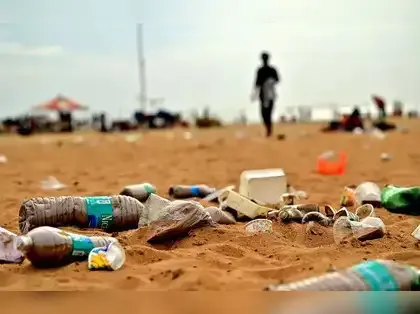
Sitting at the departure gate waiting for a flight out of the uber polluted Delhi last week, my eyes fell on a peripatetic boy who looked about four years old. He had just finished a tetrapak of juice and was wondering what to do with it and the straw. His mother told him to put it in the bin just under the flight display monitor. He could not understand his mother's directions to the bin though she repeated it at least thrice. So he just chucked both under the row of seats and walked off!
Instantly I called out in a stern voice, "No, no, no! Please pick them up and throw in the bin, not under the seats." The boy stopped in his tracks and looked rather startled. So did his mother. I repeated firmly, "No. You cannot do that." She then got up and picked up the juice pack and straw and walked to the bin to put them in there. My own instinct was that she should have made her son do it instead, so that he understood why I had admonished him and why it is important not to litter.
That is the problem with many parents in India. All too often they shy away from telling their darling offspring to behave-that includes inculcating a civic sense-for fear of either rebellion or being typecast as too strict. Parents ignore rules so that they do not have to teach them to their children, or they pretend their kids are above reproach, or they pick up after their progeny rather than getting them to do so. They are doing the nation a great disservice by being so lackadaisical.
Throwing tetrapaks under chairs to polluting cities may be a huge conceptual leap but the same mindset causes both. They stem from a sense that there is no individual responsibility towards a collective goal; it is only about personal convenience. Many think pollution, an extreme variant of littering, is the government's fault and therefore has to be dealt with only by the sarkar. The rest of us can simply sit back and complain about AQI staying at hazardous levels.
But governments are not bots or entities in themselves: they are made up of people just like us. Both breathe the same sulphurous air, clog roads with cars and bikes, add to mountains of garbage in landfills and buy or build flats whose construction spew tons of dust. The industries that pump smoke into the air and effluents into rivers are owned and operated by people; their goods are also bought by people, most of whom do not really care how they are produced or even disposed of.
Both are equally guilty of selfishness, shortsightedness and graft-bribes to avoid adhering to norms. Yet, if the government cracks down on pollution there will be loud protests as strict implementation of emission norms would take many vehicles off the roads and shut down hundreds of factories, impacting jobs. A ban on cutting marble and granite at building sites (a major cause of dust) would hike costs and evoke indignation not "Paying extra is okay if it means cleaner air..."
Blaming governments is deflecting responsibility; without us doing our bit, which includes accepting lifestyle and behavioural changes apart from inconvenience, no clean-up can ever happen. China did the needful-shut down, cut down et al-because protest is not allowed there. India is a democracy, so rather than coercion, we have to cooperate to combat pollution. Not chuck a metaphorical tetrapak under a seat and expect mai-baap Sarkar to pick it up and put it in the bin.
Instantly I called out in a stern voice, "No, no, no! Please pick them up and throw in the bin, not under the seats." The boy stopped in his tracks and looked rather startled. So did his mother. I repeated firmly, "No. You cannot do that." She then got up and picked up the juice pack and straw and walked to the bin to put them in there. My own instinct was that she should have made her son do it instead, so that he understood why I had admonished him and why it is important not to litter.
That is the problem with many parents in India. All too often they shy away from telling their darling offspring to behave-that includes inculcating a civic sense-for fear of either rebellion or being typecast as too strict. Parents ignore rules so that they do not have to teach them to their children, or they pretend their kids are above reproach, or they pick up after their progeny rather than getting them to do so. They are doing the nation a great disservice by being so lackadaisical.
Throwing tetrapaks under chairs to polluting cities may be a huge conceptual leap but the same mindset causes both. They stem from a sense that there is no individual responsibility towards a collective goal; it is only about personal convenience. Many think pollution, an extreme variant of littering, is the government's fault and therefore has to be dealt with only by the sarkar. The rest of us can simply sit back and complain about AQI staying at hazardous levels.
But governments are not bots or entities in themselves: they are made up of people just like us. Both breathe the same sulphurous air, clog roads with cars and bikes, add to mountains of garbage in landfills and buy or build flats whose construction spew tons of dust. The industries that pump smoke into the air and effluents into rivers are owned and operated by people; their goods are also bought by people, most of whom do not really care how they are produced or even disposed of.
Both are equally guilty of selfishness, shortsightedness and graft-bribes to avoid adhering to norms. Yet, if the government cracks down on pollution there will be loud protests as strict implementation of emission norms would take many vehicles off the roads and shut down hundreds of factories, impacting jobs. A ban on cutting marble and granite at building sites (a major cause of dust) would hike costs and evoke indignation not "Paying extra is okay if it means cleaner air..."
Blaming governments is deflecting responsibility; without us doing our bit, which includes accepting lifestyle and behavioural changes apart from inconvenience, no clean-up can ever happen. China did the needful-shut down, cut down et al-because protest is not allowed there. India is a democracy, so rather than coercion, we have to cooperate to combat pollution. Not chuck a metaphorical tetrapak under a seat and expect mai-baap Sarkar to pick it up and put it in the bin.




Reshmi Dasgupta
Senior Editor with The Economic Times