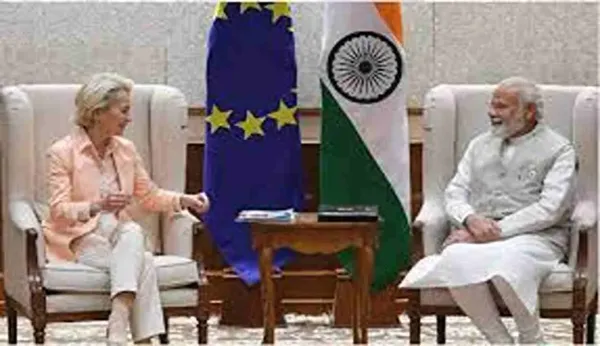
India and European : The diplomatic relationship between India and the European Union has entered a renewed phase of momentum following the arrival of Kaja Kallas, the European Union’s High Representative for Foreign Affairs and Security Policy and Vice-President, on her first official visit to India. The visit has been described by Indian officials as timely and significant, reflecting the growing importance of India–EU cooperation in an increasingly uncertain global environment.
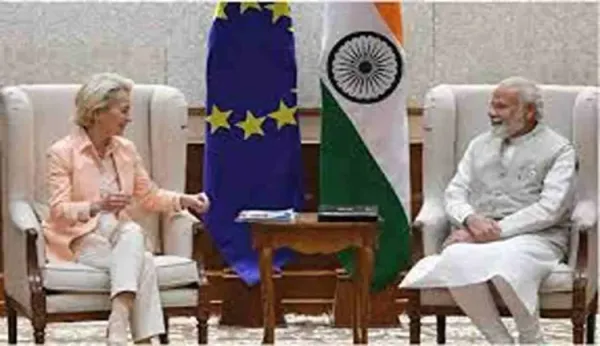
The Ministry of External Affairs highlighted that this visit comes at a moment when both sides are actively seeking to expand political, economic, and security cooperation. Sustained high-level engagements over recent months have laid the groundwork for a stronger and more resilient strategic partnership between India and the European Union, particularly in the context of global volatility.
Kaja Kallas’ arrival signals the European Union’s intent to deepen its engagement with India across multiple sectors. According to the Ministry of External Affairs, the visit aligns with ongoing efforts to strengthen bilateral dialogue and cooperation. Indian officials have noted that the partnership has matured beyond traditional diplomacy and now encompasses trade, technology, security, and people-to-people exchanges.
The visit also reflects the EU’s recognition of India’s growing global role. As geopolitical alignments continue to shift, both India and the European Union see value in working together to promote stability, economic resilience, and a rules-based international order.
Ahead of Kallas’ visit, External Affairs Minister S. Jaishankar held detailed discussions with ambassadors from EU member states in New Delhi. These interactions focused on the evolving global landscape, which Jaishankar described as increasingly volatile and unpredictable.
He emphasized that closer India–EU cooperation could help address shared global challenges. According to him, stronger ties would contribute to stabilizing the world economy by supporting resilient supply chains and reducing overdependence on limited sources. He also underlined the importance of cooperation in areas such as humanitarian assistance, disaster relief, maritime security, and development initiatives.
India and the European Union are positioning their partnership as a force for global reassurance. Through collaboration on trade, mobility, digital innovation, and security frameworks, both sides aim to provide practical solutions at a time when international institutions face growing strain.
The partnership is also seen as a means to enhance economic confidence. Expanding trade relations, facilitating business cooperation, and encouraging investment flows are central to the shared agenda. These efforts are expected to benefit not only India and the EU but also contribute positively to global economic stability.
The recent diplomatic engagements come ahead of a major milestone in India–EU relations. European Council President Antonio Luis Santos da Costa and European Commission President Ursula von der Leyen are scheduled to visit India later this month. They will attend India’s 77th Republic Day celebrations as Chief Guests, underscoring the strategic depth of the bilateral relationship.
The two leaders will also co-chair the 16th India–EU Summit, which is expected to focus on long-term cooperation frameworks. During their visit, they will meet President Droupadi Murmu and hold both restricted and delegation-level talks with Prime Minister Narendra Modi.
An India–EU Business Forum is also planned alongside the summit, highlighting the emphasis on economic engagement and private sector collaboration. Both sides see strong potential in expanding cooperation in clean energy, digital infrastructure, manufacturing, and innovation-driven sectors.
Overall, the series of high-level visits and dialogues reflects a shared understanding between India and the European Union that deeper cooperation is essential in navigating global uncertainty. The evolving partnership is increasingly viewed as strategic, forward-looking, and capable of contributing meaningfully to regional and global stability.