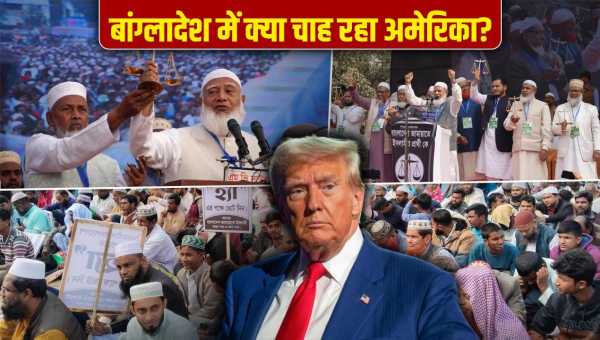
After the fall of Sheikh Hasina's government in Bangladesh, general elections are proposed for the Yunus government on February 12 for the first time. There is a lot of turmoil in the politics of Bangladesh before the general elections. According to media reports, before the elections, America is trying to strengthen relations with Bangladesh's fundamentalist party Jamaat-e-Islami. Jamaat-e-Islami is a party which has always been anti-India and which had opposed the independence of Bangladesh in 1971.
According to a report by Washington Post, bangladesh US Embassy officials recently met with Jamaat-e-Islami leaders at the party's Sylhet regional office, the latest in a series of contacts between the US State Department and the Islamist group ahead of Bangladesh's February elections.
“We want them to be our friends,” the report quoted an American diplomat as saying during a conversation with local media. However, the US Embassy rejected the claim that the US supported any “particular party” in Dhaka.
The embassy said, "The December conversation was a routine meeting. The conversation between US Embassy officials and local journalists was off-the-record. During this, a number of political parties were discussed. The US does not give preference to any one political party over another and plans to work with any government elected by the Bangladeshi people," the embassy said.
America's engagement with Jamaat has increased continuously in the last two years. It began in 2023, when a US diplomat met a senior Jamaat leader in Dhaka, a day before violent protests against the Sheikh Hasina government.
This contact became stronger in 2025. In March, two former US ambassadors visited Jamaat's headquarters. In June, the party was summoned to the US Embassy to discuss its views on internal governance and the rights of women and minorities, and in July, Chargé d'Affaires Tracy Anne Jacobson met with Jamaat chief Shafiqur Rehman at the party's headquarters.
Read this also- Jamaat sweats due to Tariq Rahman's entry in Bangladesh, this move was made to save the party
Despite Rahman's record of radical statements, including praising Hamas leader Yahya Sinwar and openly anti-Semitic remarks. The US granted him a visa through November 2025, which reflects Washington's growing desire to engage with the Islamist group ahead of Bangladesh's elections.
India's relations with the Yunus government have remained tense following the ban on India's pro-party party Awami League and the granting of asylum to Sheikh Hasina in India. Hindus are being tortured in Bangladesh. In the absence of the Awami League, three forces are likely to dominate the elections: the Bangladesh Nationalist Party (BNP), the Islamist Jamaat-e-Islami (JI), and the National Citizen Party (NCP), which emerged from the 2024 Student Movement. The results of the 2026 elections are expected to be decided by meeting these groups. The worry is that whichever party wins, its relations with India will remain difficult.
The victory of Jamaat-e-Islami will increase India's concerns, as the party has historically been against India and had opposed Bangladesh's independence in 1971, making it unlikely to maintain close relations with New Delhi.
Jamaat can force Bangladesh to move away from India and towards China or Pakistan in terms of defense and infrastructure. Despite soft public messaging, its core ideology remains anti-secular. Its victory in the student wing elections of Dhaka University in 2025 gives an idea of its strength. This has naturally increased India's concern.
Meanwhile, BNP's victory could mean a calm but practical relationship with India. The party has strengthened itself after not participating in the 2024 elections. Candidates have been fielded for 237 seats. Tariq Rahman is following the policy of Bangladesh First. Recently he had said in his speech that he will maintain equal distance from Delhi and Rawalpindi.
Read this also- If Makar Sankranti is celebrated, the consequences will be bad. Jamaat-e-Islami in Bangladesh gave open threat to Hindus.
However, the BNP has recently shown willingness to engage in a practical manner on trade and security, with good behaviour, such as its positive response to PM Modi's message on the death of Khaleda Zia.
At the same time, NCP is a party that emerged from the Student Movement of 2024, which was formed as a youth-led, reformist alternative to the traditional party dual system of Bangladesh. The leadership of this party was done by people like Nahid Islam. She played an important role in the protests against Hasina and later joined the interim government of Muhammad Yunus as an advisor after Hasina's removal.
Its relations with India have only worsened. Bangladesh is demanding the return of Sheikh Hasina. Since then, relations between the two countries have remained strained, and both recently suspended visa services for a period of time citing security concerns. India has accused the interim government of promoting radical elements, failing to protect minorities and weakening relations with New Delhi.
Read this also- Big defeat for Tariq Rahman before Bangladesh elections, Jamaat makes clean sweep in university elections
He has alleged that fundamentalist groups are using Yunus to run foreign policy without the approval of the people. He said that relations with India can be improved only when the right government is back in power. However, India has always advocated good relations with Bangladesh.
On the eve of Republic Day, Indian High Commissioner to Bangladesh Prannoy Verma said India and Bangladesh, being fast-growing economies, are well positioned to act as catalysts for each other's sustainable growth and anchors for stronger regional integration.
He said, “Bangladesh has been an important partner in our journey.” Verma said Dhaka and Delhi want “forward-thinking and future-ready cooperation”, and described it as “a partnership based on trust, driven by innovation and technology, and nurtured and sustained by mutual interest, mutual benefit and mutual sensitivity”.
Emphasizing on bilateral ties, Verma said Bangladesh and India “share a special bond, as well as an indelible history of shared sacrifices during the Bangladesh Liberation War of 1971.