Across the world, various nations maintain overseas territories that house strategic and military installations, but also for historical, economic and environmental reasons. The question of European overseas territories reached a head over the past weeks when Trump sought to "acquire" Denmark-ruled Greenland for the USA.
Many of these territories are remnants of colonial empires. While many former colonies around the world gained independence in the 20th century, they often chose to maintain their links for economic stability, security or because they were too small to be viable as fully independent nations.
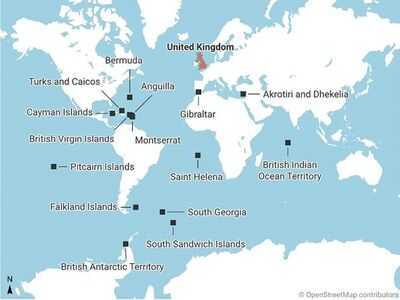
And this map, ironically produced by The West-hating al-Jazeera News, proves that on paper at least - Britain does still just about rule the waves.
United Kingdom - 14 territoriesThe UK has 14 overseas territories across the Atlantic, Caribbean, Pacific and polar regions, states the report.
The inhabited territories include Anguilla, Bermuda, British Virgin Islands, the Cayman Islands, Falkland Islands, Gibraltar and Montserrat. These are self-governing, with the UK responsible for defence and foreign affairs.
The UK also administers sparsely populated regions - the British Antarctic Territory, British Indian Ocean Territory, Pitcairn Islands, South Georgia Island and the South Sandwich Islands, as well as Akrotiri and Dhekelia bases in Cyprus.
Keir Starmer is attempting to hand over sovereignty of the Chagos Islands to Mauritius. This week, Trump strongly criticised this move as "an act of great stupidity".
United States - 14 territoriesThe US has five permanently inhabited territories and nine which are uninhabited, mainly in the Caribbean and the Pacific.
The inhabited territories are: Puerto Rico, Guam, the US Virgin Islands, American Samoa and the Northern Mariana Islands. Puerto Rico is the most populous and is a self-governing commonwealth.
The US also controls mostly uninhabited islands commonly referred to as the US Minor Outlying Islands, primarily used for military or strategic purposes.
France - 13 territoriesFrance has 13 overseas territories spread across the Atlantic, Caribbean, Indian Ocean, Pacific and South America. Unlike the UK and US territories, some are fully integrated into France as administrative regions.
Five territories - French Guiana, Guadeloupe, Martinique, Mayotte and Reunion - are fully integrated parts of France. They have representatives in the French parliament and use the euro. French Guiana is home to the Guiana Space Centre, where space launches are conducted by several European private companies and government agencies.
France administers French Polynesia, New Caledonia, Saint Pierre and Miquelon, Wallis and Futuna, Saint Martin and Saint Barthelemy, and Clipperton Island, all with varying degrees of autonomy.
Australia - 7 territoriesAustralia has seven overseas territories, three of which are inhabited - Norfolk Island, Christmas Island and the Cocos (Keeling) Islands.
The four mostly uninhabited territories are Heard Island and McDonald Islands, Ashmore and Cartier Islands, the Coral Sea Islands Territory and the Australian Antarctic Territory, primarily used for scientific research.
The Netherlands - 6 territoriesThe Netherlands has six territories in the Caribbean.
Three - Aruba, Curacao and Sint Maarten - have their own governments, parliaments and prime ministers and are known as "constituent" countries. Aruba gained this status in 1986, with Curacao and Sint Maarten becoming constituent countries in 2010.
The other three territories are Bonaire, Sint Eustatius and Saba, directly administered by The Hague.
Norway - 5 territoriesNorway has five territories in the Arctic and Antarctic.
Its first Arctic territory is Svalbard, which has a special legal status under the 1920 Svalbard Treaty. The second territory is Jan Mayen, an uninhabited volcanic island used for meteorological research.
Norway also claims three uninhabited territories in Antarctica: Bouvet Island, Peter I Island and Queen Maud Land, which hosts the largest-known seabird colony in Antarctica.
New Zealand - 4 territoriesNew Zealand has two self-governing regions that are part of it, one dependent territory, and one Antarctic claim.
The Cook Islands and Niue are both self-governing in "free association" with New Zealand, assuming responsibility for domestic affairs but deferring to New Zealand for defence and foreign policy.
Tokelau came under the control of New Zealand in 1925 and is a non-self-governing territory. Since 1923, New Zealand has maintained a right of sovereignty over the Ross Dependency in Antarctica for research purposes.
Denmark - 2 territoriesThe Kingdom of Denmark has two self-ruling territories, Greenland and the Faroe Islands.
Greenland is at the centre of a transatlantic dispute as US President Donald Trump insists on buying the resource-rich island, despite it having its own parliament and leader. Both Denmark and Greenland have repeatedly stated that the island is not for sale.
China - 2 territoriesChina has two Special Administrative Regions (SARs) - Hong Kong and Macau, generally autonomous under the principle of "One Country, Two Systems".
Hong Kong is a former British colony returned to China in 1997, with a population of about 7.5 million and is one of the world's most important financial centres.
Macau is a former Portuguese colony returned to China in 1999, with a population of about 680,000 and known for its financial services industry and casinos.
Portugal - 2 territoriesPortugal has two autonomous regions: The Azores and Madeira, both in the Atlantic Ocean.
The Azores are an archipelago of nine volcanic islands roughly 1,400 to 1,600km west of mainland Portugal. In 2025, Portugal's aviation regulator granted a five-year licence to operate a spaceport in the Azores on Santa Maria Island.
Madeira is roughly 1,000km southwest of mainland Portugal, with a population of about 260,000. Madeira was officially discovered in July 1419 by two sailors who had veered off course due to a storm.