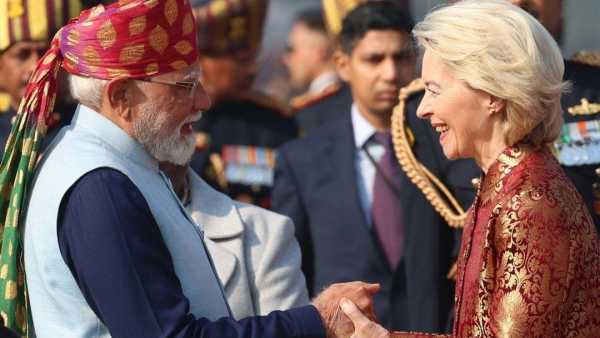
India-EU Summit: After nearly two decades, India and the European Union (EU) will be bringing an end to the negotiations on the free trade agreement (FTA) to a close at a time when both New Delhi and Brussels are facing adverse impact on trade and investments owing to US President Donald Trump’s arbitrary tariff imposition. Both sides will also seek to enhance defence and security ties by formalising a robust plan.
The FTA and the Security and Defence Partnership will see fruition during the 16th India-EU Summit which will be jointly chaired by Prime Minister Narendra Modi while the EU will be represented by European Commission President Ursula von der Leyen and European Council President António Costa. Both the Presidents were joint Chief Guests at the 77th Republic Day celebrations that took place in New Delhi on Monday.
The FTA, the negotiations for which were launched in 2007, will seek to grant more access to the Indian market for the European carmakers by significant reduction in tariffs. As a result several carmakers BMW, Renault, Volkswagen and Mercedes-Benz, among others will be able to sell their cars at a cheaper price, highly places sources told ABP Live.
EC President von der Leyen and Commerce and Industry Minister Piyush Goyal both have called the FTA as the “mother of all deals” even as the leaders are all set to formally announce the conclusion of negotiations.
The talks have reached the final stage after nearly 18 years of periodic delays and issues concerning non-trade issues even as the EU insisted on including matters related to labour standards and climate change within the gambit of the FTA.
The FTA talks were stalled in 2013 after 15 rounds due to deep disagreements over market access for automobiles, wines, spirits, and divergent views on intellectual property rights and data security. Thereafter, in 2014, when Modi came to power, the government decided to stall all trade negotiations, including the India-EU FTA.
Negotiations were finally resumed in June 2022 with a broader scope, including separate tracks for an Investment Protection Agreement (IPA) and Geographical Indications (GIs).
Patryk Kugiel, Senior Analyst, Polish Institute of International Affairs, told ABP Live, “This FTA has not only economic but also strategic dimensions. It will bind Europe and India closer together in all dimensions … It will build connections and trust, will prove it can deliver, and can bring tangible benefits to both sides.”
Kugiel, an expert on India-EU relations and South Asia, also said, “In times of instability of world order it will make EU-India main pillar of international order. Its significance cannot be overestimated. It will pave a way for closer strategic cooperation in changing existing systems and writing new rules for emerging areas, from AI to space.”
However, the question of ratification of the India-EU FTA in the EU parliament remains a cause of concern for India, said the sources quoted above. This is because, during several trade negotiations, the EU has expressed concerns over India’s purchase of Russian oil. The issue has also been flagged by EU top diplomat Kaja Kallas.
“Surely, the perspectives on Russia's war in Ukraine is where two sides have different views. But it is the only strategic area where their views differ and they learned how to de-hyphenate it from other issues and it cannot derail the overall partnership. Therefore tensions over India's import of Russian oil will not harm the partnership nor the FTA. In times of destructive Russia, disruptive China and unreliable America EU and India need each other more than ever. And they know it,” pointed out Kugiel.
According to him, ratification of the FTA in the EU parliament will “not be an issue.”
“There is an overwhelming majority in support of this deal, both in the European Parliament and European Council. I see no force willing to delay it. I believe it can be ratified by the European Parliament and endorsed by the European Council in less than six months. It is even easier when agriculture - the most sensitive issue for the European public - is taken out of the deal. So, once the FTA is signed, it can be implemented rather fast,” he added.
In October 2025, the Council of the EU endorsed the new strategic EU-India agenda and its objective of further developing EU-India ties.
At the Summit on Tuesday, both leaders are expected to adopt a joint EU-India comprehensive strategic agenda, which aims to increase strategic cooperation between both sides in four areas of security and defence, connectivity and global issues, technology and innovation and connectivity and global issues.
On Sunday, External Affairs Minister S. Jaishankar met both the Presidents von der Leyen and Costa as well as Kallas where all the issues were discussed which will be finalised during the summit.
With the formalisation of the security and defence partnership, India will become the third such partner in Asia for the EU after Japan and South Korea, with which Brussels will have such a deal, underlined Kugiel.
“It will enhance defence and security cooperation between India and Europe at both national and supranational levels. It can open up new opportunities and access to India to take part in the process of rearming and modernisation of the European defence industry. It gives a new security dimension to this partnership,” he said.