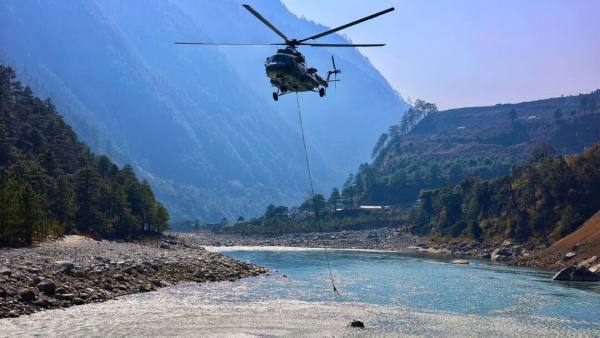
A massive forest fire raging through the ecologically sensitive Lohit Valley in Arunachal Pradesh has triggered an intensive aerial firefighting operation by the Indian Air Force, underscoring the growing challenges of combating wildfires in India’s high-altitude regions. As flames tore through dense forest cover along the Lohit River, Mi-17V5 helicopters were pressed into service to deliver critical water drops over terrain largely inaccessible to ground crews.
Operating at altitudes close to 9,500 feet above mean sea level, IAF pilots flew repeated sorties in difficult Himalayan conditions, releasing more than 12,000 litres of water in a bid to halt the fire’s advance. The Air Force described the operation as a display of “exceptional courage and precision”, noting the risks involved in flying heavy helicopters in thin air above steep ridges.
The mission was launched following an urgent appeal from the Arunachal Pradesh government, as local authorities found it nearly impossible to reach the affected areas by land. The fire had spread rapidly across narrow ridgelines and deep valleys, overwhelming initial containment efforts by forest officials.
Battling forest fires at nearly 9,500 feet in Arunachal Pradesh’s Lohit Valley. #IAF Mi-17V5 helicopters dropped 12,000 litres of water in the rarefied Himalayan air, showcasing exceptional courage, precision and a commitment towards protecting lives and fragile ecosystems.… pic.twitter.com/5SXBm7M5he
— Indian Air Force (@IAF_MCC) January 29, 2026
To reinforce the response, units of the Indian Army were deployed alongside state forest teams to create fire lines and shield nearby habitations in the Lohit–Anjaw belt.
Forest department officials explained that a mix of dry winter vegetation, steep slopes and strong winds typical of the eastern Himalayas during fire season allowed the flames to spread quickly. For air crews, the conditions were especially demanding. Reduced air density at high altitude limits helicopter lift and leaves little margin for error during low-level water release runs, making such missions technically complex and physically taxing.
However, teams remain on heightened alert, as shifting winds and persistently dry weather could reignite hotspots or spark new fires in nearby areas.
While the exact trigger of the Lohit Valley fire is still being investigated, officials noted that wildfires in the region are frequently linked to prolonged dry spells or accidental human activity related to forest use and agriculture. The valley has, in the past, recorded notable seasonal losses in tree cover due to similar incidents.
To support the firefighting effort, emergency air traffic control arrangements were swiftly set up in coordination with local authorities, ensuring safe helicopter operations. In a related development, the IAF also pointed to its recent deployment at Baramati Airport after a plane crash, where Air Warriors provided basic air traffic control and meteorological assistance at the request of civic officials.