On January 13, 2026, the University Grants Commission (UGC) unveiled the Promotion of Equity in Higher Education Institutions Regulations, 2026, an attempt to address discrimination in universities and colleges across India by strengthening a framework that had existed since 2012 but had clearly fallen short. The earlier rules struggled to confront entrenched biases, especially those faced by marginalized communities. The new regulations sought to widen the scope of protection, covering not only Scheduled Castes (SC) and Scheduled Tribes (ST) but also explicitly including Other Backward Classes (OBC), along with discrimination rooted in gender, religion, disability, race, place of birth, and institutional power hierarchies. They proposed equity committees, helplines, and structured sensitization programmes, backed by UGC oversight and the option of appeals to external ombudspersons. The push for reform followed Supreme Court directions and reflected the failure of earlier mechanisms—visible in the paradox of low formal complaints despite persistent problems—and the haunting reminders provided by student suicides such as those of Rohith Vemula and Payal Tadvi, which exposed the depth of systemic exclusion on campuses.
That momentum, however, was abruptly halted just over two weeks later. On January 29, 2026, the Supreme Court stayed the regulations, describing them as “completely vague” and vulnerable to misuse. A bench led by Chief Justice Surya Kant and Justice Joymalya Bagchi questioned the narrow framing of caste-based discrimination, noting that its exclusion of individuals from the general category ran contrary to Article 14’s guarantee of equality and risked reinforcing social divisions in a society that aspires to move beyond rigid classifications. Pending a detailed review scheduled for March 19, the court restored the 2012 rules, underscoring the need for clarity and inclusiveness in any legal framework meant to govern educational spaces, while cautioning against provisions that could be weaponised for personal or political vendettas.
The episode reveals a deeper tension: while the intent to confront discrimination in higher education is both necessary and overdue, the regulatory approach falters when it lacks precision, workable safeguards, and a vision that moves beyond entrenched caste-versus-caste binaries. Campus inequities are real and demand serious intervention, yet equity cannot be built through ambiguous rules that invite misuse or inadvertently stigmatise particular groups. What is required is a balance—robust protections that address lived discrimination across social lines, coupled with mechanisms that prevent exploitation and foster trust. Without this balance, well-meaning policies risk narrowing the conversation, intensifying resentment, and diverting attention from the broader, everyday injustices that persist in academic life. True progress lies less in hurried mandates and more in sustained, empathy-driven sensitisation and institutional accountability that confront discrimination in all its forms.
The 2026 regulations represent an evolution from the 2012 UGC guidelines, which focused primarily on SC/ST protections but acknowledged broader discriminations like those based on religion, language, ethnicity, gender, disability, and place of birth. The update explicitly incorporates OBCs into caste-based safeguards, reflecting their 37% share in higher education enrollment as per 2021-22 data, and extends coverage to faculty, non-teaching staff, contract workers, and online learners. Key provisions include replacing single anti-discrimination officers with multi-member equity committees for fairer grievance handling; UGC-centralized oversight to monitor compliance; external appeals to ombudspersons, addressing conflicts where institutional heads are implicated; stricter timelines for resolutions; and proactive measures like workshops and helplines to prevent bias, not just react to complaints. These steps were driven by Supreme Court observations on the 2012 rules' poor enforcement, with minimal complaints despite evident issues, prompting reforms after over a decade.
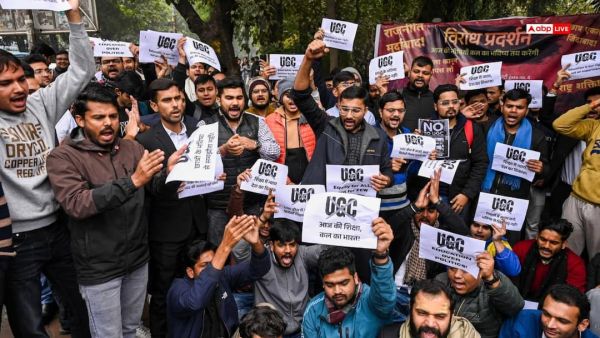
Yet, controversy erupted immediately. Protests flared on campuses like Delhi University, with general category students decrying the rules as divisive and exclusionary. Regulation 3(c)'s definition of caste-based discrimination—limited to acts against SC, ST, and OBC—sparked fears of reverse bias, lacking provisions for general category complaints or penalties for false allegations. Political ripples followed: a Bharatiya Janata Party (BJP) leader from Uttar Pradesh resigned, labeling the rules resentment-fueling, while Union Education Minister Dharmendra Pradhan defended them as essential for safe campuses. Opposition parties like Congress and Dravida Munnetra Kazhagam (DMK) voiced mixed support, criticizing the government's handling amid calls for a Bharat Bandh by groups like Karni Sena. The Supreme Court's stay highlighted these flaws, questioning why ragging was excluded and warning of misuse in a polarized society, underscoring how a well-intentioned policy became a flashpoint for debates on equity versus equality.
Discrimination in Indian higher education institutions is an undeniable scourge, manifesting not just in caste but also religion, gender, ethnicity, and beyond. From subtle exclusions in classrooms to overt name-calling and biased assessments, it has driven despair, as seen in high-profile student suicides over the years. For 14 years, the 2012 UGC regulations attempted to tackle this, mandating equal opportunity cells and grievance mechanisms, but their impact has been negligible—complaint numbers remain low, enforcement sporadic, and systemic change absent. Thus, opposing the 2026 rules outright would be misguided; they introduce sensible enhancements like centralized UGC monitoring, external appeals, and committee-based handling, all aligned with Supreme Court pushes for better equity.
However, these rules, while important, remain ill-made and loosely built, riddled with major gaps and a lack of real-world understanding. The dilution of specific examples of discriminatory acts—from classroom segregation to grading biases—shifts the burden onto victims to interpret vague categories, potentially deterring complaints. Absent are robust safeguards against misuse, such as distinguishing malicious from unproven claims, mandatory external verifications, or protections for accused parties during inquiries. Can the UGC, with its history of uneven oversight, centrally monitor every institution's implementation? Past failures in enforcing even basic compliance, like anti-ragging norms, suggest not. This lack of concreteness risks rendering the rules symbolic, failing to address intersecting discriminations—such as those faced by women from minority religions or disabled OBC students—while inviting procedural chaos.
Caste questions in India cannot be reduced to a simplistic caste-versus-caste battle; equity emerges not from demonizing one group to uplift another but through thoughtful, inclusive policies. The 2026 regulations' backlash, framed as "savarna" versus reserved categories, misses this nuance—discrimination flows in multiple directions, including within SC/ST/OBC groups or against general categories in power-imbalanced settings. Yet, any law carries misuse risks, as seen in anti-harassment or atrocities acts; that's why safeguards are essential, crafted by policymakers rather than public frenzy. The rules' exclusionary caste definition exemplifies this oversight, violating constitutional equality and fueling protests without addressing potential abuses like false complaints for vendettas.
Without such balance, the regulations could inadvertently heighten discrimination against SC, ST, and OBC students. Reservations already demonize these communities, with slurs like "quota beneficiaries" amplifying shame over inherent caste bias. Ill-conceived rules might worsen this, enabling reputational attacks or institutional retaliation under the guise of equity. Political parties must transcend opportunism—the BJP's internal dissent and Congress's selective outrage highlight how caste becomes a wedge. True policy-making demands depth: multi-layered appeals, independent committee members, and clear penalties for fabrications. The real tragedy? Overshadowed discriminations—gender-based violence in labs, religious profiling in hostels, or regional biases against northeastern students—never enter the discourse, lost in polarized debates.
Ultimately, curbing campus discrimination requires more than mandates; it demands empathy, open discussions, and sustained sensitization. Workshops on intersectional biases, regular equity audits, and inclusive dialogues could foster understanding, reducing reliance on complaints. Imposing ill-made laws, as with the 2026 rules, risks backlash and non-compliance, especially when UGC's track record in centralized monitoring is spotty—few institutions have fully activated even 2012 cells.
Positive elements like proactive measures and ombudsperson appeals show promise, but without refinements, they falter. Policymakers should heed the Supreme Court's call for redrafting: broaden definitions, embed safeguards, and prioritize unity. Parties like the BJP, in power, bear responsibility to lead with nuance, while opposition like Congress must advocate holistic equity. In a diverse nation, education should reflect harmony, not division—focusing on shared progress over battles ensures no one's suffering is sidelined.
(Sayantan Ghosh teaches at the St Xavier’s College (Autonomous) and is the author of The Aam Aadmi Party: The Untold Story of a Political Uprising and Its Undoing. He is on X as @sayantan_gh.)