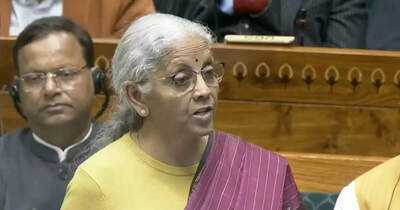
Union Finance Minister Nirmala Sitharaman used her Union Budget 2026-27 speech to send a clear signal: India’s banking and financial architecture must now prepare for the next leap in growth.
At the heart of the announcements was the proposal to set up a ‘High Level Committee on Banking for Viksit Bharat', a move that could reshape how credit flows, capital markets function and foreign investors participate in India’s growth story.
The centrepiece of the day’s announcements was the proposed ‘High Level Committee on Banking for Viksit Bharat’. Presenting the Union Budget in Parliament, the Finance Minister said the committee will comprehensively review the financial sector and align it with India’s next phase of growth, while safeguarding financial stability, inclusion and consumer protection.
The Budget document highlighted that the Indian banking sector today is characterised by strong balance sheets, historic highs in profitability, improved asset quality and coverage exceeding 98 per cent of villages in the country.
With that foundation in place, the government now wants the system to evolve for a more ambitious economic phase.
The move signals a broad review rather than incremental reform, potentially covering regulatory architecture, capital adequacy, financial inclusion frameworks and the future of digital banking.
In a significant step for the non-banking financial company (NBFC) space, the government announced plans to restructure the Power Finance Corporation (PFC) and the Rural Electrification Corporation (REC). The objective is to achieve scale and improve efficiency in Public Sector NBFCs.
The Budget outlined a broader vision for NBFCs under the Viksit Bharat framework, with clear targets for credit disbursement and technology adoption. By strengthening large state-backed NBFCs, the government appears keen to enhance long-term infrastructure financing capabilities while improving operational efficiency.
Recognising India’s growing integration with global capital markets, Nirmala Sitharaman proposed a comprehensive review of the Foreign Exchange Management (Non-debt Instruments) Rules. The aim is to create a more contemporary and user-friendly framework for foreign investments, aligned with India’s evolving economic priorities.
This review is expected to streamline processes and remove friction points that investors often flag, particularly in equity participation and cross-border capital flows.
A major push was also announced for India’s corporate bond market. The Union Budget proposes a market-making framework with suitable access to funds and derivatives on corporate bond indices, along with a proposal for total return swaps on corporate bonds.
This move could improve liquidity and pricing efficiency in the corporate bond segment, an area India has long sought to deepen to reduce over-reliance on bank lending.
Urban infrastructure financing also received attention. To encourage the issuance of municipal bonds of higher value by large cities, the Union Budget proposes an incentive of Rs 100 crore for a single bond issuance of more than Rs 1000 crore.
The current scheme under AMRUT, which incentivises issuances up to Rs 200 crore, will continue to support smaller and medium towns. This dual-track approach aims to help both major metros and developing cities access capital markets for infrastructure funding.
To further enhance ease of doing business and attract global capital, Individual Persons Resident Outside India (PROI) will be permitted to invest in equity instruments of listed Indian companies through the Portfolio Investment Scheme.
The Budget also proposes increasing the investment limit for an individual PROI under this scheme from 5 per cent to 10 per cent, with an overall investment limit for all individual PROIs to 24 per cent, from the current 10 per cent.
This change could widen the investor base for listed companies and improve foreign participation in Indian equity markets.
Industry leaders welcomed the broader banking reform signal. Shikhar Aggarwal, Chairperson, BLS E-services, said, "Signalling a major review of financial architecture, the Finance Minister proposed a 'High Level Committee on Banking for Viksit Bharat' to ensure the sector supports India's growth ambitions while safeguarding stability, inclusion, and consumer protection. To empower women entrepreneurs, the Budget introduced the 'She-Marts' initiative, aimed at improving access to credit and innovative financial instruments."