Finance Minister Nirmala Sitharaman on Sunday, February 1, presented the Union Budget 2026–27, outlining the government’s plans on growth, taxation, spending and sector-wise reforms amid global uncertainty.
Opening her speech in the Lok Sabha, Sitharaman said the government has focused on “delivering reforms over rhetoric,” adding that India’s economic trajectory over the past 12 years has been marked by stability, fiscal discipline and sustained growth despite repeated global disruptions.
She said the Budget is guided by three kartavyas — accelerating and sustaining economic growth, fulfilling the aspirations of the people, and ensuring access to opportunities for every region and community — and described it as a “yuva shakti–driven” Budget.
Fiscal position and government financesSitharaman said the government remains committed to fiscal consolidation and debt reduction.
Fiscal deficitShe said the government has accepted the 16th Finance Commission’s recommendation to retain 41 per cent tax devolution to states, with Rs 1.4 lakh crore to be transferred in the coming financial year.
Sectoral allocationsAs per the Budget estimates for 2026–27, major sectoral outlays include:
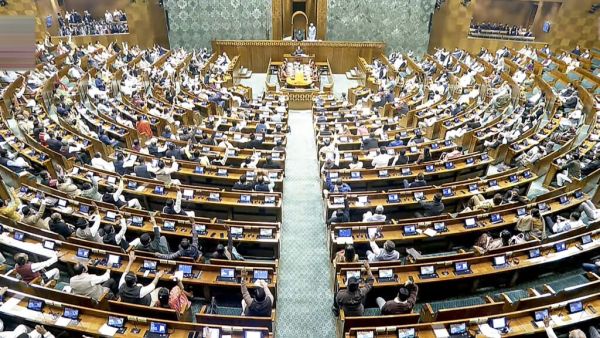 Proceedings underway in the Lok Sabha during the Budget Session of Parliament, in New Delhi. Infrastructure and investment
The Budget continues the focus on infrastructure-led growth. Sitharaman announced the setting up of an Infrastructure Risk Guarantee Fund to reduce risks for private developers and proposed dedicated Real Estate Investment Trusts (REIT) to recycle assets of central public sector enterprises.
Other key measures include incentives for large municipal bond issuances, development of an integrated East Coast Industrial Corridor with a major node at Durgapur in West Bengal, provision for 4,000 electric buses and an outlay of Rs 20,000 crore over five years for carbon capture, utilisation and storage.
Manufacturing, MSMEs and exportsTo strengthen domestic manufacturing, the Finance Minister announced:
To boost exports and manufacturing competitiveness, Sitharaman proposed:
The Budget proposed a Dedicated Freight Corridor connecting Dankuni in West Bengal and Surat in Gujarat, seven high-speed rail corridors and the development of 20 new national waterways over the next five years.
A ship-repair ecosystem for inland waterways will be developed at Varanasi in Uttar Pradesh and Patna in Bihar, while a coastal cargo scheme and incentives for indigenous manufacturing of seaplanes were also announced.
Services, IT and digital economyHighlighting India’s strength in technology services, Sitharaman said software development, IT-enabled services, knowledge process outsourcing and contract research and development (R&D) services are deeply interconnected.
To simplify the tax framework, she announced:
Highlighting the second “kartavya,” Sitharaman said close to 25 crore people have exited multidimensional poverty over the past decade and the next phase of growth will focus on aspirations and capacity building.
She announced a high-powered Education to Employment and Enterprise Standing Committee to position the services sector as a core driver of growth, with a target of achieving a 10 per cent global share by 2047. The panel will assess the impact of artificial intelligence (AI) and emerging technologies on jobs and skills.
Higher education and creative economyThe Budget proposed:
Sitharaman said tourism will play a key role in employment generation and local economic growth.
Key announcements include:
The Budget also proposed:
To provide relief to patients, Sitharaman announced:
To simplify and rationalise customs duties, the Finance Minister proposed reducing the tariff rate on all dutiable goods imported for personal use from 20 per cent to 10 per cent.
Exempting basic customs duty on:
The government will launch Bharat Vistar, a multilingual AI platform integrating agri-stack portals and Indian Council of Agricultural Research (ICAR) practices. A coconut promotion scheme has been announced, along with dedicated programmes for cashew and cocoa to enhance exports and build premium global brands by 2030.
Taxation and complianceSitharaman said the Income Tax Act, 2025, will come into force from April 1, replacing the six-decade-old law. The new legislation is revenue-neutral, simplifies compliance and introduces a single “tax year.”
Key tax proposals include extending the deadline for revising returns to March 31 with a nominal fee.
Staggered filing timelines:
Related moves:
The Finance Minister announced a high-level committee on Banking for Viksit Bharat, restructuring of Renewable Energy Certificate (REC) and Power Finance Corporation (PFC), a review of Foreign Exchange Management Act (FEMA) non-debt rules, a market-making framework for corporate bond indices and a higher investment limit for persons of Indian origin.
OutlookSitharaman said the Budget seeks to “balance ambition with inclusion” as India moves towards its long-term development goals.
She presented the 15th Budget of the Narendra Modi government and her ninth consecutive Budget.
Get the latest updates in Hyderabad City News, Technology, Entertainment, Sports, Politics and Top Stories on WhatsApp & Telegram by subscribing to our channels. You can also download our app for Android and iOS.