




Listen to this article in summarized format
Loading...
××
Subscribe to

Unlock AI Briefing and Premium Content
Subscribe NowWhat's Included
- Exclusive Stories
- Daily ePaper Access
- Smart Market Tools
- Curated Investment Ideas
- Ad-lite Experience
Subscription

India plans to create rare-earth corridors in the mineral-rich states of Odisha, Kerala, Andhra Pradesh, and Tamil Nadu to promote mining, processing, research, and manufacturing.
Finance minister Nirmala Sitharaman underscored how the country faces an external environment in which trade and multilateralism are imperilled, and access to resources and supply chains are disrupted.
“New technologies are transforming production systems while sharply increasing demands on water, energy and critical minerals,” Sitharaman said while announcing a slew of measures to reduce import dependence and continuing support for clean mobility and battery manufacturing.
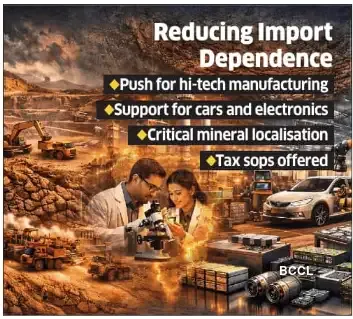
The step is in line with ongoing measures for self-reliance in manufacturing of rare earth permanent magnets (REPM), vital to meet rapidly growing demand from upstream industries in sectors such as electric vehicles, renewable energy, electronics, aerospace, and defence.
The need for securing supply chains grew after China, the world’s largest supplier, curbed REPM exports, triggering a global shortage that threatened to disrupt manufacturing across industries. While Chinese exports have resumed, the jolt has catalysed a push towards more indigenisation.
“Rare earth corridors will significantly strengthen domestic capabilities and reduce import dependence,” heavy industries and steel minister H D Kumaraswamy told ET, adding these measures along with the scheme for enhancement of construction and infrastructure equipment would spur investment, promote innovation, and generate skilled employment.
“These position India as a global hub for high-value and sustainable manufacturing,” he said.
The budget has also proposed scrapping the basic customs duty on monazite — used for high-end permanent magnets — from 2.5% currently.
A ₹7,280 crore scheme for rare earth permanent magnets was launched last November.
In addition to the corridors, Sitharaman announced basic customs duty exemption to import capital goods required for processing of critical minerals in India.
She also proposed a tax sop for certain critical minerals, adding them under Schedule XII of the Income Tax Act. This will allow expenditure on prospecting and exploring to be eligible for deduction as per the provision of Section 51 of the Act. Gold, copper, iron ore, and aluminium ore are already eligible for this incentive.
Budget 2026 Live
Your 2-minute guide to becoming a Budget pro
Check what gets cheaper and costlier in Budget this year
How far has India come since the last money manual
Budget 2026 Highlights: Here's the fine print
“New technologies are transforming production systems while sharply increasing demands on water, energy and critical minerals,” Sitharaman said while announcing a slew of measures to reduce import dependence and continuing support for clean mobility and battery manufacturing.
The step is in line with ongoing measures for self-reliance in manufacturing of rare earth permanent magnets (REPM), vital to meet rapidly growing demand from upstream industries in sectors such as electric vehicles, renewable energy, electronics, aerospace, and defence.
The need for securing supply chains grew after China, the world’s largest supplier, curbed REPM exports, triggering a global shortage that threatened to disrupt manufacturing across industries. While Chinese exports have resumed, the jolt has catalysed a push towards more indigenisation.
“Rare earth corridors will significantly strengthen domestic capabilities and reduce import dependence,” heavy industries and steel minister H D Kumaraswamy told ET, adding these measures along with the scheme for enhancement of construction and infrastructure equipment would spur investment, promote innovation, and generate skilled employment.
“These position India as a global hub for high-value and sustainable manufacturing,” he said.
The budget has also proposed scrapping the basic customs duty on monazite — used for high-end permanent magnets — from 2.5% currently.
A ₹7,280 crore scheme for rare earth permanent magnets was launched last November.
In addition to the corridors, Sitharaman announced basic customs duty exemption to import capital goods required for processing of critical minerals in India.
She also proposed a tax sop for certain critical minerals, adding them under Schedule XII of the Income Tax Act. This will allow expenditure on prospecting and exploring to be eligible for deduction as per the provision of Section 51 of the Act. Gold, copper, iron ore, and aluminium ore are already eligible for this incentive.


