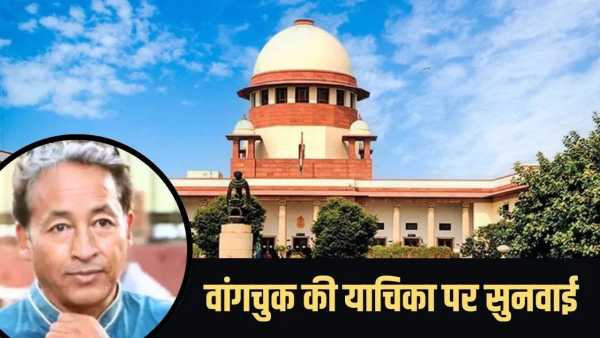
The central government on Monday (February 2) defended the detention of social activist Sonam Wangchuk under the National Security Act (NSA) in the Supreme Court. The government told the court that Wangchuk's public speeches were a provocation, a separatist message and a threat to national security, especially in the sensitive border area.
The central government said in the court that Sonam Wangchuk wants to make Ladakh like Nepal or Bangladesh. Such a person cannot be allowed to spew more venom. Solicitor General Tushar Mehta, appearing for the government, told the court that Wangchuk had tried to instigate the younger generation to push Ladakh towards a situation like Nepal, Bangladesh and Sri Lanka, and cited examples of violent insurgencies and political instability in these countries.
A bench of Justices Arvind Kumar and Prasanna Varale was hearing a petition filed by Wangchuk's wife Gitanjali J. Angmo, challenging his detention.
The government argued that Sonam Wangchuk's statements pose a serious threat to national security and public order. Solicitor General Tushar Mehta, appearing for the government, said that Wangchuk cannot be allowed to spread poison by demanding plebiscite and referendum.
The Supreme Court said that under Article 32, the Court does not hear appeals on detention orders. The main question is whether the reason, basis and contents of the order have any bearing on national security or not. The Solicitor General said the court's job is not to assess its own satisfaction, but to examine whether the District Magistrate (DM) was satisfied that Wangchuk's actions were likely to disrupt public order. He said that the DM concluded that Wangchuk's speeches were instigating the youth and could harm public peace.
Mehta said the detention order was passed following proper legal procedure and action was taken within four hours. He told the court that a DIG had met Wangchuk, shown him video clips of his speeches and Wangchuk had accepted that the clips were authentic.
The Solicitor General said, 'He (Wangchuk) calls the central government 'they'. This 'we' and 'them' is enough for detention under NSA. There is no 'we' and 'them' in this country, we are all Indians. Mehta alleged that Wangchuk wanted to take Ladakh to a situation like Nepal or Bangladesh and he only used Mahatma Gandhi's name as a cover in his speeches to instigate the youth.
Earlier, in the last hearing, it was argued on behalf of Sonam Wangchuk that criticizing and opposing the government is her democratic right and it does not pose a threat to the security of the state. The hearing of the case will continue on Tuesday. Wangchuk was arrested under the National Security Act (NSA) from 26 September 2025. His arrest came two days after violent protests took place demanding statehood for Ladakh and its inclusion in the Sixth Schedule. In these demonstrations, four people were killed in Ladakh, while 90 people were injured. The government had accused him of inciting violence. Currently he is lodged in the Central Jail located in Jodhpur.