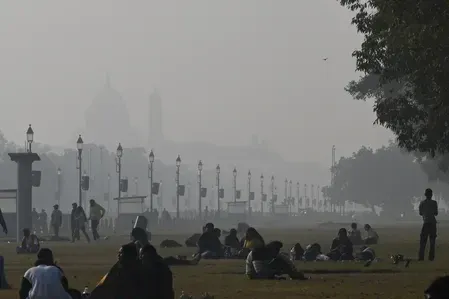
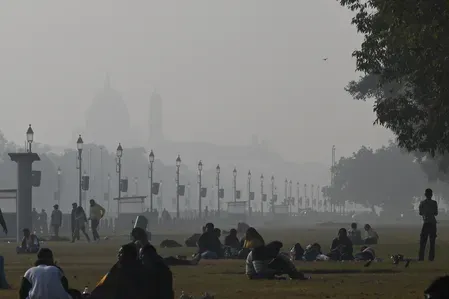
Delhi – Several areas of the national capital woke up to thick fog on Tuesday morning, with air quality remaining firmly in the poor category, according to official data. At 7 am, the overall Air Quality Index stood at 256, reflecting unhealthy conditions for sensitive groups and prolonged outdoor exposure.
Data released by the Central Pollution Control Board showed that many monitoring stations across the city recorded air quality levels ranging from poor to very poor. Ashok Vihar reported an AQI of 287, while Chandni Chowk registered one of the highest readings at 324, placing it in the very poor category.
Other areas also reflected elevated pollution levels. Bawana recorded an AQI of 239, Burari 234, and Dwarka Sector 8 stood at 293. Readings from ITO were logged at 248, Mundka at 297, and Wazirpur at 316. In south Delhi, Okhla Phase-2 recorded 310, while RK Puram touched 300. Punjabi Bagh reported an AQI of 295, and Rohini stood at 281.
Some relief was observed in the outer northern parts of the city. Narela recorded a comparatively lower AQI of 168, which falls in the moderate category, while Alipur logged a reading of 212, still within the poor range but below several central locations.
Under the national AQI classification system, values between 0 and 50 are considered good, while 51 to 100 fall in the satisfactory range. Levels from 101 to 200 are categorised as moderate. Readings between 201 and 300 are labelled poor, 301 to 400 very poor, and anything above 400 is classified as severe, posing serious health risks.
Alongside pollution, weather conditions further affected morning visibility. The India Meteorological Department reported that the temperature in the city hovered around 12 degrees Celsius at 7 am. The combination of low temperatures and high moisture contributed to dense fog in several pockets, affecting early-morning commuters and traffic movement.
The issue of air pollution has also gained renewed political attention ahead of the ongoing Budget session of Parliament. On Sunday, Rahul Gandhi, the Leader of the Opposition in the Lok Sabha, called for a dedicated parliamentary discussion on the worsening air quality situation. He urged the government to allocate sufficient funds in the Union Budget to address the problem in a meaningful way.
In a post shared on social media, Gandhi said he had received thousands of messages from citizens describing the impact of pollution on their daily lives. He also released a self-recorded video appealing to Narendra Modi to formally recognise air pollution as a national health emergency.
In his remarks, Gandhi emphasised the need for collective action and long-term planning. He said Parliament should be allowed to debate the issue openly and stressed that policy responses must be supported by adequate financial resources. According to him, citizens are seeking practical solutions and cleaner air rather than reports or statements.
The current Budget session of Parliament is scheduled to run for 30 sittings over a span of 65 days and will conclude on April 2. Both Houses will adjourn for a recess on February 13 and reconvene on March 9. The break will allow Standing Committees to examine the Demands for Grants of various ministries and departments before discussions resume.