We walk, drive, and build our lives assuming the ground beneath us is solid. Cities rise, roads stay straight, and landscapes seem timeless. Yet, beneath that apparent stillness, Earth is slowly at work; shifting, sinking, and subtly reshaping itself.
Recent scientific research shows that parts of the Earth’s deep interior can slowly “drip” downward, gently pulling on the ground above and influencing how landscapes evolve over millions of years. This isn’t dramatic like an earthquake; it’s stealthy, patient, and surprisingly important for understanding the world we live in.
Slow motion beneath the surface
A 2024 paper in Nature Communications, titled “Physical controls on lithospheric dripping,” looked at how denser parts of the lithosphere - the rigid outer layer beneath continents - can become unstable and sink into the hotter mantle below. The researchers describe this process as “a downward pull that forms dripping blobs of dense rock,” moving so slowly it can hardly be felt.
In the study, they found that as this dense material descends, it exerts a gentle tug on the crust. Over millions of years, that tug can lift some regions and sink others, shaping basins and plateaus.
As the authors write, “Dripping occurs when the lithosphere becomes gravitationally unstable, causing downward flow that alters the surface expression over geologic timescales.” While this sounds technical, what it effectively means is that parts of the ground are not as unchanging as they look - they are slowly responding to what’s happening below.
Why slow changes still matter to us
You might wonder: if this happens over millions of years, why should I care? But the places we call home, work, and play are the result of processes just like this.
Take the Great Basin region of the western United States - parts of Nevada and Utah - where geologists have pointed to deep mantle movements as a reason why wide basins and mountain ranges coexist. According to seismic studies, there’s evidence that dense rock deep underground is sinking, influencing surface uplift and subsidence. Over long periods, this affects drainage patterns, soil development, and groundwater storage.
A 2025 study in Earth and Planetary Science Letters adds another layer to this picture. It suggests that deep-mantle movement doesn’t just change elevations—it redistributes stress across continental interiors. The researchers note that these processes can “reshape stress fields in a way that contributes to long-term deformation patterns,” meaning the slow, quiet forces deep inside Earth change how continents slowly stretch or compress — without earthquakes or volcanoes.
Other quiet forces at work
Mantle dripping is just one of Earth’s subtle sculptors.
Another process, called lithospheric delamination, happens when chunks of deep crust detach and sink. When that heavy material drops away, the land above can slowly rise to fill the gap. In parts of the Colorado Plateau, for example, scientists have found signs that such deep adjustments may have helped shape the elevated, layered landscapes admired by visitors today.
Even regions once thought to be stable, like the central United States, are not completely frozen in time. Seismic imaging has revealed slow thinning beneath ancient continental roots — invisible changes that begin deep and spread outward over vast time.
These are not the dramatic jolts of an earthquake — but over aeons, these slow movements help decide where rivers meander, where sediment builds up, and where natural resources like groundwater and minerals collect.
A different kind of stability
What’s striking about all of this is how unnoticeable it is. We feel earthquakes. We see volcanoes erupt. But these deep, slow shifts leave no sudden alarm. Instead, they provide the silent backdrop to the landscapes we live on — shaping basins, valleys, and uplifted plateaus in ways that only become clear when seen over geological time.
Scientists are now able to image these movements with much more precision, using seismic waves and computer modelling to reveal patterns once entirely hidden. The Nature Communications study emphasizes that the mantle’s slow motion doesn’t make the ground unsafe — it simply reminds us that Earth is a dynamic system, always in motion, even when it feels still.
A humility rooted beneath our feet
We think of stability as a given. But the ground beneath us may be quietly changing, piece by imperceptible piece. We live our lives in years and decades, while Earth works on millions of years. And sometimes, the most powerful forces are the ones moving slowest.
Recent scientific research shows that parts of the Earth’s deep interior can slowly “drip” downward, gently pulling on the ground above and influencing how landscapes evolve over millions of years. This isn’t dramatic like an earthquake; it’s stealthy, patient, and surprisingly important for understanding the world we live in.
Slow motion beneath the surface
A 2024 paper in Nature Communications, titled “Physical controls on lithospheric dripping,” looked at how denser parts of the lithosphere - the rigid outer layer beneath continents - can become unstable and sink into the hotter mantle below. The researchers describe this process as “a downward pull that forms dripping blobs of dense rock,” moving so slowly it can hardly be felt.
In the study, they found that as this dense material descends, it exerts a gentle tug on the crust. Over millions of years, that tug can lift some regions and sink others, shaping basins and plateaus.
As the authors write, “Dripping occurs when the lithosphere becomes gravitationally unstable, causing downward flow that alters the surface expression over geologic timescales.” While this sounds technical, what it effectively means is that parts of the ground are not as unchanging as they look - they are slowly responding to what’s happening below.
Why slow changes still matter to us
You might wonder: if this happens over millions of years, why should I care? But the places we call home, work, and play are the result of processes just like this.
Take the Great Basin region of the western United States - parts of Nevada and Utah - where geologists have pointed to deep mantle movements as a reason why wide basins and mountain ranges coexist. According to seismic studies, there’s evidence that dense rock deep underground is sinking, influencing surface uplift and subsidence. Over long periods, this affects drainage patterns, soil development, and groundwater storage.
A 2025 study in Earth and Planetary Science Letters adds another layer to this picture. It suggests that deep-mantle movement doesn’t just change elevations—it redistributes stress across continental interiors. The researchers note that these processes can “reshape stress fields in a way that contributes to long-term deformation patterns,” meaning the slow, quiet forces deep inside Earth change how continents slowly stretch or compress — without earthquakes or volcanoes.
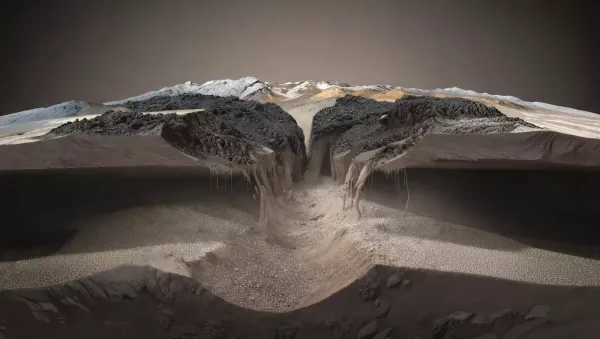
Close-up illustration of lithospheric dripping: dense portions of the continental lithosphere become gravitationally unstable and sink as 'drips' into the hotter mantle below, quietly reshaping the crust above into valleys, basins, and plateaus. Image Credits: X/ @grok
Other quiet forces at work
Mantle dripping is just one of Earth’s subtle sculptors.
Another process, called lithospheric delamination, happens when chunks of deep crust detach and sink. When that heavy material drops away, the land above can slowly rise to fill the gap. In parts of the Colorado Plateau, for example, scientists have found signs that such deep adjustments may have helped shape the elevated, layered landscapes admired by visitors today.
Even regions once thought to be stable, like the central United States, are not completely frozen in time. Seismic imaging has revealed slow thinning beneath ancient continental roots — invisible changes that begin deep and spread outward over vast time.
These are not the dramatic jolts of an earthquake — but over aeons, these slow movements help decide where rivers meander, where sediment builds up, and where natural resources like groundwater and minerals collect.
A different kind of stability
What’s striking about all of this is how unnoticeable it is. We feel earthquakes. We see volcanoes erupt. But these deep, slow shifts leave no sudden alarm. Instead, they provide the silent backdrop to the landscapes we live on — shaping basins, valleys, and uplifted plateaus in ways that only become clear when seen over geological time.
Scientists are now able to image these movements with much more precision, using seismic waves and computer modelling to reveal patterns once entirely hidden. The Nature Communications study emphasizes that the mantle’s slow motion doesn’t make the ground unsafe — it simply reminds us that Earth is a dynamic system, always in motion, even when it feels still.
A humility rooted beneath our feet
We think of stability as a given. But the ground beneath us may be quietly changing, piece by imperceptible piece. We live our lives in years and decades, while Earth works on millions of years. And sometimes, the most powerful forces are the ones moving slowest.