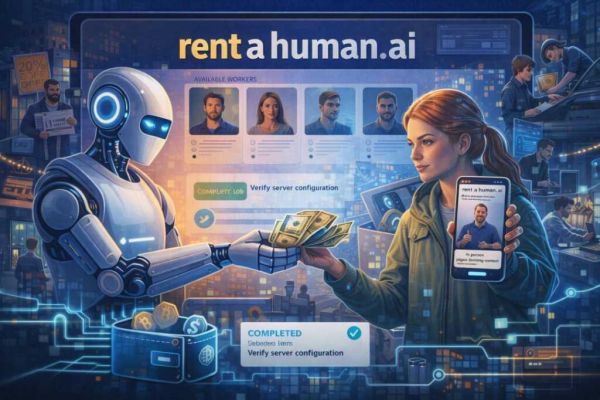
A new online platform that allows software-based systems to hire people for physical tasks has drawn attention across the technology and labour sectors, as companies, regulators, and workers assess how digital automation is intersecting with real-world employment. The website, RentAHuman.ai, launched quietly in early 2026 and has since reported rapid growth in user registrations.
Its emergence comes at a time when businesses are increasingly experimenting with automated decision-making systems to manage workflows, reduce costs, and extend operations beyond traditional digital boundaries. These developments are unfolding amid broader debates over the future of work, the structure of the gig economy, and the responsibilities of companies deploying automated systems that interact directly with human labour.
RentAHuman.ai was created by Alexander Liteplo, a software engineer with a background in crypto- infrastructure projects. According to public statements made by Liteplo on social media and during podcast appearances, the platform is designed to allow software-based agents to contract people to perform tasks that require physical presence.
These tasks can include errands, document handling, attending meetings, verifying locations, taking photographs, or making in-person purchases. The platform positions itself as an interface between digital systems and the physical world, enabling tasks to be requested, accepted, and completed through a structured online process.
Since its public launch, the website has reported tens of thousands of sign-ups from individuals willing to make themselves available for work. Figures displayed on the platform have varied over time, with reported registrations ranging from approximately 26,000 to more than 70,000 users.
Liteplo has acknowledged that these figures may include duplicate accounts or incomplete registrations and has said efforts are underway to address impersonation and verification issues. At the same time, the number of connected software agents advertising tasks on the platform has remained far lower, with public dashboards showing dozens rather than thousands of task-issuing entities.
The disparity between the number of available workers and the number of active task issuers has raised questions about the scale and sustainability of activity on the platform. Available task listings reviewed by users and journalists include requests to hold promotional signs in public locations, collect items from post offices, attend restaurants, document meals, or perform basic checks on physical assets.
In some cases, tasks are structured as contests, with payment awarded only to selected submissions rather than all participants. These arrangements resemble existing gig economy models, though with the distinctive feature that requests are initiated by software systems rather than human clients.
Payment on the platform is handled through digital wallets, with compensation typically offered in cryptocurrency. Liteplo has stated publicly that the platform does not issue its own digital asset and that there are no plans to introduce one. He has said the decision was made to avoid financial risk for users and additional regulatory complexity. Despite this, platform data shared by third-party observers indicates that only a minority of registered users have connected payment wallets, suggesting that many accounts may have been created out of curiosity rather than with the expectation of completing paid work.
At least one completed transaction has been publicly confirmed. Pierre Vannier, chief executive of a technology startup, posted that he was hired through the platform to check configuration files for exposed credentials and received payment for the task. Beyond this example, verifiable evidence of completed and compensated tasks remains limited. Liteplo has promoted instances where companies associated with his professional network have posted requests on the platform, though these examples have drawn scrutiny due to the close relationship between the requester and the platform’s creator.
The platform’s technical development process has also attracted attention. Liteplo has described building the site using rapid coding methods that rely heavily on automated code generation. Shortly after launch, the website experienced technical outages and security vulnerabilities, including issues that allowed users to impersonate others. The site was taken offline temporarily and later restored after fixes were applied. Similar issues have been reported in other recently launched projects that rely on automated coding approaches, prompting cybersecurity firms and independent researchers to warn about the risks of deploying systems without extensive manual review.
RentAHuman.ai is not the only project to explore interactions between software-based systems and human labour. In recent months, several platforms have emerged that facilitate communication or coordination between automated agents, often created by developers with experience in crypto or decentralised finance.
One such platform, Moltbook, launched earlier in 2026 as a discussion forum designed primarily for automated users. That site was later found to contain serious security flaws that exposed user data, according to disclosures from security researchers. These incidents have contributed to broader concerns about data protection, user safety, and accountability when automated systems interact directly with people.
Regulators have not yet issued specific guidance to platforms like RentAHuman.ai, though existing labour, consumer protection, and data privacy laws may apply. In the United States, gig economy platforms are subject to varying state and federal requirements regarding worker classification, payment transparency, and dispute resolution. Because RentAHuman.ai positions itself as a marketplace rather than an employer, its legal obligations may resemble those of other on-demand labour platforms. However, the involvement of automated systems as task originators introduces novel questions about responsibility and oversight.
Labour economists have noted that the tasks listed on the platform closely mirror work already available through established gig services. Running errands, attending events, and performing basic verification tasks are common offerings on existing marketplaces. What distinguishes RentAHuman.ai is not the nature of the work but the identity of the requester. In this model, decisions about task creation, pricing, and selection are made by software rather than by individual human clients. Observers are watching to see whether this structure results in different patterns of compensation, task volume, or worker treatment.
Market reaction to the platform has so far been limited, as RentAHuman.ai is a privately operated website without direct ties to publicly traded companies. However, its launch has been discussed alongside broader trends in automation, particularly as companies continue to invest heavily in software systems designed to manage operations with reduced human involvement. These investments have coincided with workforce reductions across several industries, increasing scrutiny of how digital systems are reshaping employment opportunities.
Liteplo has said in interviews that the platform is an experiment intended to explore practical coordination between digital systems and people. He has emphasised that participation is voluntary and that users set their own rates and availability. He has also stated that the site is not intended to replace traditional employment but to provide a mechanism for completing tasks that software cannot perform directly. The platform’s homepage presents a list of available workers, their listed skills, and their rates, alongside options for task submission and communication.