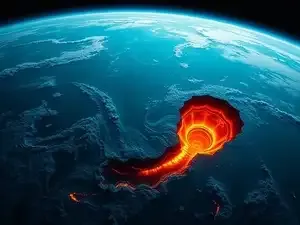
For decades, scientists and curious observers alike have been baffled by a strange feature hidden beneath the waves of the Indian Ocean. In the waters southwest of India and Sri Lanka lies an enormous gravitational anomaly where gravity is noticeably weaker than elsewhere on the planet.
Known to researchers as the Indian Ocean Geoid Low (IOGL), this region creates a bizarre effect: the sea surface there lies roughly 106 meters (about 348 feet) lower than the average sea level scientists would expect if Earth’s gravity were uniform. Recent research, however, has finally uncovered why this “gravity hole” exists, and it speaks to Earth’s deep, dynamic history.
The IOGL spans around 3.1 million square kilometers (nearly 1.2 million square miles), an area about the size of India itself, making it the largest negative gravity anomaly on Earth. In practical terms, sea level is slightly lower in this region, not because water is being physically pulled down, but because gravity itself is weaker there.
That changed with a major study published in Geophysical Research Letters in 2023 by Indian scientists Debanjan Pal and Attreyee Ghosh of the Indian Institute of Science (IISc), working with international collaborators. Their research employed advanced numerical models of mantle convection, simulations that trace the movement of heat and material within Earth’s mantle over tens of millions of years.
In those models, the scientists effectively rewound Earth’s deep geological history, running simulations back to 140 million years ago and moving forward to today. That modeling allowed them to account for shifting tectonic plates, subducting ocean crust, and large temperature variations deep within the planet.
“The existence of the Indian Ocean geoid low is one of the most outstanding problems in Earth Sciences,” Prof. Attreyee Ghosh said in explaining the research. “It is the lowest geoid/gravity anomaly on Earth and so far no consensus existed regarding its source.”
As those ancient slabs of oceanic crust descended, they disrupted deep-seated structures, particularly a massive zone of ancient, dense rock known as the African Large Low Shear Velocity Province (LLSVP). This enormous body of material, sometimes called the African superplume, sits near the core-mantle boundary beneath Africa.
The disturbances triggered by these subducted slabs caused hotter, lighter material from the African LLSVP to rise toward the upper mantle beneath the Indian Ocean. Because lighter material exerts less gravitational pull than denser rock, this created a “mass deficit” in the area, which, in turn, explains why the sea surface there is lower and why local gravity is weaker.
“A geoid low or a negative geoid anomaly would be caused by a mass deficit within the deep mantle,” Prof. Ghosh said of the research’s conclusion. “Our study explains this low with hotter, lighter material stretching from a depth of 300 km up to ~900 km in the northern Indian Ocean, most likely stemming from the African superplume.”
Gravity anomalies like this one also remind us that Earth is not a uniform sphere but a dynamic, ever-changing world shaped by processes unfolding over hundreds of millions of years. From the movement of ancient oceans to the behavior of molten rock deep below our feet, the forces that created the Indian Ocean’s gravity hole are part of the same system that drives earthquakes, uplifts mountain ranges, and reshapes continents.
Scientists continue to refine their models and seek seismic data that could further verify the presence and behavior of low-density material beneath the IOGL. By unlocking this mystery, researchers not only explain one of the most unusual features of Earth’s gravity field but also gain a deeper appreciation for the complex forces at work within the planet itself, forces that operate slowly, invisibly, but with vast influence over the world we live in.
Visualizing the Indian Ocean's gravitational dip and the dynamic mantle currents beneath.
Not a Physical Pit, But a Gravitational One
It’s important to understand that the “gravity hole” is not a literal hole in the ocean floor. You could not dive down and see a massive cavern at that depth. Instead, it is a dip in Earth’s geoid, the imaginary surface that represents global mean sea level if not influenced by tides, currents, or waves. Variations in this geoid reflect tiny changes in Earth’s gravitational field caused by the uneven distribution of mass beneath the planet’s surface.The IOGL spans around 3.1 million square kilometers (nearly 1.2 million square miles), an area about the size of India itself, making it the largest negative gravity anomaly on Earth. In practical terms, sea level is slightly lower in this region, not because water is being physically pulled down, but because gravity itself is weaker there.
A 75-Year-Old Mystery, Explained
The gravity anomaly was first identified in 1948 by Dutch geophysicist Felix Andries Vening Meinesz during precise ship-based gravity measurements. For decades, the cause remained speculative. Scientists knew something deep beneath the Indian Ocean was reducing local gravity, but the evidence was too sparse and the theories too varied to form a consensus.That changed with a major study published in Geophysical Research Letters in 2023 by Indian scientists Debanjan Pal and Attreyee Ghosh of the Indian Institute of Science (IISc), working with international collaborators. Their research employed advanced numerical models of mantle convection, simulations that trace the movement of heat and material within Earth’s mantle over tens of millions of years.
In those models, the scientists effectively rewound Earth’s deep geological history, running simulations back to 140 million years ago and moving forward to today. That modeling allowed them to account for shifting tectonic plates, subducting ocean crust, and large temperature variations deep within the planet.
“The existence of the Indian Ocean geoid low is one of the most outstanding problems in Earth Sciences,” Prof. Attreyee Ghosh said in explaining the research. “It is the lowest geoid/gravity anomaly on Earth and so far no consensus existed regarding its source.”
Ancient Oceans and Deep Earth Dynamics
According to the study’s findings, the roots of the gravity hole lie deep beneath Earth’s crust, in the mantle, the thick layer of rock between the crust and the core. The team’s models suggest that remnants of the ancient Tethys Ocean, a vast sea that once separated Asia from Gondwana before the Indian subcontinent drifted northward, sank deep into the mantle during plate tectonic movements.As those ancient slabs of oceanic crust descended, they disrupted deep-seated structures, particularly a massive zone of ancient, dense rock known as the African Large Low Shear Velocity Province (LLSVP). This enormous body of material, sometimes called the African superplume, sits near the core-mantle boundary beneath Africa.
The disturbances triggered by these subducted slabs caused hotter, lighter material from the African LLSVP to rise toward the upper mantle beneath the Indian Ocean. Because lighter material exerts less gravitational pull than denser rock, this created a “mass deficit” in the area, which, in turn, explains why the sea surface there is lower and why local gravity is weaker.
“A geoid low or a negative geoid anomaly would be caused by a mass deficit within the deep mantle,” Prof. Ghosh said of the research’s conclusion. “Our study explains this low with hotter, lighter material stretching from a depth of 300 km up to ~900 km in the northern Indian Ocean, most likely stemming from the African superplume.”
Why It Matters Beyond Curiosity
While the idea of a “gravity hole” might sound like a scientific oddity, it has meaningful implications for earth science. Understanding the IOGL helps geophysicists make sense of how Earth’s internal dynamics shape surface phenomena, including sea level, tectonic motion, and even satellite orbits.Gravity anomalies like this one also remind us that Earth is not a uniform sphere but a dynamic, ever-changing world shaped by processes unfolding over hundreds of millions of years. From the movement of ancient oceans to the behavior of molten rock deep below our feet, the forces that created the Indian Ocean’s gravity hole are part of the same system that drives earthquakes, uplifts mountain ranges, and reshapes continents.
Scientists continue to refine their models and seek seismic data that could further verify the presence and behavior of low-density material beneath the IOGL. By unlocking this mystery, researchers not only explain one of the most unusual features of Earth’s gravity field but also gain a deeper appreciation for the complex forces at work within the planet itself, forces that operate slowly, invisibly, but with vast influence over the world we live in.