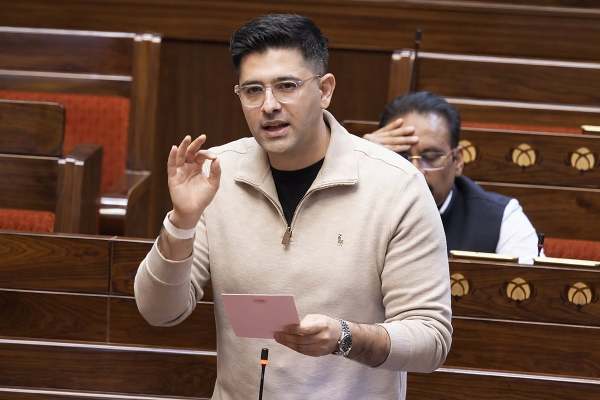
AAP MP Raghav Chadha warned in the Rajya Sabha that India’s AI ambitions face a major bottleneck due to limited access to GPUs. He said the country’s current GPU pool of about 34,000 is too small to train advanced AI models, urging the government to outline targets, timelines and geopolitical strategies to secure critical computational resources.
Aam Aadmi Party MP Raghav Chadha flagged the critical shortage of Graphics Processing Units (GPUs) as the primary bottleneck threatening India's artificial intelligence (AI) ambitions, urging the government to outline specific targets and geopolitical strategies to secure computational resources.
India's GPU pool 'very small' compared to global requirements
Speaking in the Rajya Sabha, Chadha stressed that the primary constraint facing India's AI development is not funding, capital, or talent, but the availability of computational resources, particularly GPUs.
"Sir, the biggest constraint today in India's AI ambitions is not funding, is not capital, is not talent. It is computational resources, in particular GPUs," Chadha said during Question Hour. "The biggest bottleneck is the rising GPU cost and the global GPU supply chain issues."
The MP noted that India's current pool of GPUs stands at approximately 34,000, a figure he described as very small compared to the scale required globally for developing cutting-edge AI systems. "This potentially could choke India's data centre ambitions as well as our ambition of training advanced AI models," he warned.
Demands for government action
Through the Chair, Chadha sought specific details from the Minister of State for Science and Technology on the targets, timelines, and geopolitical engagements initiated by the government to ensure predictable and secure access to these vital computational resources.
"I would want the Honourable Minister for Science and Technology to specifically point out the targets, the timelines, and the geopolitical engagements that have been set in motion to secure predictable access of our computational resources, in particular the GPUs," he stated.
Why GPUs are critical for AI development
GPUs have become the backbone of AI development, particularly for training large language models and running complex machine learning algorithms. Training a top large language model can use tens of thousands of GPU chips, which may each require five to eight times the energy used by typical chips, significantly increasing AI energy consumption.
The single biggest driver behind the current shortage is the rapid expansion of AI infrastructure, with hyperscalers and enterprise customers deploying GPUs at an unprecedented scale to power AI training and inference workloads. A single AI data centre can require hundreds or even thousands of GPUs, consuming volumes that far exceed typical consumer or gaming demand.
Global GPU shortage intensifies
The global GPU shortage in 2026 is being shaped by structural demand shifts and supply pressures that go beyond gaming, with major manufacturers increasingly redirecting production capacity toward enterprise and AI-focused workloads where demand for high-bandwidth memory is both massive and long-term.
Reports suggest NVIDIA plans to reduce production capacity of its GeForce RTX 50 series graphics cards in 2026 to cope with memory shortages, with supply potentially reduced by 30-40 percent compared to the first half of 2025. In extreme cases, flagship models could reach prices as high as $5,000 later in 2026, according to industry reports.
India AI Impact Summit 2026
The answer to GPU shortages could well be revealed at the India AI Impact Summit scheduled to commence on February 16 in New Delhi. The government looks to release its AI governance guidlines at the summit, and make several other announcements as well.
This summit is touted to be 'one of the biggest AI summits in the global south'. Attendees include Chief AI officer of Meta Alexandr Wang, Chair of Gates Foundation Bill Gates, OpenAI CEO Sam Altman, Google CEO Sundar Pichai, President and Vice Chair of Microsoft Brad Smith, Anthropic CEO Dario Amodei, Nvidia CEO Jensen Huang, Accenture CEO Julie Swet, Qualcomm CEO Christiano Amon, Cloudflare CEO MAtthew Prince, RIL Chairman Mukesh Ambani, Infosys co-founder Nandan Nilekani, and many more.