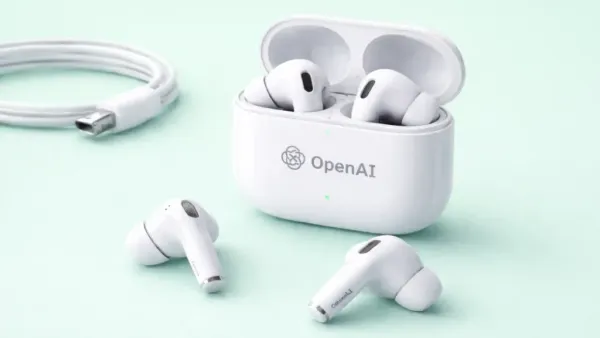
The first hardware product of OpenAI may look far more familiar than earlier reports suggested. Instead of a screenless AI companion or a wearable pin, the company may debut with AI-powered earbuds.
According to a Chinese tipster on Weibo, OpenAI is preparing to launch a pair of earbuds that run on the company’s own AI models. The product could be called “Dime.” If true, this would mark OpenAI’s first direct move into consumer hardware.
So far, OpenAI has not confirmed the report. Still, the claim fits with recent shifts in the company’s hardware strategy.
In earlier discussions, OpenAI appeared interested in unusual device formats. Reports pointed to a small pendant, a pin, or even a pen-like object. OpenAI CEO Sam Altman described these ideas as calmer and less intrusive than smartphones.
These plans gained traction after OpenAI began working with Jony Ive, Apple’s former design chief, and his firm LoveFrom around 2024. The aim was to design “AI-first” devices that reduce screen use and feel natural in daily life.
In May 2025, OpenAI acquired Ive’s startup, IO, in a $6.5 billion stock deal. The move brought IO’s team into OpenAI, while LoveFrom stayed independent. At the time, the deal fueled expectations that OpenAI would launch a bold new kind of consumer device.
The latest leak suggests a more cautious start. Instead of introducing a new form factor, OpenAI may be choosing a simpler and proven category.
Hardware is expensive. Custom designs, new components, and unclear demand raise risk. Earbuds avoid many of these problems.
The earbuds market already has strong demand, established supply chains, and clear user habits. Consumers understand how earbuds fit into daily life. That lowers the barrier for a first product.
Rising hardware costs are also said to have influenced OpenAI’s shift. By entering a mature category, the company can focus on software and AI features rather than manufacturing challenges.
This approach mirrors how many tech firms enter hardware. They start with a known product type, then expand once the platform proves itself.
Details about the earbuds remain limited. The Weibo tipster claims the device will run on OpenAI’s own AI model and may be branded as “Dime.” The launch could happen before the end of the year.
The report also notes that OpenAI plans a more advanced version later. That depends on improvements in the supply of high-bandwidth memory, or HBM. HBM plays a key role in AI workloads, especially for on-device processing.
Because of current shortages, the first version of the earbuds may rely more on cloud-based AI. Future models could handle more tasks locally, reducing latency and improving privacy.
If accurate, this suggests OpenAI sees hardware as a long-term effort rather than a one-off product.
AI-powered earbuds would give OpenAI a clear and focused way to enter consumer electronics. The company would not need to compete on audio quality alone. Its strength would lie in AI.
Deep integration with OpenAI’s models could turn earbuds into constant AI companions. Users might interact through voice for tasks such as reminders, summaries, or quick answers, without pulling out a phone.
This would align with OpenAI’s broader goal of making AI more present but less distracting.
For now, the report rests on a single source, and OpenAI has made no official announcement. Still, if the earbuds launch later this year, it would mark a clear shift. OpenAI would be moving from software platforms to physical products, starting with a device people already use every day.
Whether “Dime” becomes real or not, the leak suggests one thing. OpenAI’s first step into hardware may be cautious, practical, and focused on putting AI closer to the user, not on reinventing the device itself.