The Central Government has issued a new guideline on the country's national song Vande Mataram.
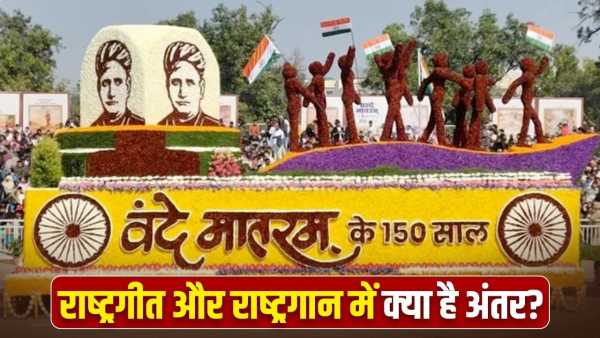
The national song Vande Mataram remains in the news continuously. Last year on December 8, the national anthem completed 150 years. Then there was a debate on Vande Mataram in Parliament. A tableau with the theme of Vande Mataram was taken out in the Republic Parade. And now the central government has issued new guidelines on the national anthem of the country. During this period, standing will be mandatory and its duration will be 3 minutes 10 seconds.
According to the guidelines, all 6 paras of the national anthem will be sung. Till now only the first two antras were sung. This is the first time that a protocol has been issued in the country regarding the manner of singing the national anthem. Vande Mataram was given the status of national anthem by the Constituent Assembly on January 24, 1950. This song, written by Bankim Chandra Chatterjee during the freedom struggle, became the mantra of the revolutionaries against the British rule, which united the people.
Controversies were also associated with Vande Mataram. It was composed by Bankim Chandra Chatterjee in the year 1870 and published in 1882. Gurudev Rabindranath Tagore sang it for the first time in the year 1896. Opposition to it started during that period. The reason for the protest was its words in which Hindu goddesses were mentioned. The protesting Muslim leaders said that the song mentioned a goddess. Worship of Goddess is related to idol worship and it is against Islam. In the song the country has been described as Goddess Durga. She has been called Ripudalvarini i.e. the destroyer of enemies.
A committee was formed to resolve this dispute. The committee heard everyone's views and came to the conclusion that the first two verses of this song are in praise of the motherland and later the Hindu goddess is mentioned. Therefore, only the first two stanzas of this song should be sung.
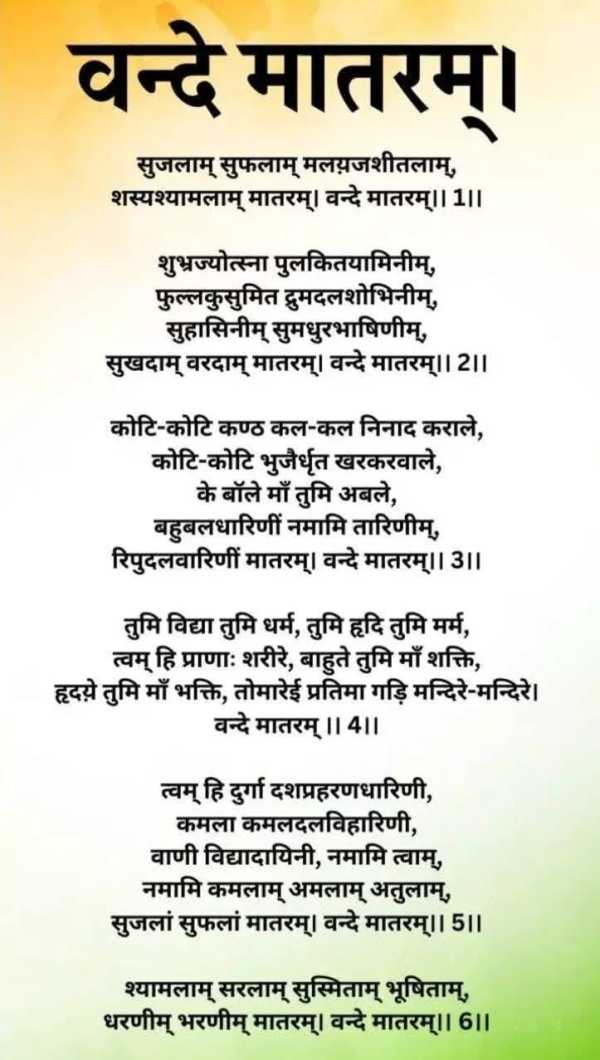
Vande Mataram full version.
Vande Mataram was longer. The tune and rhythm of the song was considered a bit difficult to sing in military bands and on occasions like state functions. At the same time, Jana Gana Mana was simple, balanced and formal in tune compared to Vande Mataram. Pandit Nehru's views were not in favor of making Vande Mataram the national anthem.
In a note sent to the Cabinet on May 21, 1948, Pandit Nehru believed that it was more appropriate to adopt Jana Gana Mana as the national anthem than Vande Mataram. What he wrote is as follows - The national anthem is certainly a form of words, but more than that it is a tune or musical composition. It is often played by orchestras and bands and rarely sung. Therefore the music of the national anthem is the most important factor. It should be lively and dignified and can be played effectively by large and small orchestras, military bands and pipes. It should be played not only in India but also abroad. It should be something that is widely appreciated in both these places.
Jana Gana Mana… appears to meet these criteria. Vande Mataram, for all its beauty and history, is not an easy tune to play by an orchestra or band. It does not have those special features which are in the public mind. It more truthfully reflects our times of struggle than the fulfillment of our aspirations in the future.
National song is a patriotic song which is adopted by the government of a country to sing on public or state occasions. At the same time, the national anthem is a musical composition, which defines the history, traditions and struggles of a country. It is recognized and adopted either by the government of the country or by the public through traditional usage. There is also a difference in the protocols of both.