He saw her absence from her husband’s family on New Year’s Eve as “causing chaos.”
For 10 years, as the wife of the eldest son of a family in Bac Ninh, a province neighboring Hanoi, the 33-year-old had followed an unbreakable routine: From the 28th day of the 12th lunar month – two days before the new year, until noon on the second day of the new year, she was firmly “assigned” to her husband’s family.
But last month her father, who lives in Nam Dinh, suffered a severe stroke and was left bedridden, with only his elderly wife to care for him. Thao wanted to break her in-laws’ unwritten rule and return to Nam Dinh.
When she raised the idea of spending the Lunar New Year holiday with her own family, her father-in-law immediately rejected it, insisting that she “had to be at [her husband’s] home before New Year’s Eve to tend the ancestral altar.” Despite her explanations and pleas for a one-year exception because of her father’s condition, he refused to budge.
Thao pushed back, saying: “I asked for permission out of respect, but in reality I was just informing you.” The remark instantly chilled the atmosphere. Her father-in-law lashed out, accusing his daughter-in-law of “stirring up trouble” and criticizing his son for “failing to teach his wife.”
Thao’s experience reflects a broader tension simmering in many Vietnamese households over whether married women should spend the Lunar New Year holidays with their husband’s family or their own.
|
A family making banh chung, Vietnamese traditional square sticky rice cakes filled with pork and mung beans and wrapped in green leaves, for the Lunar New Year. Photo by Read/Phan Duong |
According to Dr. Bui Xuan Dinh, an ethnology researcher, disputes over married women spending the Lunar New Year holiday with their own families have surged over the past decade, particularly in urban areas. This is not a fleeting change in attitudes, but a reflection of deeper societal shifts, he says.
“In an agrarian society, the belief that ‘a boat follows its helmsman, a woman follows her husband’ made it natural that married women were responsible for Lunar New Year holiday duties at their in-laws’ home,” he says. “But that structure is breaking down.”
Modern women are more financially independent and occupy social positions comparable to men. As economic power becomes more balanced, demands for equal responsibility in caring for one’s own parents have grown naturally.
At the same time society is moving from merely “fulfilling duties for the New Year” to “enjoying the New Year holidays,” the expert points out. As personal freedom and emotional well-being gain importance, the burden of elaborate holiday feasts traditionally shouldered by women is no longer enough to bind them to the kitchen in their in-laws’ homes, he says.
“The ‘uprising’ of spending the New Year with the wife’s family is the result of these changes,” Dinh says.
Dr. Ngo Thi Phuong Lan, president of the University of Social Sciences and Humanities under the Vietnam National University Ho Chi Minh City, shares that view.
“The measure of happiness has changed, and equality is no longer a slogan, it is a real need,” she says. “When both sides of the family support the nuclear family equally, the right to share the New Year atmosphere must also be balanced.”
She says the shift is irreversible.
Now both the husband and wife’s families play comparable roles in supporting young families – financially, professionally and in caring for the next generation – and so the right to enjoy the Lunar New Year for the two sides should return to a more “humane” balance, she says.
Beyond pressure from in-laws, obstacles sometimes come from women’s own ingrained sense of endurance.
Chu Thanh, 48, of Hanoi says though her parents-in-law encourage her to visit her parents, she still only “stops by briefly.”
“A married daughter belongs to her husband’s family,” she says. “At my parents’ home, I feel like a guest. Sitting around feels awkward, but helping out doesn’t feel natural either.”
She admits that the mindset of “serving one’s husband after marriage” is deeply ingrained.
Even Thao’s own mother, after hearing her daughter complain about the difficulty of returning home for the Lunar New Year, advised her to “fulfill her duties there and avoid being judged.” Such advice reinforces a culture of stoicism, leading women to believe that forbearance and sacrifice are unspoken rules.
Psychologist Hoang Hai Van notes that gender inequality and patriarchy are sometimes sustained by this very compromise.
“When women define themselves as ‘guests’ in their parents’ homes, they give up their right to equality even before anyone else takes it away,” she says.
|
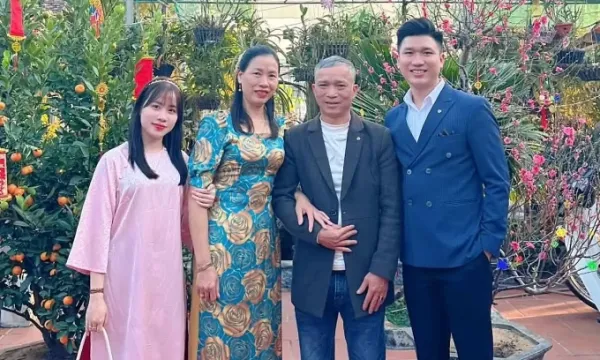
Lam Thao Ly (L), 27, with her husband (R) and parents-in-law in Thanh Hoa Province on the third day of this Lunar New Year in January 2025. Photo courtesy of Ly |
To address the issue, psychologist Hong Huong of the Vietnam Association for the Protection of Children’s Rights suggests that couples should keep one principle in mind: “Warmth matters more than winning.” Family relationships are not courtrooms but spaces that require empathy, she says.
“The true measure of a family is togetherness and happiness.”
Dr. Lan echoes that sentiment, emphasizing that the start of a new year should be a time to nurture harmony.
“Don’t let the question of where to spend the New Year become a trigger for family conflict,” she says. “Couples need to prioritize empathy and shared responsibility so the balance between both families can be maintained.”
Lam Thao Ly, 27, considers herself fortunate that in three years of marriage she has never struggled with the New Year question.
Despite the more than 300-kilometer distance between her husband’s hometown in Thanh Hoa Province and her own in Phu Tho Province, her in-laws have consistently suggested taking turns hosting Ly during the Lunar New Year holiday, she says. Last year her in-laws even urged her to leave for her parents’ home as early as the 25th day of the 12th lunar month.
Dinh notes that there is no one-size-fits-all solution. For married men caring for elderly parents, the ancestral duties for them and their wives can be difficult to avoid. But for young couples whose parents are still healthy, alternating years or reasonably dividing the holiday schedule is a more civilized option, he says.
“To keep the Lunar New Year from becoming a battleground, the key lies in the older generation’s generosity and the husband’s willingness to share responsibility.”