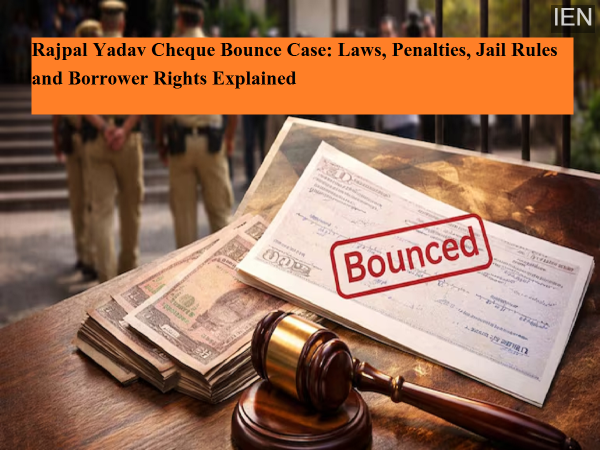
The recent conviction of Bollywood actor Rajpal Yadav in a cheque bounce case has brought renewed attention to India’s financial and legal rules surrounding unpaid debts, dishonoured cheques, and borrower liability. The case stems from a financial dispute related to the film Ata Pata Lapata, for which a company had reportedly provided funding years ago. When repayment cheques issued in settlement were returned unpaid, legal proceedings followed, eventually resulting in a six-month jail sentence pronounced earlier by a Delhi trial court.
While such cases often make headlines when public figures are involved, legal experts emphasize that cheque bounce disputes are common across India and frequently reach courts. Understanding how the law treats these situations is essential for both borrowers and lenders.
Legal Framework: Negotiable Instruments Act, 1881Cheque bounce cases in India are governed primarily by the Negotiable Instruments Act, 1881, especially Sections 138 to 143A. These provisions clearly define when dishonour of a cheque becomes a criminal offence, how complaints can be filed, and what penalties may apply.
Under Section 138, a cheque bounce becomes punishable if it was issued to repay a debt or legal liability and is returned by the bank due to insufficient funds or because it exceeds the account’s permitted limit.
However, certain legal conditions must be satisfied before criminal liability arises.
Conditions That Make Cheque Bounce a Criminal OffenceA dishonoured cheque does not automatically lead to punishment. The law requires the following steps:
The cheque must be presented within its validity period (generally within six months or as specified on the cheque).
The payee must send a written demand notice within 30 days of receiving the bank’s dishonour memo.
The issuer must fail to make payment within 15 days of receiving that notice.
Only if all these conditions are met can a criminal complaint be filed. If guilt is proven, punishment may include up to two years’ imprisonment, a fine up to double the cheque amount, or both.
Is Loan Default Punishable by Jail?Simply failing to repay a loan does not automatically result in imprisonment. In most situations, loan default is treated as a civil matter, not a criminal offence. Banks and financial institutions typically pursue recovery through legal notices, civil suits, asset seizure, or negotiated settlements.
Jail may become a possibility only if there is evidence of criminal intent—such as fraud, forged documents, deliberate non-repayment schemes, or issuing cheques that later bounce. In such cases, criminal charges can be added alongside civil recovery proceedings.
Why the Law Favors the PayeeIndian cheque bounce law presumes that a cheque was issued to settle a valid debt unless proven otherwise by the issuer. This shifts the burden of proof onto the person who issued the cheque.
Key legal principles include:
A bank return memo serves as primary evidence of dishonour.
Claiming ignorance about insufficient balance is not a valid defense under Section 140.
The issuer must prove that the cheque was not issued toward a legitimate liability.
These provisions are designed to maintain trust in cheque-based transactions, which remain widely used despite the growth of digital payments.
Liability When a Company Issues a ChequeIf a cheque issued on behalf of a company bounces, responsibility may extend beyond the organization itself. Individuals responsible for managing the company’s affairs at the time—such as directors or partners—can also be held liable.
An individual can avoid punishment only if they prove the offence occurred without their knowledge or despite due diligence. The law defines “company” broadly to include firms and associations, while “director” may also include partners in a partnership firm. Government-nominated directors of public sector companies, however, are generally exempt.
Complaint Filing and Trial ProcessA cheque bounce complaint must usually be filed within one month after the 15-day payment window expires. Courts may condone delays if justified. Such cases are heard only by a Metropolitan Magistrate or Judicial Magistrate First Class.
To ensure consistency, if multiple cases are filed against the same individual, they may be consolidated and heard in a single court. Trials are intended to be conducted through a fast-track process, ideally concluding within six months, though complex cases can take longer.
Interim Compensation ProvisionUnder Section 143A, courts may order the accused to pay up to 20% of the cheque amount as interim compensation during trial. This must usually be paid within 60 days, extendable by 30 days for valid reasons.
If the accused is later acquitted, the complainant must return this amount with interest calculated at the Reserve Bank of India’s bank rate.
Does Jail Cancel Debt Liability?Importantly, imprisonment does not eliminate the underlying financial obligation. Even if a person is jailed in a cheque bounce or loan-related criminal case, the original debt still exists. The lender can continue civil recovery actions until the outstanding amount, penalties, or settlement terms are satisfied.
Key TakeawayThe Rajpal Yadav case highlights how seriously Indian law treats cheque dishonour tied to financial liabilities. While loan default alone is usually a civil issue, issuing a cheque that bounces after due legal process can lead to criminal prosecution, fines, or imprisonment. For individuals and businesses alike, maintaining adequate account balances, understanding legal timelines, and responding promptly to notices are essential steps to avoid legal trouble and financial penalties.