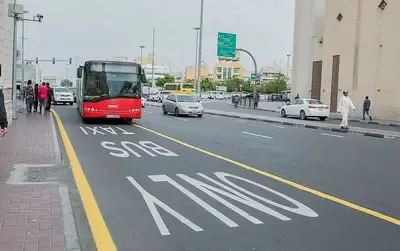
Dubai’s Roads and Transport Authority (RTA) will expand dedicated lanes for buses and taxis across the emirate over the next two years and is studying a new trackless tram system at eight locations, a top official confirmed Sunday.
Mattar Al Tayer, Director General and Chairman of the Board of Executive Directors of the RTA, said the authority will implement six new corridors extending 13km during 2025 and 2026, raising the total length of dedicated bus and taxi lanes to 20km.
“These lanes will contribute to a 10 per cent increase in ridership, improve bus on-time performance by 42 per cent, and reduce bus journey times by 41 per cent,” he said.
The new 13km lanes will run across six key roads: Sheikh Sabah Al Ahmad Al Jaber Al Sabah Street, 2nd of December Street, Al Satwa, Al Nahda, Omar bin Al Khattab Street and Naif Street. The lanes are marked with a distinctive colour to prevent private vehicles from mistakenly using them. Motorists caught driving in the dedicated lanes face a Dh600 fine.
Stay up to date with the latest news. Follow KT on WhatsApp Channels.
Trackless tramAl Tayer added that the RTA is also examining the introduction of a trackless tram project across eight locations in Dubai.
“This advanced, autonomous and environmentally friendly system operates on electric power and uses a virtual track guided by camera-based detection of painted road markings. It offers lower costs and shorter implementation timelines compared with conventional tram systems,” he said.
Unlike traditional trams — including the existing Dubai Tram — the trackless system does not require fixed rails, allowing it to move through city streets using smart navigation technologies. Like buses, it will operate on fixed routes with designated pick-up and drop-off stations.
Each trackless tram will consist of three carriages with a capacity of 300 passengers, which is more than three times that of a regular bus. The trams will run at a top speed of 70km/h, with operational speeds ranging between 25 and 60km/h.
Easing trafficThe measures are part of efforts to ease congestion as Dubai has seen a sharp rise in vehicle numbers — 10 per cent over two years, compared to the global average of 2 to 4 per cent. Authorities have identified traffic growth as a key challenge and are rolling out a range of solutions including new road projects, dynamic toll and parking tariffs, heavy vehicle restrictions, and encouraging flexible and remote working policies. The RTA has previously said flexible work initiatives could reduce traffic by up to 30 per cent based on case studies.
Al Tayer revealed the expansion plans as he announced public transport usage figures for 2025. With average daily ridership hitting 2.2 million, Dubai saw 802 million users of public transport, shared mobility and taxis in 2025.
“RTA continues to advance an intelligent, sustainable and integrated public transport system by expanding metro, tram and bus networks, enhancing the efficiency of marine transport, and supporting shared mobility solutions. We are also deploying artificial intelligence technologies in data management and in designing the customer journey, in line with Dubai’s future aspirations as a leading global city and reinforcing its position among the world’s best cities to live, work and visit,” Al Tayer said.
Dubai’s new transport systems could replace short car journeys in busy areas New highway, trains, metro: How UAE daily commutes will change for residents