February 17, 2026 Solar Eclipse: A solar eclipse is a significant astronomical phenomenon that occurs when the Sun, Moon, and Earth align, resulting in the Moon obscuring the Sun either partially or fully. This event is believed to influence not only global conditions but also individual experiences, often heightening mental stress and negative energies. As we approach the solar eclipse on February 17, 2026, many are curious about its visibility in India, its timing, and its implications.
The solar eclipse will take place on February 17, 2026, coinciding with the Phalguna Amavasya in the Hindu calendar. The event is set to commence at 5:26 PM and conclude at 7:57 PM. Unfortunately, this first solar eclipse of the year will not be observable from India.
According to astrologers, the Shukraditya Rajyoga will enhance the fortunes of certain zodiac signs, potentially leading to significant changes in their lives.
Astrological beliefs suggest that the Sutak period, which lasts for 12 hours prior to the eclipse, should be observed. During this time, it is advised to refrain from starting new ventures, performing religious ceremonies, or traveling. Wearing new attire is also discouraged. However, since this solar eclipse will not have an impact in India, the Sutak period will not be applicable here.
While the solar eclipse will not be visible in India, it can be observed in various locations including Argentina, Botswana, the British Indian Ocean Territory, Chile, Comoros, Eswatini, the French Southern Territories, Lesotho, Madagascar, Malawi, Mauritius, Mayotte, Mozambique, Namibia, the Réunion Islands, South Africa, South Georgia/Sandwich Islands, Tanzania, Zambia, and Zimbabwe, as well as Antarctica.
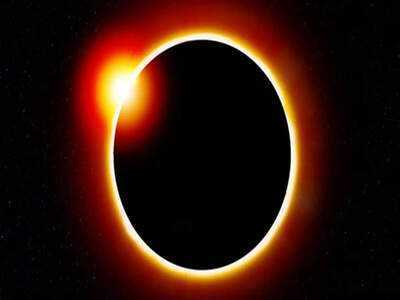
Experts indicate that the eclipse on February 17, 2026, will be an annular solar eclipse, often referred to as the Ring of Fire. This phenomenon occurs when the Moon does not completely cover the Sun, allowing the Sun's outer edges to appear like a glowing ring.
PC Social Media