There’s a strange dissonance when one talks about India and AI. This month, the Indian IT services industry was hit by the so-called “SaaSpocalypse”, and the brute power of AI became evident to anyone who had any doubts about it. Tech companies across the globe felt the heat, tumbling on their respective exchanges, and Indian tech giants were no exception.
As the dust engulfing the bearish sentiment began to settle, India’s capital, New Delhi, has become home to holographic displays, mega exhibitions and high-level discussions on the future of AI, regulations, and infrastructure problems at its core.
Hundreds of billions of dollars have been committed for the AI vision that’s central to the India AI Impact Summit, which kicked off Monday (February 16, 2026). While the India AI Impact Summit is undoubtedly commendable for its scale and its ability to attract the biggest names in the world, the first day of the summit was plagued with issues related to access and security.
Some founders even bemoaned the loss of belongings and their proprietary hardware due to the on-ground confusion and mismanagement between various security officials.
While this has tainted some of the celebratory atmosphere around the summit, we remained focussed on graver issues surrounding AI and its clout in the country.
For one, does India have the right priorities when it comes to AI? And do we really want to lead the AI race, or just rent intelligence from those who already do?
“To align with the vision of Viksit Bharat@2047, the sector needs to achieve $750–850 Bn in annual revenue by 2035 to sustain a 7–8% share of GDP, and expand its global market share beyond 25%. However, current trajectories indicate a $250–300 Bn shortfall, underscoring the need for decisive action,” declares Niti Aayog in its “India’s Technology Services – Reimagination Ahead,” report, published ahead of the India AI Impact Summit.
The report says India’s objective should be to maintain the share of GDP for IT services at 7-8% as per current numbers, which makes for odd reading considering that India should be gunning for a higher share of GDP for the IT sector in the future. After all, these are the areas that need to be enabled to make the most of the AI revolution.
Isn’t the government perhaps being a bit conservative by presenting the narrative of maintaining the GDP share?
The government’s long-term vision for AI in 2035 and 2047 is also at odds with the fact that disruption from AI is happening in the present day. Is it right to set benchmarks for a decade from now, when AI disruption happens in a matter of days and weeks nowadays? Plus, there are hardly any defined accomplishment milestones.
The impact of AI is being seen now and is not something that will come in due time. There’s no stronger evidence of this than the SaaSpocalypse sparked by Anthropic’s latest AI suite and the wipe-out of $285 Bn in market cap for Indian legacy IT giants like TCS, Infosys and Wipro.
And we are yet to see the ramifications of the AI advancement on the quarterly earnings of these companies. More trouble is likely in store for the IT giants because of an existential realisation, which is that the business model built around manhours and human-written code is collapsing in real time.
Setting The Right HorizonsLet’s not get this wrong. The India AI Impact Summit is definitely a watershed moment for the Indian tech industry. When CEOs of the biggest AI companies in the world take their time to see the India vision, it’s no small feat. And credit is due to those in power for bringing this ecosystem together.
What we are asking is whether this will result in timely action and the impact promised in its name before it’s too late.
The question of timing is not just idle criticism. India’s AI startup ecosystem is in front of an open window of opportunity right now.
As highlighted prominently in Inc42’s Bharat AI Startups Report, published in association with Google, the highest leverage window for AI companies in India is between 2026 and 2027.
Multiple forces that usually arrive in different cycles are converging right now: enterprise demand is moving from pilots to production, consumer adoption is already at scale, public compute and data rails are lowering the cost of experimentation, and regulatory clarity is beginning to replace uncertainty.
In other words, the ecosystem has reached a point where AI stops being an experiment and starts becoming infrastructure. This theme is also evident in most panel discussions and private conversations at the India AI Impact Summit — India has to transition from merely using AI to building it.
But this kind of talk ignores the huge hurdles in the way. As of now, India cannot become a creator of IP and infrastructure overnight. It is also not in a position to dictate the terms for sovereign AI just yet, the way it wanted to last year.
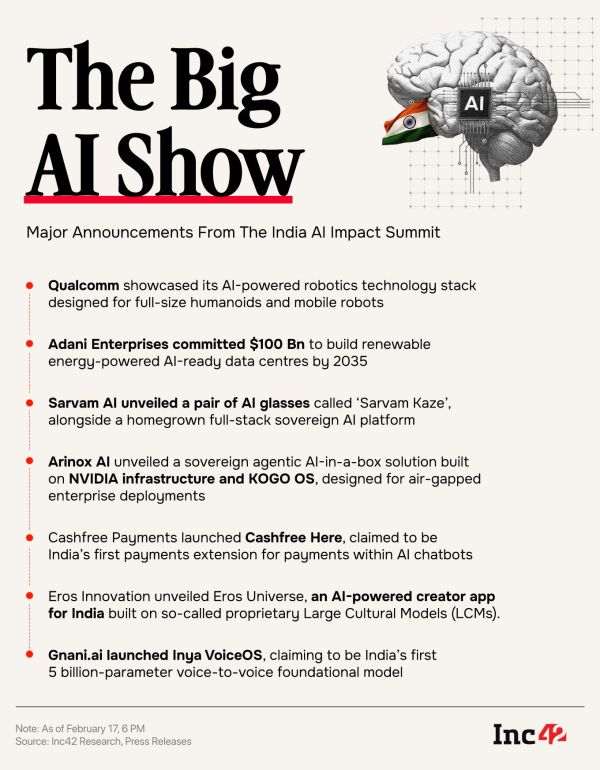
Speaking at the summit, IT minister Ashwini Vaishnaw said India is set to attract more than $200 Bn in investments towards AI over the next two years.
But, how much of this will result in India moving from a user to a creator?
A large part of this investment is expected for data centres and compute capacity. Will this actually lead to Indian companies replicating the massive value that the likes of Nvidia, OpenAI and Anthropic have managed to generate in the past two years? Or will these AI giants continue to see most of the value as is the case today?
These are some questions that might dent the bullishness around India’s AI ambitions, but they are tempered by major announcements like the $1.2 Bn fundraise for AI infra startup Neysa, the commitments for investment from the likes of Adani Enterprises and Reliance Jio in recent weeks.
The onus is on Indian companies to ensure that the value in AI is retained within India.
In this context, the recent tax holiday for global data centres announced at the Union Budget 2026 is also contentious. This could skew the market in favour of global companies that already have the scale advantage.
This begs the question: Is the summit about action or just positioning India as a hub and a destination for global AI giants?
Spectacle Vs SubstanceMany have rightly pointed out that India missed the bus on building foundational LLMs. We are renting intelligence from American servers. However, the obsession with the application layer comes with a reputational risk that Indian founders are motivated towards plucking low-hanging fruit.
On the contrary, Inc42’s report suggests a strategic pivot among Indian startups towards the application layer will unlock plenty of value. Even sub-1% market share outcomes are now venture-scale, turning execution depth and deployment speed into the real differentiators.
India did not invent the smartphone or smartphone OS, but it dominates the app economy today. Similarly, we may not have built the LLMs or massive chatbots, but the startup ecosystem is in an AI application frenzy today.
Startups have realised that the short-term opportunity, which is between 2026 and 2027, lies not in outspending or upending OpenAI or Anthropic or Google, but in using their APIs to solve problems unique to India — from regional language-based voice bots in rural banking to AI-driven diagnostics.
But this mindset shift is equally critical for the foundational and infrastructure layers as it is for the app economy. The former is where the real value will come from beyond the short term.
A spectacle like the India AI Impact Summit might serve to bring more users of AI, but will it actually spur the creation of AI models and IP in equal measure? Many have pointed out that the $1.2 Bn IndiaAI Mission is a drop in the ocean for building foundational models, but it could be transformative if redirected entirely towards subsidising compute costs for high-growth startups.
One could say that we are witnessing the destruction of value in legacy IT businesses, since it’s moving from humans maintaining legacy code to creating new AI-native and AI-created products. The India AI Impact Summit must address this not by protecting the old guard or the IT services alone, but by aggressively funding the transition of talent into this new, high-growth AI-native ecosystem.
High growth here means companies that operate on weekly sprints and aggressive release cycles, as evidenced by Sarvam AI. A five or ten-year plan as is typical of government endeavours is ill-suited for this opportunity.
This is why the India AI Impact Summit stands as a contradiction; the industry and government’s timelines run parallel to each other and may not ever converge in the long run.
On the one hand, the event offers a spectacle, some might even say a comfortable illusion. One that says India has a vision for AI and wants everyone to take notice of the direction and the people behind it, but the reality requires a lot more than five days of venerating global and Indian AI companies and policymakers.
It might be too late to weather-proof IT services empires, but the groundwork and momentum is needed to create the next Indian AI giants who will carry forward the legacy of India’s existing tech and startup ecosystem, just like startups have been capitalising on the IT wave over the past 12 years.
Come February 20, when the India AI Impact Summit concludes, the real proof of success will be if we are even one step closer to passing this baton. Because that will be the real impact of this summit.
Top Stories From Around The WorldAnthropic faced an unexpected moment last week. Mrinank Sharma, a member of technical staff at the AI giant, announced that he resigned from the company, sharing a deeply reflective letter explaining his decision to leave.
In his letter, Sharma wrote that while he was proud of his work on AI safety, sycophancy in LLMs and internal transparency, he increasingly felt the tension between values and action.
He described a world ‘in peril’, not only from AI but from interconnected crises, and suggested that wisdom must grow alongside capability. His parting note hinted at deeper concerns about how AI assistants could distort human judgment or make us ‘less human’.
The timing amplified the moment. Days earlier, research led by Sharma, analysing 1.5 Mn Claude conversations, highlighted ‘disempowerment patterns’ in AI interactions. While rare overall, these patterns appeared more frequently in sensitive contexts like relationships and mental health. Strikingly, higher-risk interactions often received higher user approval, suggesting short-term satisfaction may conflict with long-term empowerment.
Online reactions quickly broadened the discussion. Reddit threads framed the resignation as a potential fault line between Anthropic’s safety-first brand and its expanding commercial ambitions, including defence-linked partnerships. Some saw it as a principled stand, while others questioned whether leaving reduces internal guardrails.
Sharma’s tone, however, was less combative than contemplative. He spoke of integrity, poetry, climate anxiety and the need to create space for courageous speech.
In a week dominated by funding rounds and model launches, this stood out for a different reason. It wasn’t about what AI can do. It was about what it should do and who gets to decide.
Startup In The Spotlight: ArrowheadEnterprise call centres in financial services have long depended on large human teams trained to handle nuanced, high-stakes conversations. Sales calls, loan conversions, insurance renewals and debt collections require empathy, regulatory awareness and consistency. But high attrition, uneven performance and training overheads make this model difficult to scale. Most AI deployments so far have stopped at IVRs or scripted bots, leaving a clear gap for something more human-like.
Arrowhead solves this. Founded in 2022 by Devyani Gupta and Vengadanathan Srinivasan, the Bengaluru-based startup develops voice AI agents tailored for BFSI use cases, aiming to replicate the effectiveness of top-performing human callers at scale.
At the core of Arrowhead’s platform is a proprietary orchestration layer that enables natural, multi-minute conversations rather than short, transactional exchanges. The agents integrate directly with CRMs and backend systems, adhere to compliance requirements, and can manage complex workflows across sales, collections and renewals.
Arrowhead’s bots operate across Hindi, English, Tamil, Telugu, Malayalam, Kannada and Bengali, with the ability to switch languages mid-call to reduce customer drop-offs. The company claims measurable outcomes, including over 80% higher loan conversions, 15% improvement in debt recovery and a 145% increase in insurance conversion likelihood.
Targeting an enterprise conversational AI market projected at $1.85 Bn, Arrowhead reports 4X revenue growth in recent months and serves over 50 BFSI clients, including Bank of Baroda Cards, Aditya Birla Capital and Paytm.
As financial institutions rethink cost structures and customer engagement, Arrowhead is positioning voice AI not as a support layer, but as a scalable revenue engine.
Prompt Of The WeekWhat prompts and hacks are CTOs, CEOs and cofounders using these days to streamline their work?
Here’s Vishnu Subramanian, founder of Jarvislabs.ai, sharing a prompt on how he uses GenAI as an assistant to polish brainstorming skills on a particular topic:
“You are an expert interviewer helping me articulate my thinking on [topic].
Ask me one question at a time.
Start broad, then go deeper based on my answers. Challenge any vague claims — push me for specifics, examples, and data.
If I say something that sounds wrong, call it out.
After 8-10 questions, synthesise everything into a structured summary with key insights and any gaps I still need to fill.”
Editor’s Note: Some prompts may need to be adjusted by users for best results or may not work as intended for certain users.
The post India’s AI Decade Begins, But Mind The Gap appeared first on Inc42 Media.