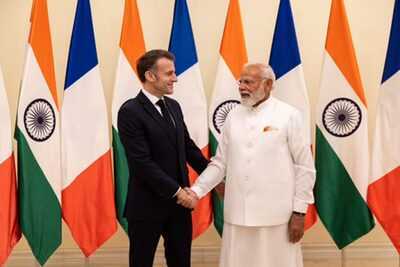
India’s recent hosting of French President Emmanuel Macron and Brazilian President Luiz Inácio Lula da Silva within the same week underscores New Delhi’s ambition to move beyond balancing powers toward actively designing new platforms for cooperation that reflect the interests of developing countries. By orchestrating consecutive visits from two leaders representing vastly different dimensions of global influence—France with advanced technology, defense capabilities, and a permanent UN Security Council seat, and Brazil with demographic weight, resource abundance, and political legitimacy in the Global South—India signals a deliberate effort to assert strategic leadership in an increasingly fragmented international order. These visits collectively reflect India’s calculated approach to international diplomacy, seeking to fuse economic, technological, and geopolitical priorities while maintaining strategic autonomy amid shifting global dynamics.
India-France Relations: From Horizon 2047 to a Special Global Strategic PartnershipIndia’s engagement with France has steadily evolved from transactional collaboration to a structural partnership, anchored by the Horizon 2047 roadmap established in 2023. Macron’s visit formalizes this evolution, elevating bilateral ties to a “Special Global Strategic Partnership” that will shape cooperation through India’s centenary of independence and fifty years of bilateral strategic alignment. This development signals not merely continuity in relations but a long-term strategic commitment to shared priorities across defense, technology, innovation, and multilateral coordination.
The institutionalization of an annual Foreign Ministers’ Comprehensive Dialogue provides a mechanism to track progress in areas such as economic security, people-to-people linkages, and multilateral coordination, reinforcing the durability of India-France relations. Concurrently, the launch of the 2026 India-France Year of Innovation fosters collaboration between universities, research laboratories, and start-ups, spanning areas from artificial intelligence and digital infrastructure to healthcare and sustainable development. Macron’s participation in the Working Group on Resilience, Innovation, and Efficiency at the India AI Impact Summit in New Delhi underscores the alignment of Indian and French priorities around responsible AI deployment, equitable access to technology, and the creation of frameworks that empower developing nations in global technological revolutions.
The technological partnership between India and France highlights New Delhi’s strategy of combining openness with digital sovereignty. The inauguration of the Indo-French Centre for AI in Health at AIIMS New Delhi marks a tangible milestone, targeting joint research for early detection of neurological disorders like Alzheimer’s and Parkinson’s through machine learning-enabled MRI analysis. Complementing this initiative, the establishment of a Franco-Indian Life Sciences Campus connects more than 22 institutions across both countries, fostering collaboration in biotechnology, life sciences research, and healthcare innovation. Additionally, partnerships between INRIA and India’s Department of Science and Technology, along with renewed MoUs between CNRS and Indian agencies, reinforce cooperative efforts in digital infrastructure, advanced materials, and artificial intelligence standards. These initiatives collectively strengthen India’s domestic capabilities while fostering mutually beneficial collaborations with French institutions.
Defense cooperation remains a cornerstone of the India-France strategic partnership. The intergovernmental agreement for 26 Rafale-Marine fighters for the Indian Navy, signed in August 2025 at an estimated value of Rs 64,000 crore, builds on the earlier induction of 36 Rafale jets into the Indian Air Force. Negotiations are underway for 114 Rafale aircraft under the MRFA program, including 90 in the F4 standard and an option for 24 in the F5 standard, with explicit emphasis on domestic manufacturing. Tata Advanced Systems has secured agreements to produce major Rafale fuselage sections in Hyderabad, delivering up to 24 fuselages annually in the latter half of the decade.
Industrial partnerships have expanded further, with Safran investing around €200 million in a LEAP engine maintenance, repair, and overhaul center in Hyderabad, operational by 2026 with a capacity of roughly 300 shop visits annually. Safran also commits over €40 million to a dedicated M88 engine MRO facility for Rafale powerplants, signaling India’s centrality in its global manufacturing strategy. The joint venture between Safran and BEL to produce HAMMER precision-guided weapons domestically reinforces India’s self-reliance in defense production, integrating capabilities across Rafale and Tejas platforms. These industrial footprints illustrate India’s dual strategy: leveraging international collaboration while building domestic capacity and technological sovereignty.
Economic and strategic cooperation also extends into critical minerals and energy security. A Joint Declaration of Intent on critical minerals between India and France aims to diversify, sustain, and strengthen supply chains in exploration, extraction, processing, and recycling. This reflects mutual concern over the concentration of mineral processing in select countries and potential vulnerabilities arising from geopolitical tensions. Such partnerships are central to securing India’s long-term access to critical resources, ensuring industrial competitiveness, and underpinning future economic and technological development.
Brazil-India Collaboration: Expanding Horizons Across Technology, Resources, and Geopolitical InfluenceIndia’s partnership with Brazil is rooted in a different historical context but is undergoing a similar transformation toward deeper, structured collaboration. Diplomatic ties formalized in 2006 have recently gained momentum, with Prime Minister Modi’s July 2025 visit marking a historic engagement—the first by an Indian Prime Minister in 57 years. Lula’s current visit, accompanied by 14 ministers and a substantial business delegation, highlights the political and commercial commitment to expanding bilateral ties, particularly in pharmaceuticals, renewable energy, critical minerals, aviation, and agricultural technologies.
Brazil’s participation in the India AI Impact Summit adds a Global South dimension to the AI discourse, complementing India’s engagement with France. Both countries share concerns about the concentration of AI capabilities in the Global North and the risk of global standards being disproportionately shaped by these nations. Collaborative initiatives centered on digital public infrastructure enable India and Brazil to offer an alternative model of open yet sovereign digital ecosystems to developing countries. These partnerships emphasize AI ethics, equitable access, and the potential of technology to support sustainable development while preserving national autonomy.
Defense collaboration with Brazil, though nascent, carries political and strategic significance. Both nations recognize opportunities for joint ventures in aerospace and other sectors, leveraging Brazil’s expertise and experience. Such partnerships allow India to cultivate strategic diversity in defense cooperation, reducing reliance on single-source alliances, and maintaining flexibility amid intensifying geopolitical competition between the United States and China. This diversified approach preserves India’s strategic autonomy while expanding its global influence.
Resource security remains a key driver of the India-Brazil partnership. Brazil’s mineral wealth and agricultural capacity provide opportunities for joint ventures across extraction, processing, and value-added manufacturing. By creating shared supply chains and processing facilities, both nations aim to secure critical inputs for energy transitions, industrial growth, and technological advancement. Parallel negotiations with France to amend bilateral tax agreements demonstrate India’s strategy of combining trade, fiscal certainty, and long-term investment incentives to strengthen economic security.
In addition, pharmaceutical companies in India and Brazil are exploring collaborations to expand access to affordable medicines, while energy firms seek partnerships in solar, biofuels, and green hydrogen projects. These commercial initiatives complement strategic goals, ensuring that diplomatic engagement translates into tangible industrial and societal benefits. The cumulative impact of these arrangements will manifest over the coming decade through expanded industrial footprints, technology transfers, and strengthened supply chain control.
The integration of defense, technology, and economic cooperation exemplifies India’s approach to multipolar engagement: deliberate, sector-specific, and strategically autonomous. India leverages France’s technological capabilities and defense infrastructure alongside Brazil’s resource endowment and global legitimacy to construct a multifaceted network of partnerships. These relationships collectively strengthen India’s position ahead of its BRICS presidency in 2026 and its ongoing campaign for a permanent seat on the UN Security Council. By framing partnerships around concrete industrial and technological deliverables, India ensures that diplomatic symbolism translates into operational outcomes.
Technology, digital sovereignty, and AI remain central to both bilateral relationships. The Indo-French AI Health Centre and the emerging Indo-Brazilian digital collaborations illustrate India’s intent to combine global expertise with domestic capability-building, ensuring that AI and other advanced technologies are both ethically deployed and aligned with national development priorities. These initiatives encompass health, life sciences, digital infrastructure, and public welfare applications, demonstrating the capacity of carefully orchestrated diplomacy to yield measurable outcomes in governance, technology, and industrial competitiveness.
The ongoing consolidation of India’s partnerships reflects a broader strategic vision: to assert leadership within the Global South while retaining flexibility in a world characterized by great-power competition, fragmented multilateralism, and rapidly evolving technology landscapes. By hosting consecutive visits from Macron and Lula, India signals both capability and ambition, demonstrating that it can convene diverse actors, integrate commercial and political interests, and establish platforms for collaborative action that extend beyond conventional power hierarchies.
In summary, India’s Macron-Lula engagement encapsulates a strategic recalibration that combines diplomacy, technology, defense, and economic security. The dual visits represent more than symbolic gestures; they reflect India’s deliberate effort to construct durable partnerships, secure strategic resources, and shape global norms and standards in alignment with the interests of emerging and developing countries. As these arrangements mature, the outcomes will be measurable in industrial capacities, AI deployments, supply chain resilience, and the integration of technological innovation with ethical governance.
Through these engagements, India positions itself as an architect of a new multipolar order, capable of connecting, convening, and steering global agendas in ways that reinforce strategic autonomy while fostering inclusive economic and technological progress. Modi’s orchestration of back-to-back visits from two very different global leaders signals the beginning of a proactive, design-oriented diplomacy that seeks to move beyond reactive balancing toward shaping the architecture of the international system in a way that reflects India’s priorities, competencies, and vision for the future of the Global South.
The post PM Modi’s strategic Macron-Lula engagement signals India’s ambition to shape global partnerships in a fragmenting multipolar world | Cliq Latest appeared first on CliQ INDIA.