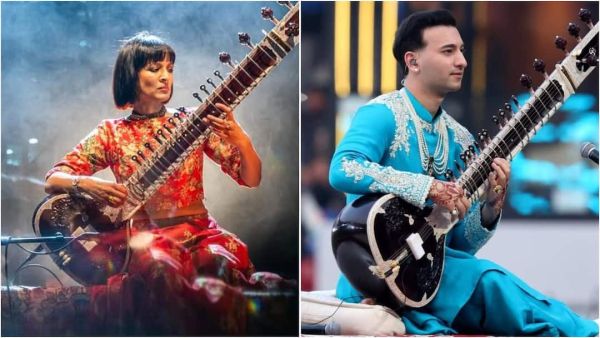
A quiet but significant debate has surfaced in the Indian classical music world. At its center are two respected names: Anoushka Shankar and sitarist Rishab Rikhiram Sharma, and a deeply personal question about lineage, mentorship, and legacy.
Recently, Anoushka Shankar publicly clarified that her late father, the legendary Pandit Ravi Shankar, was not Rishab’s guru. Now, Rishab has responded with a detailed statement and photographs, asserting that he was formally accepted as a disciple of the iconic maestro.
Rishab Rikhiram Sharma, a member of the renowned Rikhi Ram family of instrument makers, has built a strong global presence. He became the first sitarist to perform a solo set at the White House, a milestone that brought him widespread attention.
However, his long-standing claim of being Pandit Ravi Shankar’s youngest and last disciple recently came under scrutiny.
In an official statement issued by his team, Rishab outlined the sequence of events that, according to him, formally established their guru-shishya relationship.
The statement says that on January 3, 2012, a private meeting took place at the Ravi Shankar Centre (Saraswati Pooja Hall) at the express request of Pandit Ravi Shankar. Present at the meeting were 13-year-old Rishab, his parents Sanjay and Manjul Sharma, his brother Mukul Sharma, Pandit Parimal Sadaphal, Shruti Sadamal, and Pandit Ravi Shankar along with his wife, Sukanya Shankar.
According to the account, the meeting followed a personal phone call from Pandit Ravi Shankar to Sanjay Sharma a day earlier, requesting Rishab’s presence for a Ganda Bandhan ceremony, a traditional ritual that formally marks the acceptance of a disciple.
The statement further explains that Sukanya Shankar had previously shown Pandit Ravi Shankar a YouTube recording of Rishab performing Raag Tilak Kamod at a February 2011 event in New Delhi. After reviewing the performance again on the morning of January 3, 2012, Pandit Ravi Shankar reportedly decided to accept Rishab as a shishya and nurture his potential.
During that meeting, Pandit Ravi Shankar allegedly asked Rishab to perform the same raag, listened closely, demonstrated corrections, and conducted a lesson lasting several hours. The session culminated in the Ganda Bandhan ceremony, where the maestro tied a traditional red thread around Rishab’s wrist. He also spoke about Kartavya Vidya, emphasizing that while the physical thread may break, the spiritual bond between guru and disciple endures for life.
The statement adds that while Pandit Ravi Shankar noted he might not always be physically present, Pandit Parimal Sadaphal would oversee Rishab’s structured training, with periodic remote reviews conducted by the maestro.
Rishab’s team further stated that on February 10, 2012, during a Sanjay Rikhi Ram Vadya Parampara event at Delhi’s Kamani Auditorium, Pandit Ravi Shankar publicly introduced 13-year-old Rishab on stage as his youngest disciple. The event, attended by Sukanya Shankar, members of the Sharma family, fellow disciples, and the audience, marked Panditji’s final public appearance in India before relocating to the United States.
At the same event, Pandit Ravi Shankar formally launched the electric sitar "rikEsitar," conceived by Sanjay Sharma, and announced that Rishab would perform Raga Pancham Se Gara, a composition he had studied under his guidance.
Following the maestro’s passing in December 2012, the statement says Rishab was invited by Sukanya Shankar to perform at the memorial gathering held at Nehru Park on March 10, 2013, alongside other disciples from Pandit Ravi Shankar’s extended teaching lineage.
From 2013 onward, Pandit Parimal Sadaphal reportedly continued Rishab’s training in accordance with Pandit Ravi Shankar’s guidance, a mentorship that, according to the statement, continues to this day.
The controversy began after Anoushka Shankar addressed the subject during an interview with Humans of Bombay.
While praising Rishab’s talent, she clarified her position regarding his association with her father.
"Rishab is really talented and he is clearly speaking to people in a really wonderful way," she said. "I think there is some misunderstanding about his guruship. He learnt very intensively with someone very dear to me, one of my father’s senior disciples Parimal Sadaphal, and he had a couple of lessons with my father, very informally, with Parimal uncle also in the room."
She further explained that the families had known each other for years, as Rishab is the son of their instrument maker, Sanjay Rikhi Ram Sharma. According to her, this familiarity may have contributed to the perception that he was Pandit Ravi Shankar’s last or youngest disciple.
"Somehow that has gone blown up into some story of him being his last disciple or the youngest disciple, which isn’t true. But he is super talented and deserves all success with or without that story," she added.