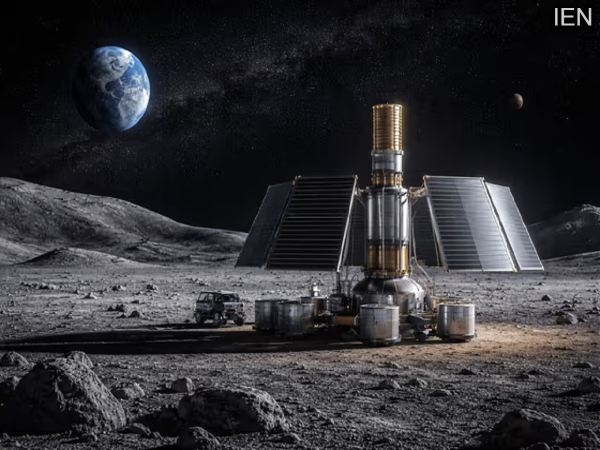
Nuclear Reactor on the Moon: The US wants to install a nuclear reactor on the Moon by 2030. Its two most important agencies, NASA and the Department of Energy, are putting all their efforts into this endeavor. But why is the US taking such a drastic step so soon?
Nuclear Reactor on the Moon: The space race is a race that began with the dawn of human history. Every civilization has envisioned a paradise beyond space. The Sun became the deity of day, and the Moon brought the light of night. The Sun is 149.6 million kilometers away from Earth. To date, humans (NASA's Parker Solar Probe) have only reached a maximum of 6.1 million kilometers from the Sun. You can understand why. Heat, the Sun's ever-hot nature, is a major factor. But humans have certainly set foot on the cold Moon. Now, the matter has gone far beyond just setting foot on the Moon. Some philosophically scientific-minded billionaires (like Elon Musk) have even begun talking about establishing colonies there. Well, that's a distant dream for now. Currently, plans are underway to install a nuclear reactor on the Moon. But why? Let's find out.
NASA and the US Department of Energy (DOE) have reaffirmed their joint project to develop a nuclear fission reactor on the lunar surface. This mission is a phase of the Artemis mission and future Mars missions. According to the space agency's announcement, both organizations hope to complete the development phase of this facility by 2030.
What will installing a nuclear reactor on the Moon achieve?
This reactor will be designed to provide continuous power for years for proposed lunar surface missions, eliminating the need for frequent refueling from Earth. Lunar bases, scientific experiments, communication systems, and life support facilities will be able to operate 24/7. NASA Administrator Jared Isaacman hopes this will develop the capabilities necessary to usher in a golden age of space exploration and discovery.
The US also wants to install a nuclear fission reactor on the Moon because it will serve as a launch pad for future space missions. Nuclear reactors have become a key requirement for reliable and consistent energy. NASA and the US DOE believe that solar energy is insufficient to sustain human and robotic presence on the Moon, given its long periods of darkness, extreme cold, and harsh environmental conditions.
The US also believes that maintaining a strategic advantage in space is essential, as countries like China and Russia are advancing nuclear technology on the Moon. A nuclear reactor on the Moon would not only strengthen US space leadership but also create a sustainable and powerful energy base for deep space missions, space commerce, and future exploration.