The UAE’s latest Islamic Treasury Sukuk auction drew exceptionally strong interest from investors, with the federal government’s debut seven‑year dirham‑denominated tranche attracting nearly six times its issuance value — an outcome that officials say underscores both market confidence and the growing depth of the country’s Islamic finance ecosystem.
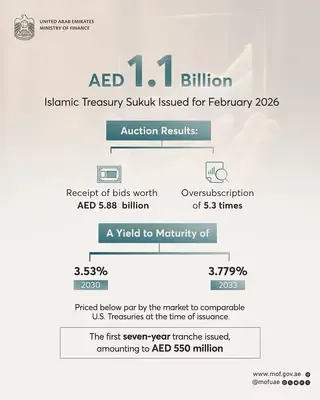
The Ministry of Finance (MoF) announced that the new Dh550 million, seven‑year tranche, maturing in February 2033, received bids totalling roughly Dh3.1 billion. It is the longest‑tenor sukuk issued under the UAE’s Islamic Treasury Sukuk (T‑Sukuk) programme to date, marking what the ministry describes as a strategic step toward extending and strengthening the domestic yield curve.
This seven‑year issuance formed part of a wider Dh1.1 billion sukuk sale for the month of February 2026, conducted in collaboration with the Central Bank of the UAE as issuing and payment agent. In total, both tranches — maturing in May 2030 and February 2033 — drew bids amounting to Dh5.88 billion, reflecting an overall oversubscription of 5.3 times across the auction.
Officials highlighted the competitive pricing achieved, noting that the seven‑year tranche cleared at a yield to maturity (YTM) of 3.779 per cent, while the 2030 tranche priced at 3.53 per cent. According to the ministry, the February 2033 tranche was priced below par relative to comparable US Treasuries at the time — an indication, they said, of the UAE’s favourable credit standing among regional and global investors.
The strong turnout from the government’s eight primary dealers signals broad investor confidence in the country’s economic resilience and the robustness of its Islamic finance framework. Market participants say the introduction of a longer‑dated sukuk is a meaningful development that provides institutional investors — ranging from banks to asset managers — with more options along the dirham yield curve.
The sukuk are listed on Nasdaq Dubai, a move aimed at enhancing secondary‑market accessibility and strengthening the UAE’s position as a regional hub for Islamic debt instruments. The T‑Sukuk program, introduced to support the development of the local debt capital market, is designed to provide secure, Sharia‑compliant investment avenues while helping the government diversify its funding base.
Authorities emphasised that the continued strengthening of the dirham‑denominated sukuk market contributes to long‑term economic sustainability, particularly as the UAE expands its fiscal tools in line with evolving economic priorities. With demand consistently outpacing issuance, analysts expect the government to continue deepening the program throughout 2026.