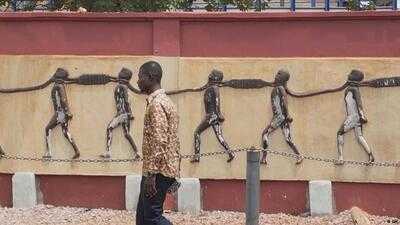
Ghana's President Mahama has received the African Union's backing in pushing the United Nations to recognize transatlantic slavery as the 'gravest crime against humanity.' But will the motion pass?Ghanaian President John Mahama wants to push the proposal, which is supported by 40 African Union (AU) members, at the United Nations in March. He says the initiative is "firmly grounded in international law" and, together with the endorsement of the African Union, Ghana will formally table the resolution before the UN General Assembly. The resolution is just the first step, Mahama said on the sidelines of the recently concluded AU summit in Addis Ababa, Ethiopia. With wide support amongst AU nations, Mahama says the "truth about the story of the transatlantic slave trade must be told" and recognized as the "gravest crime against humanity." The 'gravest crime' in human history There is broad historical consensus that the transatlantic slave trade between the 15th and 19th centuries, which involved the kidnapping, enslavement and transport of millions of Africans to the Americas and the Caribbean, was one of the biggest tragedies in human history. It's estimated that over 400 years, 15 million men, women and children were forcibly transported. Other sources say 12 to 12.8 million were enslaved. About 10.7 million arrived in the Americas alive, while between 1.5 and 2 million died during the crossing, also known as the Middle Passage. In Addis Ababa, Mahama said: "People jumped out of ships, who preferred to die. People who were too ill or sick and were thrown overboard to be eaten by sharks." Historical and legal validity Kojo Asante from the Ghana Center for Democratic Development (CDD-Ghana) told DW the crime "definitely" has "historical and legal validity." He says the transatlantic slave trade has significantly shaped affected nations to this day. African states have fought for recognition, or at least an apology, from former slave trading nations. For some governments, this has been a decades-long battle, Asante tells DW. In Ghana, the subject has long been on the agenda. Mahama is not the first president to champion this initiative, says Asante: Nana Akufo-Addo, his predecessor, also championed reparations. Next step: Demands for reparations? The AU declared 2025 "The year of reparations: Justice for Africans and people of African descent through reparations." The resolution sees reparations as future mechanism to assist development efforts. Mahama made it clear that it's about recognizing historical truth, rather than discussing monetary compensation. Financial questions would be discussed in future. Western resistance Asante says there is evidence of a resistance movement in ultra-conservative circles in the United States. Sources close to Donald Trump are said to argue against being held accountable for the actions of their ancestors regarding slavery. The transatlantic slave trade is a politically sensitive and debated question – especially in nations that benefitted economically from slavery and colonialism. Support for initiative among younger people Asante says that especially history oriented young people support the initiative, even if the topic remains somewhat abstract. At the same time, Asante warns against a strong fixation with the past. "I think people don't want to be too romantic about this because they want their leaders in Africa to still govern well," he tells DW. "What you do today with power, what you do today with your opportunities is also important. And there are many challenges, governance deficits in many African countries perpetrated not by colonial masters, by leaders on their own citizens," Asante says. A competition? Mahama's assertion that the slave trade is the "gravest crime against humanity" has drawn criticism. Some critics have asked if other historical crimes are being relativized. Asante pushes back. "This is not a competition. I think it's just more a question of acknowledging the transatlantic slave trade for what it was," he told DW. He adds the ongoing effects and incidences of racismshow how current the issue is. African responsibility Mahama said the truth about the transatlantic slave trade needed to be fully told. "The first step towards healing is truth," he said. It's often pointed out that some African elites benefited from the slave trade. Historians estimate a majority of people captured in Africa were enslaved by other Africans and then sold on to European slavers. Forms of slavery already existed in African societies well before the transatlantic slave trade. Yet while the transatlantic slave trade was not the only form of slavery, Asante says this trade had a disproportionately large economic, political and societal impacts along Africa's Atlantic coast. This article was originally published in German.