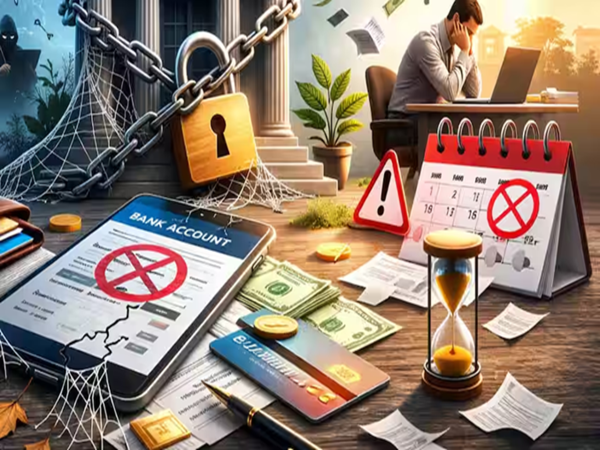
Millions of people in India have multiple bank accounts. Sometimes it's a salary account opened with a new job, sometimes an account opened because of an offer, or even a joint account opened years ago. Over time, we stop using it, but don't close it. This is where the real game of penalties and fees begins.
Money will be deducted if a minimum balance is not maintained.
Most savings accounts require banks to maintain a certain minimum balance. If the account doesn't have the required amount, the bank can deduct a penalty every month.
What happens gradually:
The balance decreases
Penalties keep accumulating
The account can even go into the negative zone
If you don't check your account for months or years, you may not realize that a mountain of penalties has accumulated in the account.
The hassle of becoming inactive and dormant
If there are no transactions for 12 consecutive months, the account can become inactive. If there are no transactions for two years, it can go into dormancy.
After that:
KYC needs to be updated
Written application needs to be submitted
Often a branch visit is necessary
This means that reactivating an account you've forgotten about takes both time and effort.
Can it impact your credit score?
A simple savings account doesn't directly impact your credit score. However, if the account has an overdraft (OD) facility or outstanding charges, the matter can become serious. Let's say:
Your account had an OD limit
Some penalty or interest accrued
The payment wasn't made
In such a situation, the bank may consider it outstanding and notify a reporting agency like TransUnion CIBIL. This could impact your CIBIL score.
This means that a small, overlooked account can impact a large loan.
If auto-debit bounces, you can suffer significant losses.
Often, these services are linked to your old bank account:
Insurance premiums
Mutual fund SIPs
Demat-related fees
Auto-debit EMIs
If your account is out of balance and you're not actively monitoring it, payments can bounce. This can lead to:
Late fees
Policy lapse
Record of EMI bounces
Also at risk of cyber fraud
Unused accounts can become easy targets for cyber criminals. If:
You've changed your mobile number
You haven't updated your email address
You haven't disabled your net banking
You may not even receive messages about suspicious transactions. You'll only realize something's wrong with your account after months. The fewer active bank accounts you have, the cleaner and safer your finances will be.
Understand the penalty and fee game at a glance
What is the situation? Potential losses
Minimum balance not maintained monthly Penalty balance exhausted or negative
No transactions for a long time Account dormant Difficulty reactivating
Interest/charges associated with OD facility Impact on credit score
Auto-debit linked payment bounce Late fees, poor record
Be sure to do these 3 things before closing the account
If you want to close the account, don't rush. Take these steps carefully:
1. Download statements
Retrieve statements from the last 2-3 years. They may be useful for tax, visa, or any future financial needs.
2. Check all links
Ensure that no EMI, SIP, subsidy, or insurance premium is linked to the account.
3. Conduct a formal closure
Simply withdrawing the money isn't enough. Go to the bank, fill out a closure form, obtain written confirmation, destroy the debit card, and surrender the checkbook.
Disclaimer: This content has been sourced and edited from Zee Business. While we have made modifications for clarity and presentation, the original content belongs to its respective authors and website. We do not claim ownership of the content.