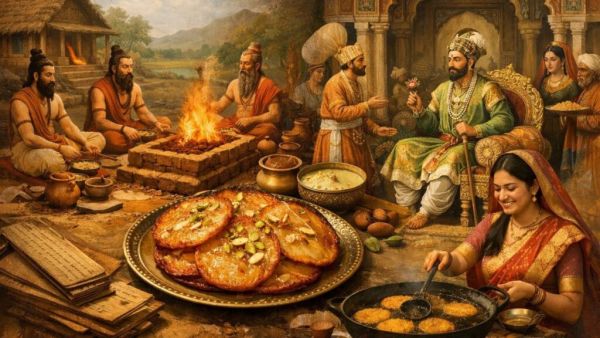
Imagine, that period of India thousands of years ago when the Vedas were being composed, and the Aryan people were living on the banks of rivers. At that time, when there was no trace of sugar, how did people still taste sweetness? This is the story of India’s historical first sweet, Malpua, which was called ‘Apupa’ in ancient times.
This sweet is not only delicious, but there is a deep history hidden behind it, which is linked to religious rituals, cultural changes and the flow of time. Come, let us understand its journey from its beginning till today like a story.
This sweet is first mentioned in the world’s oldest religious book, the Rigveda, around 1500 BC. Apupa was a simple but sacred dish, made from barley flour. Aryan people used to prepare it in the form of flat cake. The dough was shaped into rounds and fried in ghee, or sometimes boiled in water, and then dipped in honey and served. It was not only food but also an offering to the gods. The Rigveda states that food brings an end to ignorance and bondage, and dishes like apupa were part of this philosophy. In that period, barley was the main grain and ghee and honey were gifts of nature. This sweet is so old that it even predates the invention of sugar. Initially, it was a religious offering, but gradually became included in domestic celebrations.
Time passed, and Apupa became ‘Malpua’. By the Gupta period (400 AD), its recipe underwent changes. Now apart from barley, rice or wheat flour started being used. In Buddhist times, ‘Kanapuvam’ made from broken rice was a form of it. During Islamic rule, Malpua took a new form in the Mughal and Sultan courts. Eggs and khoya (mawa) were added, which is still seen in some variants today. Sugar arrived, and syrup replaced honey. Its variations emerged in different regions with thick and crispy malpua in Rajasthan, thin and rabri in Bengal, while with fruits in Uttar Pradesh. It started being made in every house during festivals like Holi, Diwali and Eid.
Today Malpua is available in different names and flavors in India, Bangladesh, Nepal and Pakistan.
Know its easy recipe to make this Holi.
Ingredients for Batter:
1. Method of preparation- Prepare the batter:
2. Make syrup:
3. Fry Malpua:
4. Serve:
Although some people also say that Rasgulla is the first sweet of India. But if we open the history books, the answer is no. This is a delicious but relatively new creation, while the original ancient sweetness of India is thousands of years old. Rasgulla originated in eastern India, but its exact birthplace is still a matter of debate. Bengalis say that Nobin Chandra Das invented it in 1868 in Bagbazar, Kolkata. He created a soft, spongy variant by boiling chhena balls in sugar syrup, which was different from the already existing ‘Kheera Mohan’ or the first ‘Rasgulla’. Nobin’s son Krishna Chandra Das (KC Das) packed it in tins and distributed it across the world. This sweet quickly became a part of Bengali culture, being the main attraction at Durga Puja and other festivals. But the people of Odisha do not agree with this. They claim that Rasgulla or Rasgolla is centuries old. Which is offered to God in the Jagannath temple of Puri. According to Dandi Ramayana, it exists since 1500 AD. In Odisha it started as ‘Kheera Mohan’, which is associated with the temple tradition. This controversy became so heated that in 2017, Odisha got the GI tag, while Bengal got the Spongy Rasgulla. But one thing is clear, the history of Rasgulla dates back to the 19th century or a little earlier, and not to ancient times.