With the biotech boom radically changing the definition of life and the meaning of our existence over the last couple of decades, businesses have turned to labs to recreate the building blocks of life, rapidly bringing in a fundamental transformation in the way humanity survived down the centuries.
The rush, in effect, sent the global bioprocessing industry on an 11.39% growth trajectory to scale a height of $228.73 Bn by 2033.
The exploding demand for bio-based ingredients in industries like cosmetics, chemicals, pharmaceuticals and foods has fostered a 16-fold surge in India’s bio-economy to $165.7 Bn in the last 10 years. Projecting a $300 Bn business opportunity unfolding by 2030, finance minister Nirmala Sitharaman in her Union Budget for FY27 thrashed out a ₹10,000 Cr outlay for the government’s Biopharma Shakti scheme to bolster India’s ecosystem for production of biologics and biosimilars through the next five years.
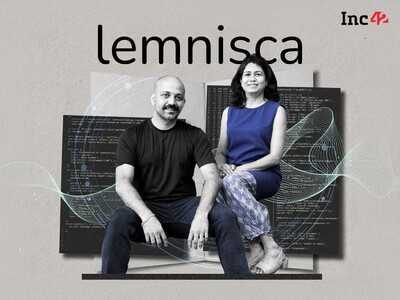
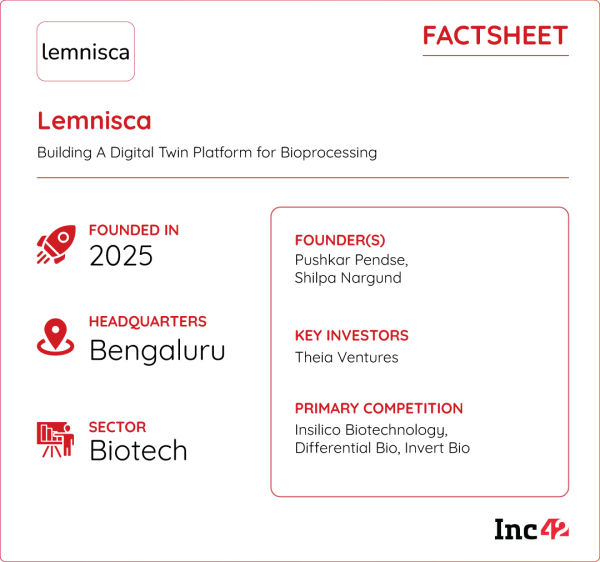
But, scaling up bioprocessing from the experiment stage to commercially viable volumes remains challenging. Lemnisca took a leap into this soaring demand in the bioprocessing industry. Founders Pushkar Pendse and Shilpa Nargund planned to plug the gaps they spotted between the lab and the factory.
“Biotech has been around for 20 years but has only been successful in developing things like insulin, which sells at $10,000 per kilo. How do you make biotech accessible at $10 per kg?” Nargund wondered during an interaction with Inc42.
The Bengaluru-based startup is building a digital twin platform for fermentation to help biotech manufacturers ramp up bioprocesses and reach industrial scale. Essentially, they combine a biological understanding of microbes along with modelling different physical conditions to predict how bioprocesses behave at scale. This speeds up the experimentation.
A doctorate in chemical engineering and a bioprocess industry veteran, seasoned for 15 years, Nargund was deeply familiar with the challenges that manufacturers encounter while trying to scale up production in India, the third-largest biotech market in the Asia-Pacific and among the top 12 globally. Resolving the hurdles will help India raise its share in the global biotech market beyond 3%.
In a lab environment, conditions like temperature and oxygen are much easier to control at a 1 litre volume scale. But in an industrial setting, the same conditions can’t be uniformly guaranteed at a scale of 1 Lakh litres. That means the microbes driving these bioprocesses may not consistently behave the same way.
As a result, finding the most efficient and reliable way to commercialise biotech processes depends heavily on trial and error.
“Customers care about achieving the maximum productivity from the fermentation process and maintaining the same productivity as they scale up. When they are trying to evaluate the best productivity they can get, they are screening a lot of experiments in the wet lab, but no matter how much effort you put in, you may not be able to do more than 100 experiments,” she said.
The range of possible parameters and inputs for designing the right experiment is, however, so vast that getting the optimal approach continues to be a harder challenge.
During her stint with the Singapore branch of Insilico Biotechnology, Nargund was introduced to the concept of digital twins and how they could solve problems. She decided to start up in this space and teamed up with Pendse for his expertise in modelling chemical processes.
In Search Of A Solution In Digital TwinsTheir expertise led to the making of the tech stack – a ‘hybrid model’ that simulates the behaviour of living cells – the building blocks of our body, in other words – as well as the physical conditions around them to understand how they respond to changes in their environment.
Digital twins organise bioprocess development, suggest experimental designs, and manage new knowledge. This drastically lowers process development costs by combining previous platform knowledge to predict future process results.
Lemnisca’s concept of digital twins for bioprocessing isn’t unique globally, as companies like Germany-based Differential Bio and America’s Invert Bio offer similar services. Nargund herself worked for Insilico, another German firm in the same space. In the Indian context, Lemnisca’s was one of a kind.
“Instead of running experiments in the lab that takes both time and effort, we can run these experiments virtually and complete thousands in the time that it could take to do just one in the lab. This reduces both costs and time to take it to the market, and ends the uncertainty,” Nargund said.
What further sets Lemnisca apart is that the startup paired its tech solution with physical infrastructure by building in-house wet lab capabilities. This is a crucial part of the company’s value proposition, as it enables a feedback loop of ‘learning’. Running experiments in the wet lab generates data that can be used to improve the accuracy of the models that power their digital twin platform.
As the model gets better at simulating how different parameters change the outcomes of the fermentation processes while scaling up, its outputs can be used to design better physical experiments.
But this approach created yet another problem. “Before we could get data from our wet lab, we needed the working algorithms,” Nargund pointed out. Due to the lack of available standardised data, the team had to resort to “creative solutions” like generating synthetic data through mechanistic models or using public datasets from Kaggle, a global data science community.
Plus, having to build both the wet lab capabilities as well as developing a digital twin platform is a much bigger task than focusing on only one or the other. “Doing both at the same time is like trying to build 1.5 startups,” she said.
Towards The Next Hurdle And BeyondThe next milestone for Lemnisca would be to prove that its tech is innovative and fit to be deployed in a manufacturing setting. In 2025, its first year of having a viable solution, it plans to take on just one or two programmes or microbial processes, creating a specific product like a chemical or protein.
From there on, Lemnisca can focus on either horizontal or vertical growth. That means either taking on more processes across different customers or different types of molecules; or taking control of multiple steps in the manufacturing process for a particular molecule, beyond fermentation.
Nargund declined to share any details on the company’s customers, citing confidentiality agreements, but clarified that the startup plans to cater to both Indian and international customers in equal measure.
That said, the company isn’t tied down to any particular industry or type of product. “Any molecule that is naturally made can today be made with microbes. We are agnostic to what products the customers are making,” Nargund said.
She added that Lemnisca could take on a diverse variety of customers – its platform could work for anything from making squalene (an organic compound used in cosmetics) to Omega-3 fatty acids for nutraceuticals players, to food colouring and flavouring.
Lemnisca is poised to ride the biotech boom, if its ambitious approach combining wet-lab infrastructure and digital twin platform can deliver speed and cost advantages. Yet, at the same time, betting on two highly complex endeavours doubles the risk of failure.
[Edited by Kumar Chatterjee]
The post Inside Lemnisca’s Big Leap For Digital Twins To Make Biotech More Scalable appeared first on Inc42 Media.