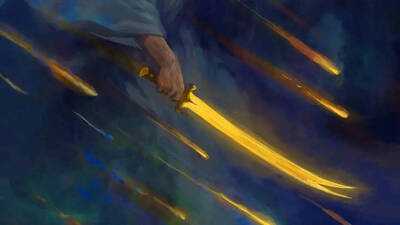
In light of escalating tensions following US-Israeli military actions targeting Iranian sites, a recent post from Ayatollah Ali Khamenei's official Persian-language X account has garnered significant attention. This post included a devotional reference to Imam Ali, revered in Shia Islam as Haider, or 'the Lion', and was accompanied by striking artwork depicting Ali wielding the 'Zulfiqar sword' amidst flames and meteors. While it initially appeared to be a religious message for Ramadan, the context of the ongoing conflict adds layers of meaning. Released at 3 AM (IST) on February 28, 2026, during Ramadan, and coinciding with US President Donald Trump's announcement regarding the death of Iran's Supreme Leader, the post arrived at a time of significant uncertainty. The imagery was far from trivial.
The Zulfiqar sword, also known as Dhulfiqar, holds immense historical significance and is regarded as one of the most potent symbols in Shia Islam. Traditionally, this sword is attributed to Imam Ali ibn Abi Talib, who was both the cousin and son-in-law of Prophet Muhammad and the first Imam in Shia belief. A well-known phrase often associated with this imagery states: “There is no hero like Ali, and there is no sword like Zulfiqar.” In Shia art, the Zulfiqar is typically illustrated with a distinctive split, double-pointed blade. Over the centuries, it has evolved to represent justice, divine authority, bravery, and resistance against tyranny. In contemporary political contexts, especially in Iran, Iraq, and Lebanon, the sword symbolizes resilience against foreign aggression. When depicted alongside flames or celestial elements, as seen in Khamenei's post, it evokes themes of martyrdom, cosmic justice, and divine support. The Zulfiqar imagery, particularly in light of recent targeted strikes and speculation surrounding Khamenei's health, may convey various interpretations, potentially serving as a reassurance of ongoing resistance against perceived aggression. For many Iranians, including those critical of the regime, religious symbols resonate emotionally beyond mere political affiliations. Imam Ali is widely respected across different sects for his principles of justice and integrity. Referencing him during a time of conflict taps into a legacy that predates the Islamic Republic.
This post also emerges amid ongoing discussions regarding the future of Iran's leadership. According to Iran's constitution, the Assembly of Experts is responsible for selecting a new Supreme Leader in cases of death or incapacitation. The potential candidates for succession are often the subject of discreet discussions within clerical and security circles. Although there is no confirmed indication of a leadership transition, periods of regional crisis tend to heighten concerns about succession, both within Iran and beyond. In this context, imagery associated with Imam Ali and divine legitimacy can play a stabilizing role, signaling continuity rather than a power vacuum.