When we think about what lies beneath our feet, we imagine solid rock, stable ground, something permanent. But thousands of miles below the surface, Earth is constantly moving. Heat rises. Rock shifts. Vast currents flow slowly over millions of years.
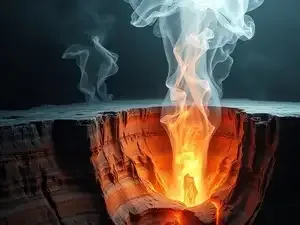
And sometimes, according to new geophysical research, columns of hot rock begin rising from deep inside the planet only to disappear before they ever reach the surface. Scientists informally call them ghost plumes. They rise, they weaken, and they fade.
No volcano. No lava. Just quiet motion in the deep Earth.
What Scientists Mean By Deep Mantle Plumes
For decades, researchers have studied mantle plumes, which are columns of unusually hot rock that rise from near the boundary between Earth’s core and mantle. This boundary sits about 2,900 kilometers below the surface. The classic plume theory, proposed in the 1970s, suggested that these rising columns of heat feed some volcanoes.
Seismic tomography studies over the past twenty years have strengthened this picture. By tracking how earthquake waves travel through Earth, scientists can map temperature and density differences deep underground. These studies have revealed massive structures in the lower mantle, including hot regions that appear to feed flowing material upward.
But newer high-resolution seismic imaging has complicated the story. In several regions, researchers have detected narrow upwellings that resemble plumes deep in the mantle but do not connect to active volcanoes at the surface. These rising structures appear to stall or spread out before reaching the crust.
That is where the idea of ghost plumes comes in.
Why Some Plumes Never Reach the Surface
Computer simulations of mantle convection provide important clues. These models, based on physics and mineral behavior at extreme pressures and temperatures, show that rising hot rock does not move through a simple, uniform environment.
The mantle is layered. Around depths of 410 and 660 kilometers, minerals change structure in what scientists call phase transitions. Laboratory experiments recreating these high-pressure conditions demonstrate that these transitions can alter density and viscosity. In practical terms, they can slow down or deflect rising material.
If a plume is not hot enough or buoyant enough, it may lose momentum when it hits these boundaries. Instead of continuing upward, it can flatten, spread sideways, and gradually cool.
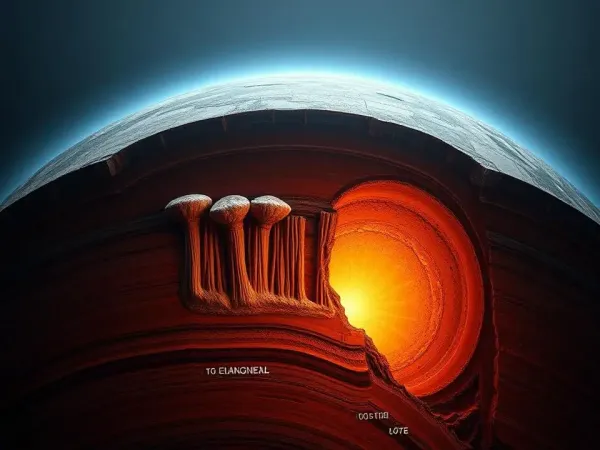
Seismic studies published in leading geophysical journals support this idea. In some regions, imaging shows plume-like structures rising from deep mantle zones but fading out in the upper mantle. There is no volcanic chain above them. No hotspot signature. Just a stalled column deep below.
Mantle convection models also show that temperature differences alone are not the full story. Chemical variations in mantle rock can affect buoyancy. Recycled oceanic crust, dragged down by plate tectonics, creates a patchwork interior. A rising plume moving through this uneven terrain may lose its structure before it can pierce the lithosphere.
What This Means For Volcanoes And Plate Tectonics
Not every volcano is fed by a deep plume, and not every plume creates a volcano. That realization is reshaping how scientists think about Earth’s internal engine.
Older models often pictured plumes as straight vertical pipes connecting the core to the surface. Modern seismic tomography paints a more tangled image. Upwellings can tilt, branch, or spread out. Some never complete the journey.
Research on gravity anomalies and surface heat flow suggests that even stalled plumes may influence the planet in subtle ways. They can contribute to mild regional uplift or gradual warming in the crust, changes too slow to notice without precise instruments.
Understanding these hidden processes helps refine long-term models of Earth’s thermal evolution. Studies simulating billions of years of mantle convection indicate that heat does not always escape in dramatic bursts. Much of it circulates internally, redistributed through complex flow patterns.
A Planet More Dynamic Than It Looks
It is easy to forget that the ground beneath us is part of a restless system. Cities, highways, and farmland sit atop rock that is slowly riding on currents of semi-molten material far below.
Ghost plumes remind scientists that Earth’s interior is not a simple machine with predictable outputs. It is layered, chemically diverse, and constantly adjusting. Some plumes rise powerfully enough to create volcanic islands. Others begin the climb and quietly fade into the surrounding mantle.
The idea that massive columns of heat can rise for thousands of kilometers and then vanish challenges our intuition. We often expect big causes to produce visible effects. Deep Earth science shows that it is not always true.
Through seismic waves, laboratory experiments, and advanced computer modeling, researchers are uncovering a more detailed portrait of our planet’s interior. It is a place where motion is constant, but not always dramatic.
Beneath the calm surface we walk on every day, ghost plumes may be rising right now. They may never erupt. They may never make headlines. But they are part of the slow, powerful system that has shaped Earth for billions of years and continues to shape it today.
And sometimes, according to new geophysical research, columns of hot rock begin rising from deep inside the planet only to disappear before they ever reach the surface. Scientists informally call them ghost plumes. They rise, they weaken, and they fade.
No volcano. No lava. Just quiet motion in the deep Earth.
What Scientists Mean By Deep Mantle Plumes
For decades, researchers have studied mantle plumes, which are columns of unusually hot rock that rise from near the boundary between Earth’s core and mantle. This boundary sits about 2,900 kilometers below the surface. The classic plume theory, proposed in the 1970s, suggested that these rising columns of heat feed some volcanoes.
Seismic tomography studies over the past twenty years have strengthened this picture. By tracking how earthquake waves travel through Earth, scientists can map temperature and density differences deep underground. These studies have revealed massive structures in the lower mantle, including hot regions that appear to feed flowing material upward.
But newer high-resolution seismic imaging has complicated the story. In several regions, researchers have detected narrow upwellings that resemble plumes deep in the mantle but do not connect to active volcanoes at the surface. These rising structures appear to stall or spread out before reaching the crust.
That is where the idea of ghost plumes comes in.
Why Some Plumes Never Reach the Surface
Computer simulations of mantle convection provide important clues. These models, based on physics and mineral behavior at extreme pressures and temperatures, show that rising hot rock does not move through a simple, uniform environment.
The mantle is layered. Around depths of 410 and 660 kilometers, minerals change structure in what scientists call phase transitions. Laboratory experiments recreating these high-pressure conditions demonstrate that these transitions can alter density and viscosity. In practical terms, they can slow down or deflect rising material.
If a plume is not hot enough or buoyant enough, it may lose momentum when it hits these boundaries. Instead of continuing upward, it can flatten, spread sideways, and gradually cool.
These phenomena, detected through advanced seismic imaging, stall due to mineral phase transitions and chemical variations, showcasing a more dynamic and complex planetary interior than previously understood.
Seismic studies published in leading geophysical journals support this idea. In some regions, imaging shows plume-like structures rising from deep mantle zones but fading out in the upper mantle. There is no volcanic chain above them. No hotspot signature. Just a stalled column deep below.
Mantle convection models also show that temperature differences alone are not the full story. Chemical variations in mantle rock can affect buoyancy. Recycled oceanic crust, dragged down by plate tectonics, creates a patchwork interior. A rising plume moving through this uneven terrain may lose its structure before it can pierce the lithosphere.
What This Means For Volcanoes And Plate Tectonics
Not every volcano is fed by a deep plume, and not every plume creates a volcano. That realization is reshaping how scientists think about Earth’s internal engine.
Older models often pictured plumes as straight vertical pipes connecting the core to the surface. Modern seismic tomography paints a more tangled image. Upwellings can tilt, branch, or spread out. Some never complete the journey.
Research on gravity anomalies and surface heat flow suggests that even stalled plumes may influence the planet in subtle ways. They can contribute to mild regional uplift or gradual warming in the crust, changes too slow to notice without precise instruments.
Understanding these hidden processes helps refine long-term models of Earth’s thermal evolution. Studies simulating billions of years of mantle convection indicate that heat does not always escape in dramatic bursts. Much of it circulates internally, redistributed through complex flow patterns.
A Planet More Dynamic Than It Looks
It is easy to forget that the ground beneath us is part of a restless system. Cities, highways, and farmland sit atop rock that is slowly riding on currents of semi-molten material far below.
Ghost plumes remind scientists that Earth’s interior is not a simple machine with predictable outputs. It is layered, chemically diverse, and constantly adjusting. Some plumes rise powerfully enough to create volcanic islands. Others begin the climb and quietly fade into the surrounding mantle.
The idea that massive columns of heat can rise for thousands of kilometers and then vanish challenges our intuition. We often expect big causes to produce visible effects. Deep Earth science shows that it is not always true.
Through seismic waves, laboratory experiments, and advanced computer modeling, researchers are uncovering a more detailed portrait of our planet’s interior. It is a place where motion is constant, but not always dramatic.
Beneath the calm surface we walk on every day, ghost plumes may be rising right now. They may never erupt. They may never make headlines. But they are part of the slow, powerful system that has shaped Earth for billions of years and continues to shape it today.