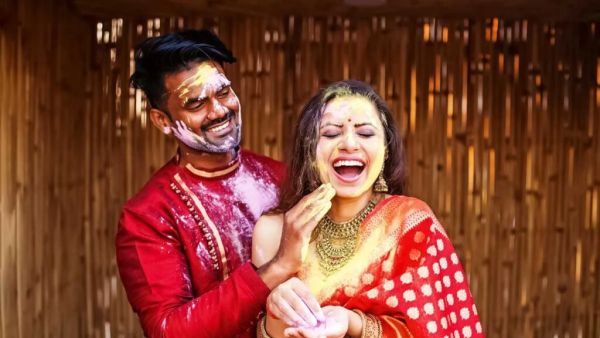
First Holi after marriage traditions: In India, festivals are special occasions full of traditions, beliefs and emotions. A special ceremony is also celebrated for the girl’s first Holi after marriage. It is often observed that a new bride celebrates her first Holi at her parents’ house, not at her in-laws’ (…)
First Holi after marriage traditions: In India, festivals are special occasions full of traditions, beliefs and emotions. A special ceremony is also celebrated for the girl’s first Holi after marriage. It is often observed that a new bride celebrates her first Holi at her parents’ house and not at her in-laws’ house. why is that? What is its origin, and is there a religious or astrological reason behind it? Let’s explore in detail why brides don’t celebrate their first Holi at their in-laws’ house.
What does religious belief say?
According to family elders, it is considered inauspicious for a new daughter-in-law to participate in the Holika Dahan ceremony at her in-laws’ house on the first Holi after marriage. This is because the Holika Dahan is symbolically considered to be Holika’s pyre, as according to mythology, Holika was burnt in this fire. Marriage is considered an auspicious and auspicious ceremony, so the new bride is kept away from this ceremony immediately after marriage, symbolized by Chita. Because of this belief, the tradition of sending the daughter-in-law to her parents’ house on the first Holi is still followed in many places.
Astrological belief behind daughter-in-law’s first Holi
According to astrology, the first year after marriage is considered Graha and the fire element is dominant on the full moon night of Phalguna. It is believed that a new daughter-in-law brings good fortune to the house, so it is advised to celebrate her first Holi at her parents’ house to protect her from any possible negative influences.
Beliefs to mother-in-law and daughter-in-law relationship
There is also a belief that watching the Holika fire burning together by mother-in-law and daughter-in-law can bring bitterness in the relationship. Although it has no scientific basis, traditional thinking considers it as a way to maintain the sweetness of a relationship.
Health of the unborn child
If a new bride is pregnant, the heat and smoke of the Holika Dahan is considered harmful to her health and the unborn child. Therefore, staying at his parents’ house gives him more comfort and care. So many families follow this tradition as a precaution.
According to Shastra beliefs, a daughter-in-law visiting her parents’ house on her first Holi is considered auspicious for both the families. A happy daughter-in-law is said to return from her parents’ home, bringing positive energy and happiness to her in-laws’ home.
The emotional reasons behind the tradition
Holi is a festival of colors and relationships. After marriage, a girl has a new home and a new environment. So, going to your parents’ house on your first Holi and spending time with your parents and family provides a form of emotional support and mental comfort.
Security reasons
In ancient times, the atmosphere during Holi was quite free and sometimes unruly. Long journeys, excessive use of colors and crowds can be uncomfortable for a new bride. Therefore, the families preferred to send him to his parents’ home in a safe environment.
Today, many families make decisions based on their convenience and consideration. However, the tradition of celebrating the first Holi at her parents’ house is still considered a symbol of love, protection, respect and sweetness of relationships.