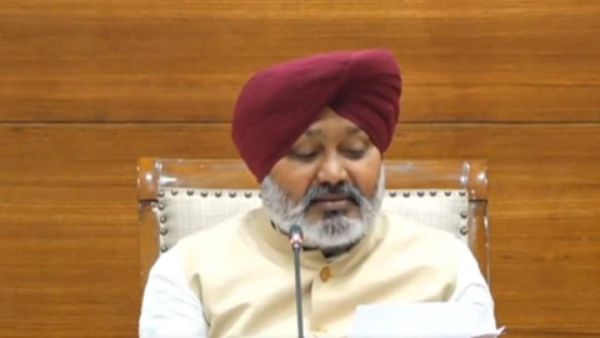
Punjab Finance, Excise and Taxation Minister Harpal Singh Cheema on Tuesday said the state has emerged among the top three in the country in revenue growth under the Aam Aadmi Party (AAP) government, attributing the performance to structural reform, fiscal discipline and administrative transparency.
Addressing a press conference at Punjab Bhawan in Chandigarh, Cheema presented data to highlight what he described as a decisive turnaround in the state’s fiscal position over the past four years.
“Punjab’s own tax revenue has surged significantly, rising from Rs 37,327 crore, which was 6.39% of the Gross State Domestic Product in 2021-22, to an impressive Rs 57,919 crore, accounting for 7.15% of the Gross State Domestic Product in 2024-25,” he said.
Cheema said excise collections have risen by 86.77% in less than four years.
“During the five-year tenure of the SAD-BJP government, total excise collection was Rs 20,545 crore with an annual average of Rs 4,109 crore. The subsequent Congress government collected Rs 27,395 crore over five years, averaging Rs 5,479 crore annually. In stark contrast, the AAP government has already amassed Rs 37,975 crore up to January 2026, achieving a staggering annual average of Rs 9,907 crore. Furthermore, excise revenue in 2021-22 under the Congress regime was Rs 6,157 crore, whereas it is expected to reach Rs 11,500 crore in the financial year 2025-26. As a percentage of the state’s Gross State Domestic Product, excise revenue has grown from 1.05% in 2021-22 to 1.28% in 2024-25,” he said.
Highlighting GST performance, Cheema said the previous Congress government’s five-year total stood at Rs 61,286 crore, averaging Rs 12,257 crore annually.
“The AAP government, however, has collected Rs 83,739 crore up to January 2026, pushing the annual average to Rs 21,845 crore. State GST revenue, which was Rs 15,542 crore in 2021-22, is projected to surpass Rs 26,500 crore in 2025-26. Despite the rationalization under GST 2.0, the state recorded a massive 70.50% growth in its GST revenue,” he said.
On stamp duty, Cheema said the SAD-BJP government collected Rs 12,387 crore with an annual average of Rs 2,477 crore, while the Congress government collected Rs 12,469 crore, averaging Rs 2,494 crore annually.
“Conversely, the AAP administration has generated Rs 19,515 crore by January 2026, with an annual average of Rs 5,091 crore. This indicates that in just four years, the AAP government collected 60 percent more stamp duty than the five-year terms of previous governments. At this accelerated pace, the revenue is expected to double the Congress era’s total by the 2026-27 financial year,” he said.
Cheema said the AAP government is set to spend Rs 31,630 crore on capital expenditure, compared to Rs 14,641 crore by the SAD-BJP government and Rs 19,356 crore by the Congress over their respective five-year terms.
On debt, he stated: “The AAP government received a legacy debt of approximately Rs 3,00,000 crore. Because of this massive historical burden, 35 percent of all new loans taken are utilized simply to clear the liabilities left by previous governments. Another 50 percent of the debt goes toward paying interest on older loans. Consequently, less than 15 percent of the borrowed funds are actually available for the AAP government to use for the state.”
Despite this, he said the Debt-to-Gross State Domestic Product ratio has been reduced from 48.25% to 44.47%.
He added that Rs 7,000 to Rs 8,000 crore has been allocated for Pay Commission implementation, Rs 14,191 crore cleared in Pay Commission arrears, Rs 2,566 crore spent to support distressed state entities including PUNSUP, Land Mortgage Bank, PSIDC and the Mandi Board, and Rs 1,750 crore paid to clear arrears of central schemes.
Cheema said investments in the Consolidated Sinking Fund and Guarantee Redemption Fund maintained with the RBI have increased significantly.
“As of March 31, 2022, the state had only Rs 3,027 crore in the Consolidated Sinking Fund and nothing in the Guarantee Redemption Fund. By December 2025, these reserves have swelled to Rs 10,738 crore in the Consolidated Sinking Fund and Rs 982 crore in the Guarantee Redemption Fund, bringing the total to Rs 11,720 crore,” he said.
“This represents an overall increase of ₹8,693 crore, a staggering 287% growth in less than four years. This proactive investment acts as a buffer against any sudden financial crises and aids in systematically retiring state debt,” he added.
Cheema said that between 2017 and 2022, the Congress government received Rs 17,740 crore in Revenue Deficit grants and Rs 54,600 crore in GST compensation, totalling Rs 72,340 crore.
“In contrast, the current government has received only Rs 15,887 crore in Revenue Deficit grants and Rs 11,945 crore in GST compensation totaling Rs 27,832 crore up to January 2026,” he said, adding that the present government received 62% less in such support and that these grants have now been halted.
Concluding the press conference, Cheema highlighted administrative reforms, including the launch of the ‘Pension Seva Portal’ to digitise pension distribution and the implementation of an ‘e-Deposit Management System’ to curb banking fraud and improve transparency.
He said the state received over Rs 800 crore as an incentive for digitising schemes under the SNA-SPARSH initiative.