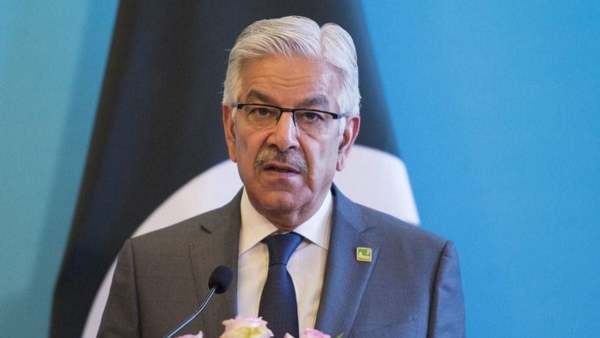
To shield Islamabad from the Trump administration's wrath following violent anti-US consulate attacks, Pakistan’s Defence Minister Khawaja Asif has fabricated a 'ring of enemies' narrative, strategically dragging India and Afghanistan into the regional crisis to deflect growing domestic and international pressure
Pakistan’s Defence Minister, Khawaja Muhammad Asif, on Tuesday issued a series of provocative warnings characterising the ongoing conflict involving Iran as a “threat to humanity.” In a lengthy social media post on X, Asif dragged India’s name into the Middle Eastern war, saying that in case the regime changes in Iran, its “joint single point agenda” along with New Delhi and Afghanistan will be "enmity towards Pakistan”.
Click Here For US-Iran-Israel War Live Updates
These claims are widely viewed as Asif's conjectures to shift the Pakistani people's anger towards India and Afghanistan primarily and immediately. Such rhetoric serves as a strategic diversion, as violent protests against the US for killing Ayatollah Khamenei—marked by direct attacks on Consulates and the embassy—put Pakistan in the bad books of Washington, a position the country cannot risk. This is Pakistan's usual tactic to divert attention towards India whenever there is an internal crisis, and its current strained ties with Afghanistan are also coming in handy to fabricate a false narrative.
By mentioning a potential regime change in Iran, which has not happened yet, the defence minister is subtly hitting out at Washington to deliver an underlying message to the Pakistani public. Pakistan cannot afford to be openly pro-Iran and anti-US, at least on paper, given its economic and military dependencies. Nevertheless, Asif alleged that the conflict was deliberately orchestrated and “imposed upon” Tehran by Zionist interests despite Iran’s purported readiness for a diplomatic agreement.
He described Zionist ideology as the driving force behind every major catastrophe to befall the Islamic world since the establishment of Israel, stating, “From the establishment of Israel on the land of Palestine until today, every catastrophe that has befallen the Islamic world, every war imposed upon it, will show the direct or indirect hand of Zionist ideology and the state.”
The minister further contended that a broader conspiracy is in play to expand Israeli influence directly to Pakistan’s borders, claiming, “the agenda, orchestrated by the Zionists, includes bringing Israel's influence right up to Pakistan's border.” According to Asif, the shifting regional situation could bring Afghanistan, Iran, and India into a shared alignment.
He argued that, “The joint single point agenda of Afghanistan, Iran, and India will then be enmity towards Pakistan, making our borders insecure, surrounding us with enemies from all sides, and turning Pakistan into a vassal state.” While Pakistan has frequently accused India of using the Taliban as a proxy, Asif now warns of a specific axis intended to weaken Pakistan’s sovereignty. He called upon all 250 million Pakistanis, regardless of political or religious affiliations, “to understand this conspiracy and the intentions of our eternal enemies.”
Escalation following the death of Ayatollah Khamenei
The geopolitical tension reached a breaking point following reports that Iran’s Supreme Leader, Ayatollah Ali Khamenei, was killed in joint American-Israeli military strikes on February 28, 2026. This event triggered a massive wave of unrest across Pakistan, which is home to one of the world's largest Shia populations.
Protests rapidly escalated into violent confrontations as demonstrators sought to avenge the leader’s death, leading to a significant loss of life and property damage. In Lahore, the situation turned chaotic as an enraged mob targeted the United States Consulate, setting fire to the facility’s main entrance gate. Fresh video footage from the scene shows a sea of protesters “pelting the consulate with stones and hurling Molotov cocktails at the perimeter walls.”
In Karachi, a mob of hundreds charged toward diplomatic zones, resulting in at least 10 deaths after security forces utilised tear gas and baton charges to repel those who breached security perimeters. Similar violence erupted in Islamabad, where at least two protesters were killed after demonstrations turned into deadly clashes and arson.
The northern region of Gilgit-Baltistan became a primary flashpoint, with demonstrators setting fire to local offices of the United Nations, including the UNDP office in Gilgit and the office of the Superintendent of Police in Skardu. Total casualties across the country are estimated to be at least 21 dead, with the unrest triggered by the confirmed death of Khamenei sparking a "revenge" sentiment against Western interests.
Diplomatic and security measures amid national unrest
In response to the deteriorating security environment, the United States Embassy in Islamabad announced, "Due to the current security situation, the U.S. Embassy in Islamabad and the Consulates General in Lahore and Karachi have cancelled all visa appointments through Friday, March 6."
This suspension applies to all diplomatic missions in the country as officials continue to monitor and evaluate the evolving situation. US officials have issued an emergency security alert, advising all American citizens to avoid large gatherings and monitor local media for further escalations.
Domestically, Pakistani authorities have significantly fortified security around all diplomatic missions and high-risk zones to control the spillover of tensions. In the province of Sindh, Section 144 of the Pakistan Penal Code was implemented, which deals with “joining an unlawful assembly armed with deadly weapons,” as several roads were closed in Karachi's west and south districts.
Despite these measures, the atmosphere remains highly charged. To control the situation, law enforcement personnel in Pakistan have resorted to tear gas shelling and baton charges, as the violence in Lahore and other hubs remains part of a broader wave of anti-US sentiment sweeping the nation.