


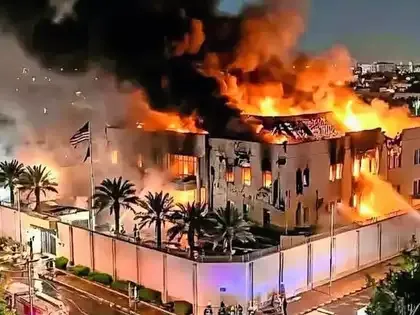
Last weekend, Donald Trump launched 'Operation Epic Fury' targeting key government and military sites in Iran. His declared objective was to crush the Iranian theocratic regime and end an ostensible 'nuclear threat' perceived by Washington. Trump's framing of 'preventive war' was inconsistent with his repeated claims that Iran's nuclear facilities were 'obliterated' by US strikes in June 2025. Essentially, the US-Israeli war on Iran is a war of choice aimed at seizing an opportunity to transform the regional geopolitical order.
Notably, the US began mobilising significant naval and air assets in the region about 2 mths ago, when a currency collapse in Iran triggered renewed mass protests. As the protests came to focus on demands for fundamental political change and transition, Benjamin Netanyahu visited the US to urge Trump to relaunch an offensive against Iran's missile capabilities. For both Israel and the US, Iran's internal fragility and military vulnerabilities offered a narrow opportunity to make the final push against Tehran.
The US objective, both during negotiations and the current war, has been to disarm Iran of its missile capabilities, and retaliatory force against the US and Israel. However, Trump's earlier threats to intervene in support of Iranian protesters, and current framing of the goals of war as 'freedom' for Iran, points to the core US and Israeli goal of creating a 'New West Asia', free from the Islamic republic and its influence in the region.
For Tehran, Trump's coercive diplomacy of using the threat of attack to compel it to accept 'zero enrichment' and dismantle its missile programme left it with a choice between strategic surrender and a war of survival. As of now, it has chosen the latter.
Iran revised its initial position of calibrated response designed to avoid a full-blown war with the US, and is now taken to the option of full aggressive response, inviting further US-Israeli aggression. Despite suffering leadership decapitation, Tehran has mounted immediate and significant retaliation to target US bases in the Gulf states, Jordan and Israel.
Learning lessons from decapitative strikes during last year's '12-day war' with Israel, Islamic Revolutionary Guard Corps (IRGC) had further decentralised command and control to ensure not only flexibility and speed, but also survivability in the face of a superior force. By regionalising the conflict in the initial phase, Tehran has succeeded in increasing costs and risks for the Gulf states and create regional pressure on the US to halt the war.
Tehran is trying to impose a new deterrence equation that spells out the fact that broader Gulf security cannot be insulated from the trajectory of escalation and pressures against Iran - and that hosting US bases amounts to insecurity for Gulf states. The latter have so far resisted being drawn as direct parties to the conflict that risks inviting further escalation on their territory.
Iran's Navy has created disruptions in critical energy and shipping routes in the Strait of Hormuz. Tehran does not need to physically close the strait. The navy issued a warning that no ship will be allowed to pass the strait, followed by a drone attack on Dubai's Jebel Ali port and a tanker off the coast of Oman, resulting in spikes in risk premiums and plummeting shipping volumes.
Given that one-fifth of global energy flows pass through the Hormuz Strait, if the war stretches on, risks will be felt globally. Asian economies, including India, which rely heavily on Gulf oil and gas, will be particularly vulnerable to economic shocks. For India, safety of some 9 mn Indians working in the region is a big concern. New Delhi will have to make a proactive diplomatic outreach to push for de-escalation, while preparing for a mammoth evacuation exercise.
Notably, the US began mobilising significant naval and air assets in the region about 2 mths ago, when a currency collapse in Iran triggered renewed mass protests. As the protests came to focus on demands for fundamental political change and transition, Benjamin Netanyahu visited the US to urge Trump to relaunch an offensive against Iran's missile capabilities. For both Israel and the US, Iran's internal fragility and military vulnerabilities offered a narrow opportunity to make the final push against Tehran.
The US objective, both during negotiations and the current war, has been to disarm Iran of its missile capabilities, and retaliatory force against the US and Israel. However, Trump's earlier threats to intervene in support of Iranian protesters, and current framing of the goals of war as 'freedom' for Iran, points to the core US and Israeli goal of creating a 'New West Asia', free from the Islamic republic and its influence in the region.
For Tehran, Trump's coercive diplomacy of using the threat of attack to compel it to accept 'zero enrichment' and dismantle its missile programme left it with a choice between strategic surrender and a war of survival. As of now, it has chosen the latter.
Iran revised its initial position of calibrated response designed to avoid a full-blown war with the US, and is now taken to the option of full aggressive response, inviting further US-Israeli aggression. Despite suffering leadership decapitation, Tehran has mounted immediate and significant retaliation to target US bases in the Gulf states, Jordan and Israel.
Learning lessons from decapitative strikes during last year's '12-day war' with Israel, Islamic Revolutionary Guard Corps (IRGC) had further decentralised command and control to ensure not only flexibility and speed, but also survivability in the face of a superior force. By regionalising the conflict in the initial phase, Tehran has succeeded in increasing costs and risks for the Gulf states and create regional pressure on the US to halt the war.
Tehran is trying to impose a new deterrence equation that spells out the fact that broader Gulf security cannot be insulated from the trajectory of escalation and pressures against Iran - and that hosting US bases amounts to insecurity for Gulf states. The latter have so far resisted being drawn as direct parties to the conflict that risks inviting further escalation on their territory.
Iran's Navy has created disruptions in critical energy and shipping routes in the Strait of Hormuz. Tehran does not need to physically close the strait. The navy issued a warning that no ship will be allowed to pass the strait, followed by a drone attack on Dubai's Jebel Ali port and a tanker off the coast of Oman, resulting in spikes in risk premiums and plummeting shipping volumes.
Given that one-fifth of global energy flows pass through the Hormuz Strait, if the war stretches on, risks will be felt globally. Asian economies, including India, which rely heavily on Gulf oil and gas, will be particularly vulnerable to economic shocks. For India, safety of some 9 mn Indians working in the region is a big concern. New Delhi will have to make a proactive diplomatic outreach to push for de-escalation, while preparing for a mammoth evacuation exercise.
(Disclaimer: The opinions expressed in this column are that of the writer. The facts and opinions expressed here do not reflect the views of www.economictimes.com.)





Deepika Saraswat
Deepika Saraswat is associate fellow, Manohar Parrikar Institute for Defence Studies and Analyses, New Delhi.