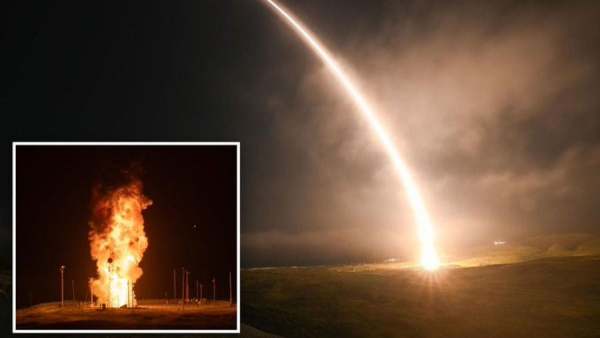
The United States conducted a test launch of its nuclear-capable LGM-30G Minuteman III missile from Vandenberg Space Force Base in California. The unarmed missile, equipped with two test re-entry vehicles, struck its impact zone near the Marshall Islands. The launch was part of routine evaluations of the US land-based nuclear deterrent and not directly linked to the Middle East conflict.
As the war in the Middle East entered its sixth day, the United States carried out a test launch of its nuclear-capable LGM-30G Minuteman III, an intercontinental ballistic missile capable of delivering warheads up to 20 times more powerful than the atomic bomb dropped on Hiroshima.
The missile was launched late Tuesday night by the United States Air Force Global Strike Command from Vandenberg Space Force Base in California. According to the United States Space Force, the unarmed missile was equipped with two test re-entry vehicles and launched as part of a routine evaluation programme.
Also Watch:
Details On The Testing
Identified as test vehicle GT-255, the missile travelled thousands of miles across the Pacific Ocean before striking its designated impact area near the Marshall Islands. Officials said the launch was not directly linked to the ongoing conflict in the Middle East.
Lt. Col. Karrie Wray, commander of the 576th Flight Test Squadron, said the test was aimed at evaluating key components of the missile system and ensuring the readiness of the United States’ land-based nuclear deterrent.
About The Minuteman III
The Minuteman III, a central part of the US strategic arsenal, has an estimated range of about 6,000 miles and can travel at speeds exceeding 15,000 miles per hour, enabling it to reach targets across continents within minutes. The latest launch is part of a long-running programme that has included more than 300 similar tests over several decades to verify the reliability and accuracy of the missile fleet. A previous test was conducted in November 2025 amid renewed debate in Washington over nuclear preparedness.
Meanwhile, the conflict in the region continues to intensify. On Thursday, Iran launched a fresh wave of missiles toward Israel, triggering air raid sirens across major cities and forcing millions of residents into bomb shelters.
The barrage came shortly after the United States Senate voted down a resolution seeking to halt Washington’s air campaign against Iran and require explicit congressional approval for further military action. The measure failed by a 53–47 vote, largely along party lines, effectively leaving Donald Trump with continued authority to pursue military operations.
With missile exchanges escalating, naval engagements widening and diplomatic efforts faltering, the conflict shows little sign of slowing, even as Washington signals continued readiness of its strategic nuclear deterrent.